Before supernova SN 2026ahvu lit up, Chandra counted zero X-rays at its position
Two archived observations narrow down which kind of white dwarf could have exploded in NGC 1433. Nearby star clusters offer a separate clue to its age.
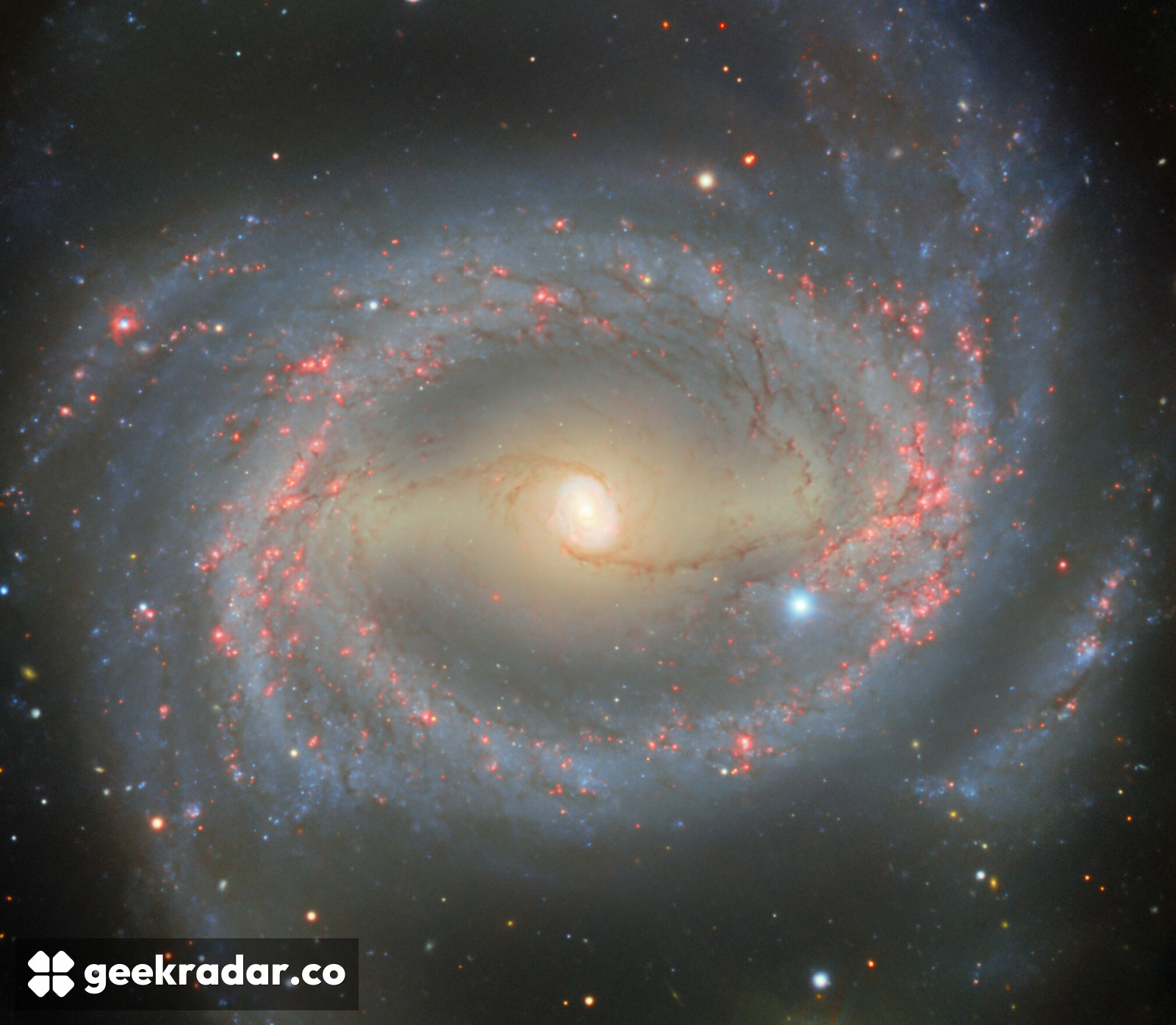
Just below and to the right of the bright centre of NGC 1433, there is a point of light that was missing from an earlier portrait of the spiral galaxy. It is a supernova, SN 2026ahvu. Astronomers have now asked a more difficult question of the same patch of sky: could they have seen the star that was about to explode? In more than 26 hours of observations taken before the explosion, the Chandra X-ray Observatory recorded no photons at its position within the area and energy range researchers searched.
That empty patch of an X-ray image is a useful clue. A new analysis by Ákos Bogdán and Tonima Ananna finds that one particular kind of white dwarf should have shown up there. The observations narrow the list of possible culprits, although they leave room for more than one way to make this explosion.
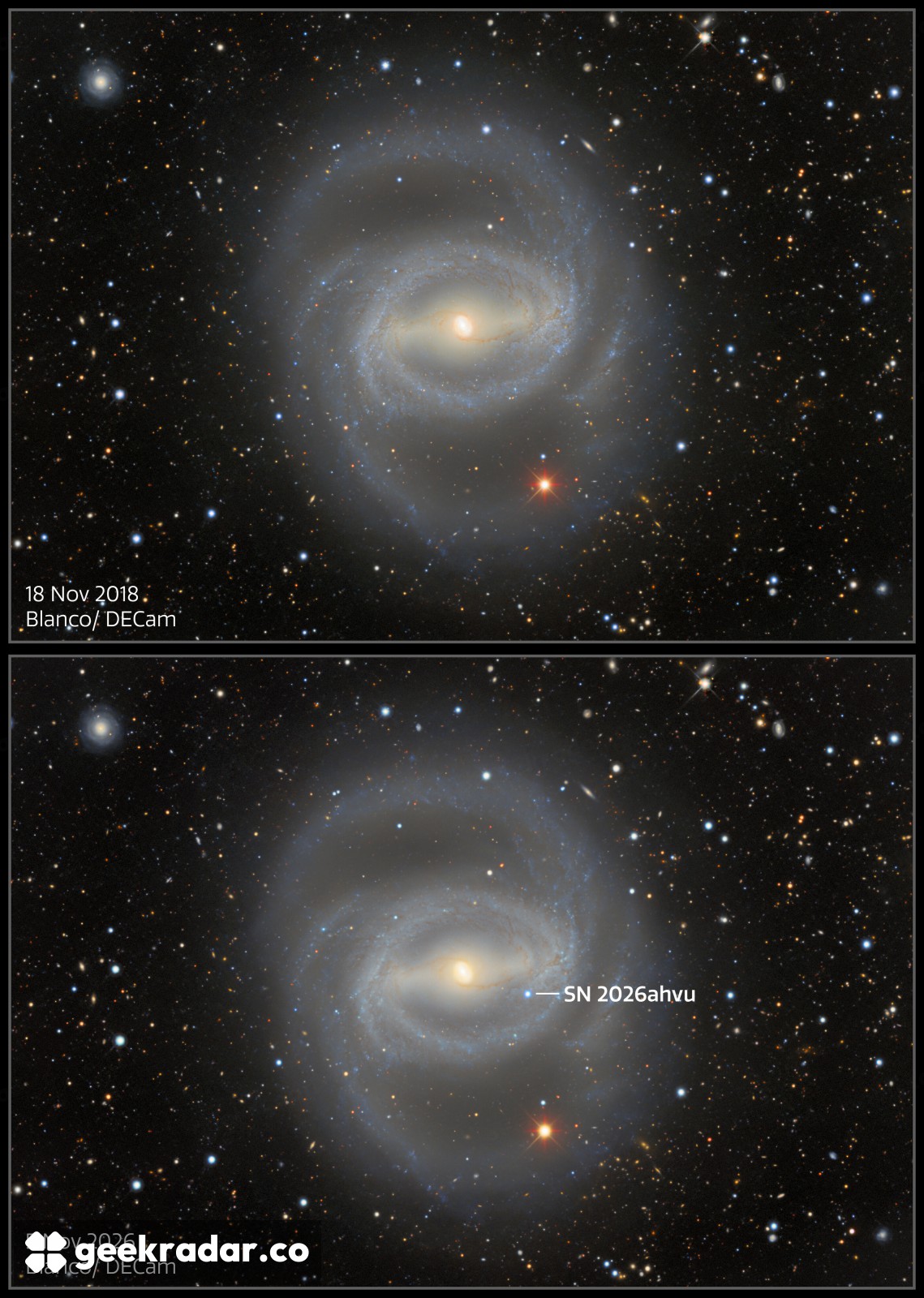
Finding the right point in a busy galaxy
The ATLAS sky survey detected the object on November 2. A spectrum, which splits light into its component wavelengths, subsequently identified it as a Type Ia supernova. That classification points to the thermonuclear disruption of a white dwarf, the dense remnant of a star. It leaves open what pushed this particular white dwarf to explode.
Look first at the bright oval in NOIRLab’s before-and-after images. That is the centre of the galaxy in both panels. Move a little to the right and down in the lower panel to find the marked newcomer. The upper image is dated November 18, 2018. The lower one is dated November 5, 2026, three days after discovery. NOIRLab notes that older exposures also contributed to the final composite. The pair establishes where the new light appeared; the telescope did not catch the instant of ignition. Gemini South’s closer view shows why a precise position matters in a spiral arm crowded with bright knots.
What Chandra should have seen
In one proposed route to a Type Ia explosion, a white dwarf gathers hydrogen from a companion and burns it steadily on its surface. If the surface is sufficiently hot and compact, it can shine in low-energy, or “soft,” X-rays before the explosion. That prediction gives astronomers something specific to seek in an old observation.
Bogdán and Ananna combined two earlier Chandra exposures, totalling 95,300 seconds. Within two arcseconds of the supernova’s position, they counted zero photons between 0.3 and 7 kiloelectronvolts. Even when they used the larger of two published estimates for the galaxy’s distance, a hot, steadily burning white dwarf in their model should have been detectable if only foreground gas in our own galaxy absorbed its light.
A cooler surface would shift more of that light out of Chandra’s band. Extra gas around the system could also have absorbed it. Those alternatives matter: finding no photons cannot by itself establish that two white dwarfs merged.
Two possible birthplaces
A separate team examining Hubble and Webb images found two ultraviolet-bright star clusters close to the explosion site. Using both telescopes’ data, the researchers estimated ages of roughly 37 million and 95 million years. If the system formed in either cluster, the time from star formation to explosion could have been about 100 million years or less. Nearness on an image cannot tell us which cluster, if either, it belonged to. Both studies are preprints.
In the recent stellar merger in Andromeda, years of light helped reconstruct what two stars had done. The archives for NGC 1433 offer a different kind of leverage. The clusters supply two possible clocks; Chandra limits what could have been shining while either clock was running. Observations after the explosion can now look for the surrounding material that might have hidden a bright source before it.