Seven years of light reveal how two stars merged in Andromeda
Long before Bao erupted, the smaller star was losing energy inside its giant companion. Infrared observations helped astronomers work out where that energy went.
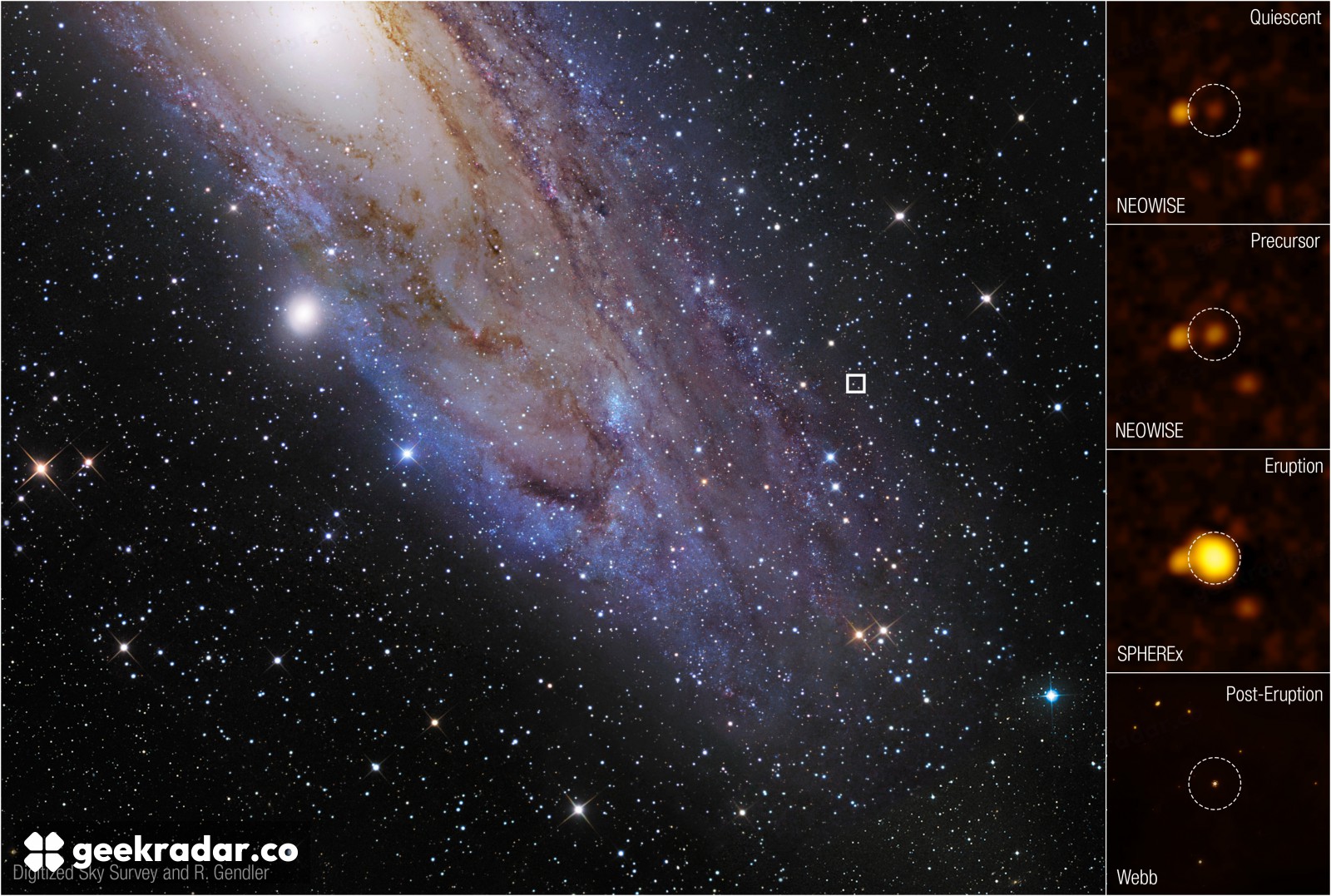
When a point of light flared in the outskirts of the Andromeda galaxy in October 2025, astronomers already had a record of it getting brighter for seven years. Those quieter years may be the most revealing part of the eruption. In a study published in Nature, Viraj Karambelkar and colleagues traced that extra light to a small star losing orbital energy as it travelled deeper into a giant companion.
The source is catalogued as AT 2025abao, or Bao for short. The team’s best fit puts the giant at about seven times the mass of the Sun and its companion at about seven-tenths of a solar mass. At Andromeda’s distance the telescopes recorded their combined light. The evidence for one star orbiting inside the other comes from how that light changed, in brightness and in wavelength, before and after the outburst.
The eruption had a long prehistory
Archive observations reaching back to 1989 gave the researchers something few stellar eruptions come with: a baseline for the same source decades before it drew attention. Its luminosity was fairly steady until 2018. By 2023, observations with the infrared survey telescope NEOWISE had brought the gradual brightening to the team’s attention. They were following the system before the Zwicky Transient Facility picked up its eruption on 17 October 2025. NASA’s account of the observing campaign sets out how the instruments handed the story on.
Dust complicates the comparison. It can absorb starlight and radiate that energy at longer wavelengths, so a source that fades in visible light can still be heating its surroundings. Webb observed Bao for three hours on 24 December 2025, 47 days after peak brightness. Its mid-infrared measurements helped distinguish material associated with the eruption from dust the giant had shed earlier.
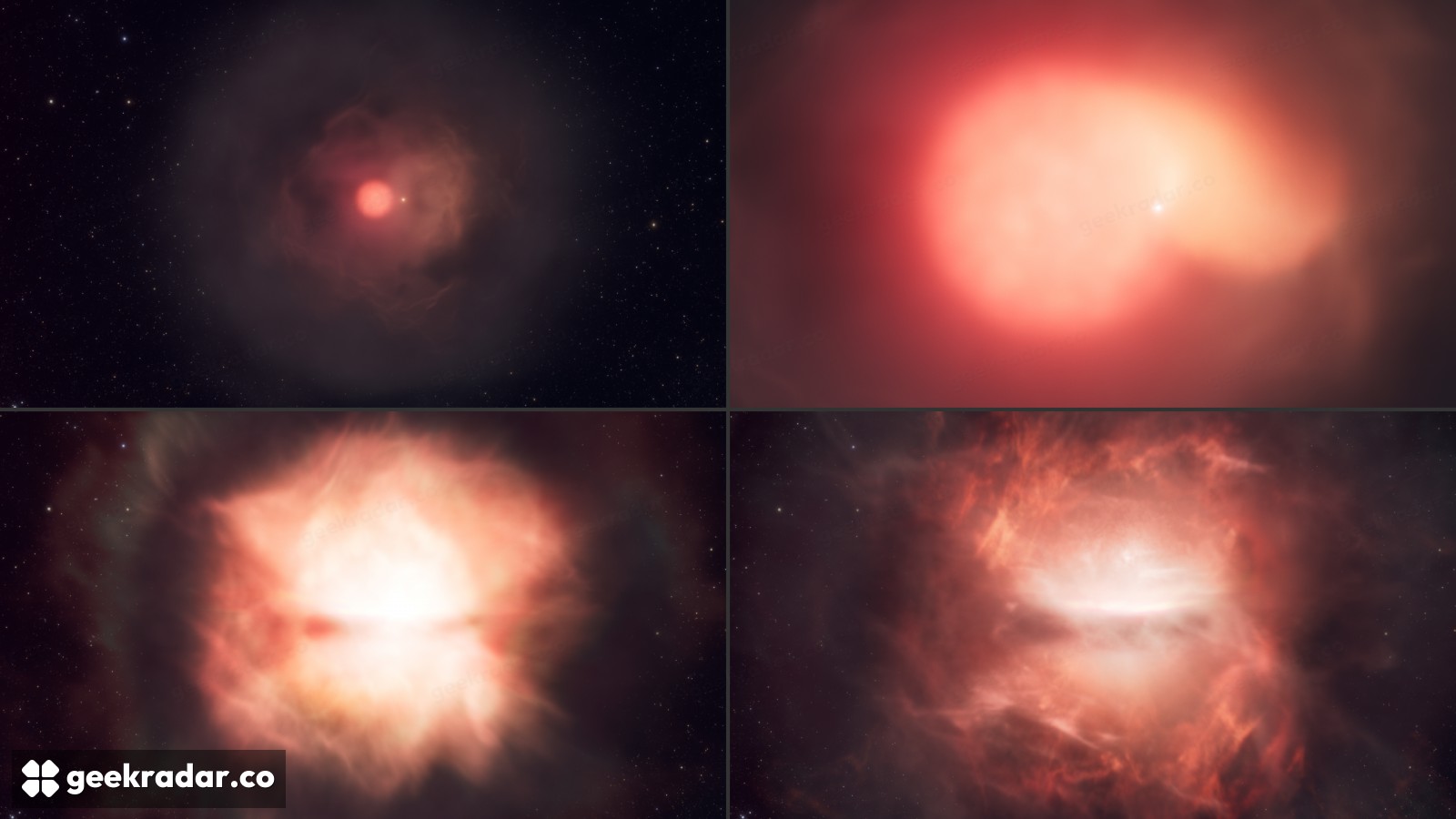
Where the missing orbital energy went
The giant had expanded enough for both stars to share its outer layers of gas, a configuration astronomers call a common envelope. Each trip through that gas cost the companion orbital energy. Its orbit tightened, and the disturbed gas carried heat towards the surface. In the team’s interpretation, some of the energy lost far below the surface was escaping as the extra light recorded year after year.
The final brightening required a different scale of disturbance. A merger with the giant’s core best fits the observations, with enough energy to throw off roughly the outermost tenth of the giant’s envelope. That distinction matters when trying to work out the fate of a close pair. Orbital energy spent lighting up the star is energy no longer available to lift its gas free. Whether enough gas escapes in time helps determine whether two stellar cores can survive on a tighter orbit.
In Webb’s image of the stellar nursery N159, different stars display different stages of their lives in one field. Bao offers something rarer: a before and an after for a single system. A telescope arriving at maximum brightness could have recorded a spectacular eruption. It would have missed the years in which the shrinking orbit was already paying out energy as light.