Q.ANT puts light to work beside an AMD GPU in a language-model demo
The Gen 2+ processor performs optical Fourier transforms inside a hybrid system. The demonstration raises a bigger question: what does that change for the complete model?
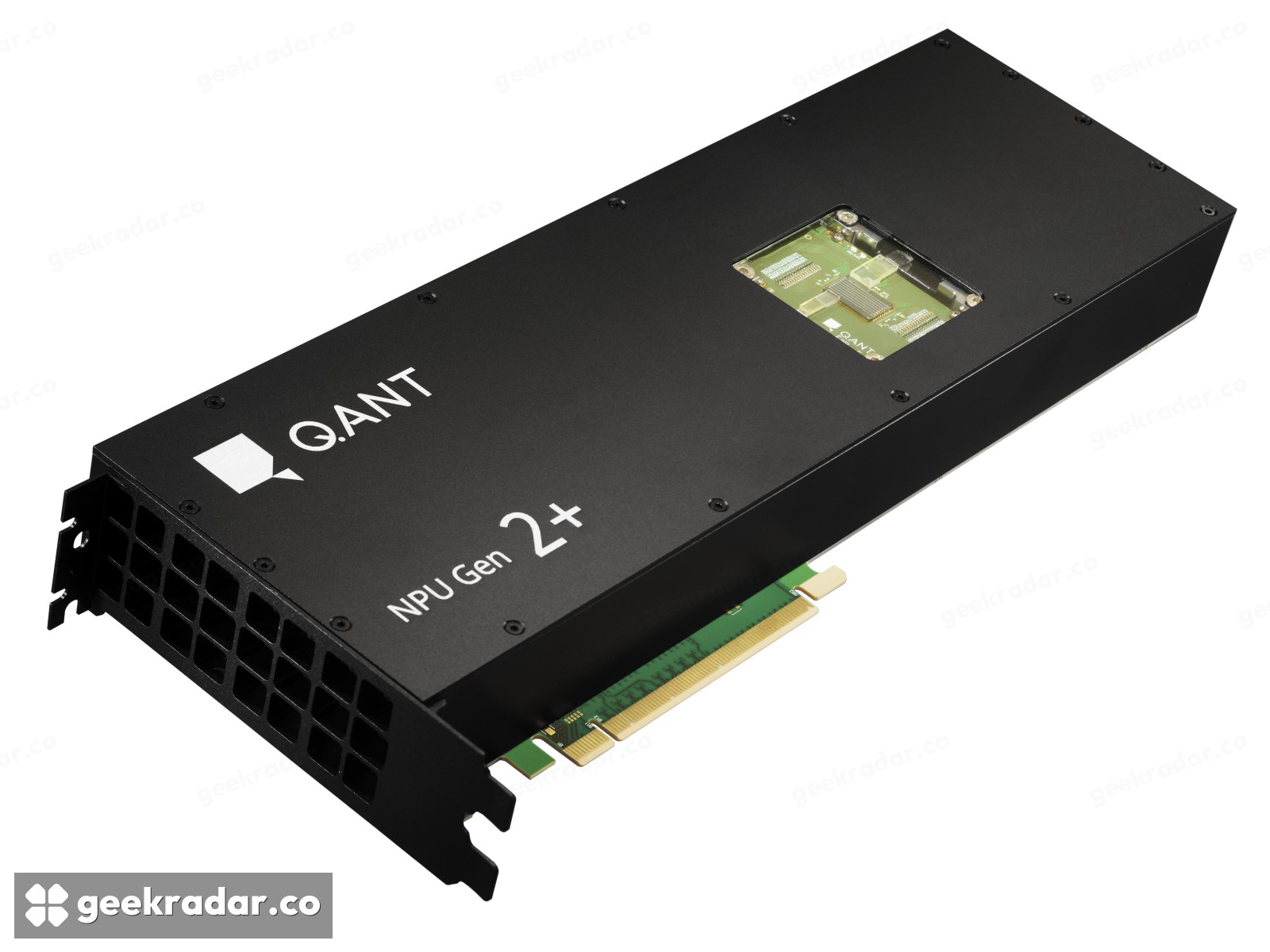
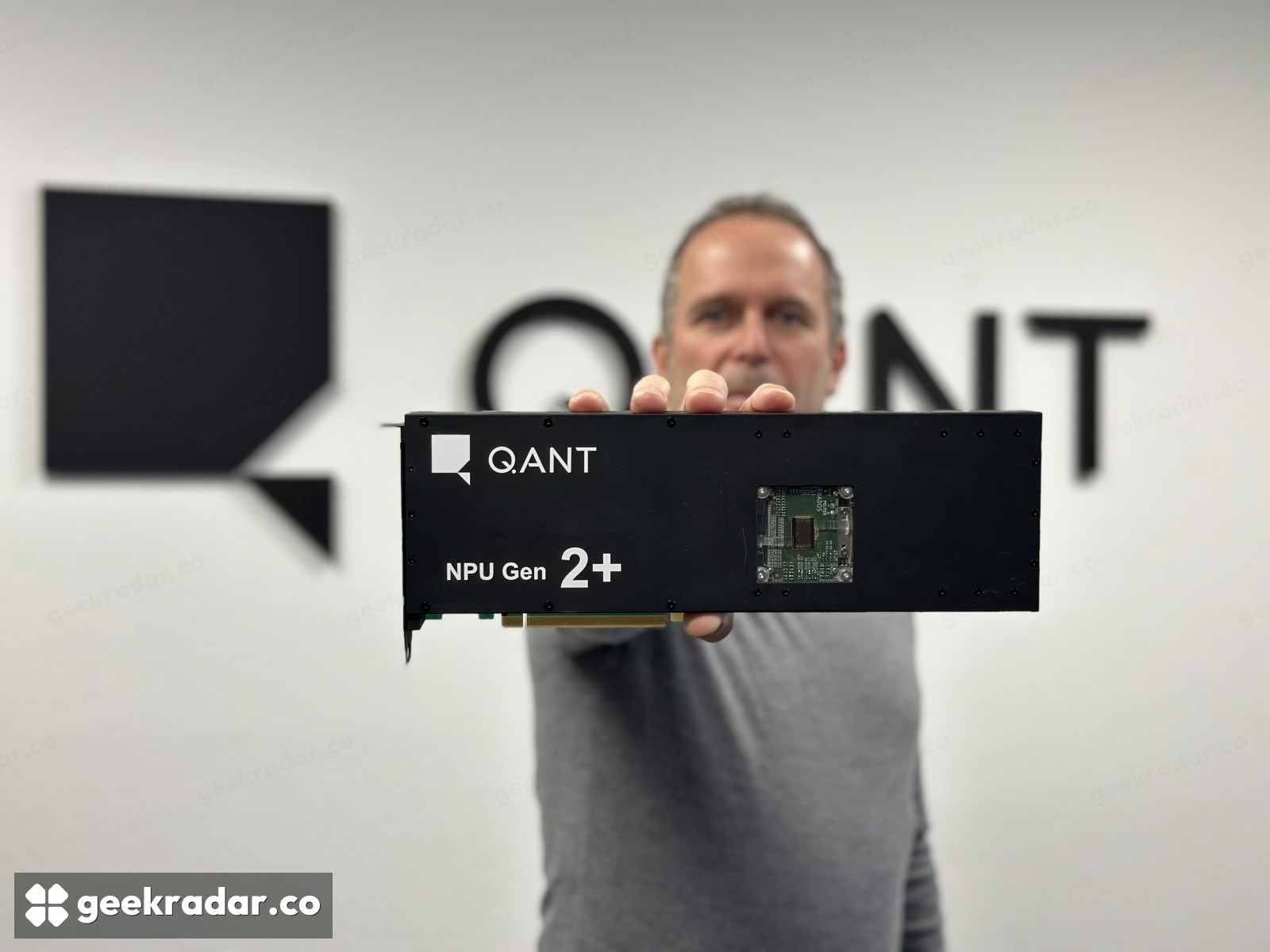
Q.ANT has demonstrated a language model running across an AMD GPU and a photonic accelerator, with part of the calculation performed using light. The useful development is the division of work: the GPU remains in the system, while Q.ANT’s new NPU Gen 2+ supplies an optical mathematical operation that could change how a model is designed.
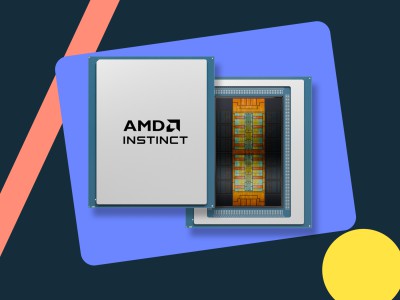
The company announced the processor at SC26 on November 17. Its public technical summary identifies an AMD Instinct MI210 and a language model with roughly one billion parameters. That establishes a concrete hybrid demonstration. It does not, on its own, establish faster responses or lower electricity costs than a comparable model running conventionally.
Giving the accelerator a different job
Gen 2+ adds native optical discrete Fourier transforms, or DFTs. Q.ANT says it used this capability in place of a computationally intensive attention layer. Here, NPU means the company’s Native Processing Unit; the name should not be read as a claim that it is interchangeable with the neural processors in consumer laptops.
A Fourier transform expresses a sequence in terms of its frequency components. In a language model, the inputs are numerical representations rather than spoken sound: the operation provides a way to mix information across those values. The significance is therefore broader than carrying data over an optical connection. The light is being used to perform a mathematical operation.
That also changes the comparison. Replacing a model component involves a choice about the model’s mathematics, not simply swapping one chip for another while keeping every calculation identical. A fast operation can be valuable, but its value depends on whether the resulting model still does the job its users need.
Earlier FNet research explored replacing attention in Transformer encoders with Fourier-based mixing, finding a speed-and-accuracy tradeoff. Those experiments are useful context for the idea, not validation of Q.ANT’s hardware or its generative model. Results from an encoder benchmark cannot be imported as the quality score of a different language system.
The second question is where a demonstration becomes a product decision. Imagine a service whose optical transform finishes quickly, but whose remaining work still determines how long the reader waits for an answer. Improving that transform would not translate directly into the same improvement in response time. Equally, reducing the cost of one calculation does not automatically reduce the whole server’s electricity use by that proportion.
This is the same reason our coverage of the AMD–NVIDIA scientific-computing debate distinguishes an attractive mathematical capability from the work surrounding it. Neither argument requires dismissing the accelerator. It requires measuring the benefit at the level where somebody will actually use it.
What developers can access today
Q.ANT’s open-source toolkit already separates software development from access to physical hardware. Its documented CPU backend allows development without a Q.ANT card; the hardware-backed version needs the corresponding drivers and equipment. Q.ANT says it is extending the toolkit to support Gen 2+ capabilities, so the existing software’s availability should not be confused with complete support for the new processor. A successful simulated run can help establish that software is ready for testing, but it cannot measure the optical board’s speed or power consumption.
There is also a real-hardware route. The IONOS pilot announced on November 9 offers selected applicants access to Gen 2, the earlier processor, through dedicated servers hosted in Germany. Applicants need a concrete use case and the expertise to administer a bare-metal server. This is a limited evaluation program, not unrestricted access to the new Gen 2+ demonstration.
Commercial systems combining Gen 2 and Gen 2+ are planned for the second half of 2027, according to the new announcement. That leaves three distinct stages: software experimentation, selected access to existing hardware, and the future systems incorporating the new processor. Treating them as a single launch would give developers the wrong expectation about what they can deploy now.
Q.ANT’s result makes photonics more interesting as a tool for designing an algorithm around the hardware. The practical prize is not that an answer has travelled through light. It is that the same useful answer might require less time or fewer resources from the complete machine—and that comparison still needs to be earned.