Twelve dust grains caught above Earth carry traces of ancient ice beyond Neptune
Radiation scars point to a journey from the Kuiper Belt. Oxygen trapped inside the grains records what happened before they left.
Twelve grains of dust caught high above Earth carry a chemical trace of water that once altered rock beyond Neptune. The water itself is long gone. What survived the journey was some of its oxygen, incorporated into minerals as they formed. Its unusually high proportion of two heavy isotopes gives researchers a way to distinguish that ancient ice from much of the material that formed closer to the Sun. NASA described the findings on November 18.
There are two puzzles in that conclusion. An aircraft collected the particles in our stratosphere, a destination shared by dust from many parts of the solar system. And a laboratory can measure the oxygen in a mineral directly, while the composition of the fluid that formed it has to be reconstructed. Each puzzle leaves a different mark in the same grain.

A journey etched into a crystal
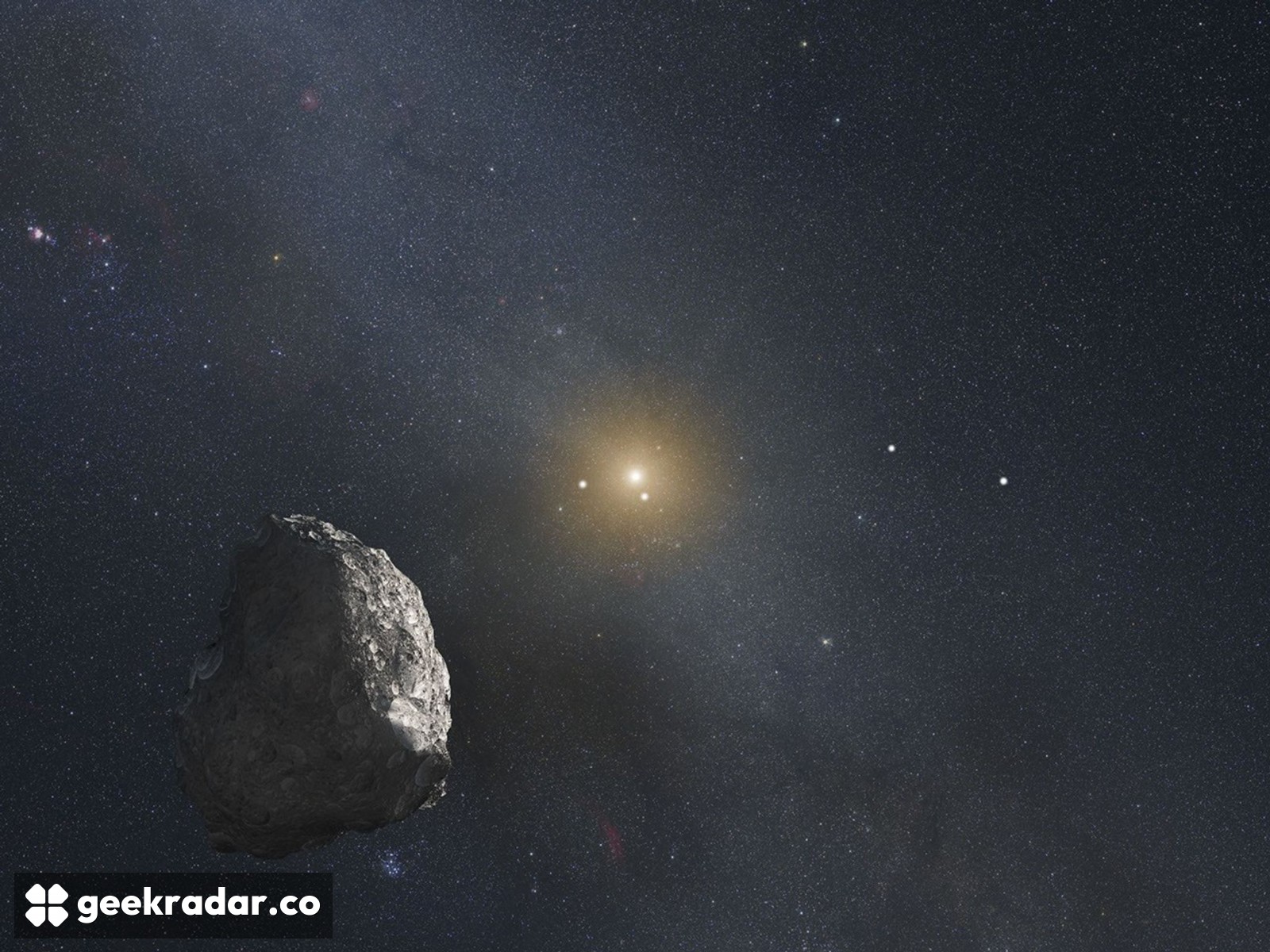
As dust travels through space, energetic particles from the Sun leave narrow tracks in its crystals. Under an electron microscope, researchers can count those scars. The grains chosen for this study had particularly dense tracks. The accumulated exposure fits a long journey inward from the Kuiper Belt, the region of icy bodies beyond Neptune. It would be harder to account for in dust arriving along a shorter route from the asteroid belt. The tracks narrow the likely source region while leaving the identity of the parent body open.
Collecting a grain with a high-altitude ER-2 aircraft trades some of the certainty of a spacecraft landing site for access to instruments on Earth. Scientists at NASA’s Johnson Space Center could examine its internal structure. Colleagues at UCLA could use an ion microprobe to measure its oxygen isotopes. A particle small enough to drift into our atmosphere brought two laboratories a sample of a region neither could otherwise reach. The research team published its analysis in *Science Advances*.
What remained after the water was gone
The grains contain abundant hydrated minerals. The researchers interpret their composition as the result of cold fluids containing water and carbon dioxide reacting with initially dry minerals. Those reactions matter because oxygen from the fluid can enter the structure of a new mineral. A measurement made today can therefore constrain the chemistry of liquid that disappeared billions of years ago.
The team inferred that the ice supplying the fluid was enriched in both oxygen-17 and oxygen-18. “Reservoir” here describes a stock of material with a shared chemical history. Twelve grains can preserve evidence that such material existed without revealing its total mass, its present location or how evenly it was distributed across the belt.
The scarcity of this signature in meteorites gives the finding a wider significance. If ingredients throughout the young solar system had mixed thoroughly, it would be harder to explain why such a distinctive composition survived far from the Sun yet appears so rarely in samples from closer in. NASA identifies the giant planets as a possible barrier to that exchange. Their role is an interpretation of the pattern. The measurements themselves are the tracks and the oxygen ratios.
A meteorite from Mars illustrates the same asymmetry in another setting. A mineral can tell us what happened to it more precisely than it can tell us where it happened. For the Kuiper Belt grains, that is enough to recover something a map alone could never show: water in the early solar system had a different chemical history depending on where it froze.