A five-millimetre jump shows why robot muscle and scaffold must be designed together
ETH’s biohybrid actuators gain movement through co-designed tissue and structure. Nutrient supply and biological variability still keep them in the lab.
A tiny robot jumping five millimetres does not sound like a breakthrough until its body is only about 15 millimetres long and its movement comes from living muscle. Researchers at ETH Zurich have demonstrated that kind of motion by designing muscle tissue and its artificial support together. The improvement comes from their interaction, rather than simply adding more muscle.
The ETH account published on October 22, highlighted in technology coverage this week, describes work published in Nature Communications in September. It is a laboratory result. The devices still depend on a nutrient solution to keep the tissue alive, so these are not self-sufficient miniature robots ready for deployment.
The scaffold is part of the actuator
The researchers combine muscle grown from mouse cells with a soft hydrogel scaffold. An actuator is the part of a machine that turns available energy into movement; here, muscle contraction deforms the support around it. If that support resists the wrong motion or the tissue is poorly anchored, contraction produces less useful movement.
The team therefore used computer modelling to choose both the arrangement of muscle and the scaffold’s properties. Experimental results fed back into that design process. Fine grooves help the tissue attach and align its fibres, improving the mechanical connection between the living and manufactured parts.
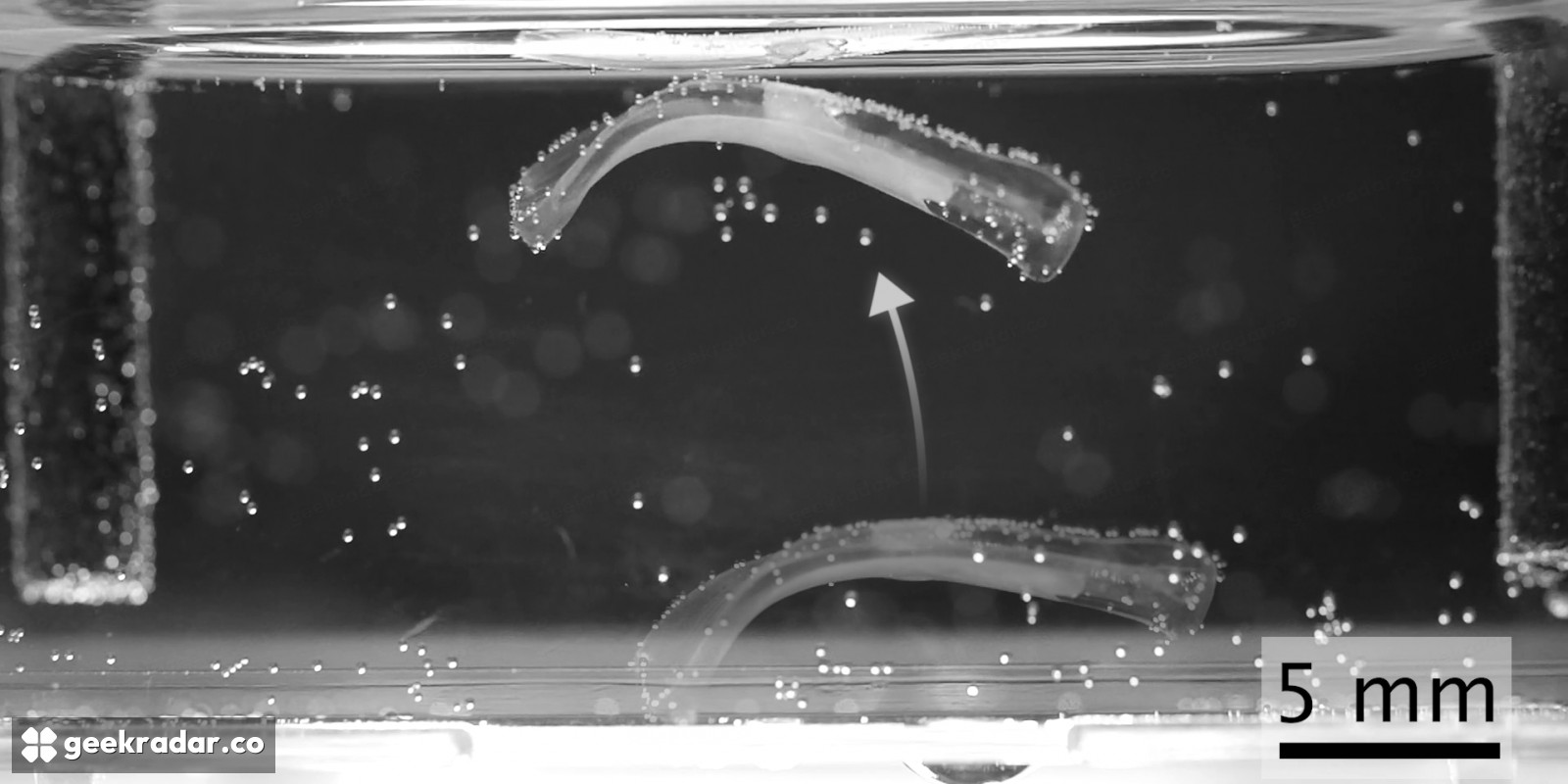
That distinction matters because a larger deformation can enable a different action without establishing that the actuator can carry a heavier load. The demonstrations include jumping, swimming, walking and grasping. ETH reports a walking speed of 6.2 millimetres per second, while a single contraction in the jumping experiment lifts the device about five millimetres from the bottom of its dish.
Scaling a living machine introduces a supply problem
Conventional motors need electrical power and cooling. Living tissue also needs conditions that keep cells viable. The researchers identify an artificial vascular system as a major challenge for larger devices: oxygen and nutrients have to reach tissue, and waste products have to be removed.
Biological variability adds another difficulty. Cultured muscles do not behave as identically as manufactured components. A design that performs well in one sample still has to cope with differences in maturation and tissue properties. The team’s next problems therefore include controlling the biological process, not just improving the robot’s shape.
The published study is useful for the wider robotics and science conversation because it treats muscle geometry as something to design alongside the machine. The five-millimetre jump is a compact demonstration of that idea. Its importance lies less in the distance travelled than in showing how much useful movement can be lost—or recovered—at the connection between muscle and structure.