NASA’s TRACERS begins separating movement from change in Earth’s magnetic boundary
Two spacecraft help resolve an ambiguity a single moving observer cannot easily untangle in magnetic reconnection.
NASA’s twin TRACERS satellites have produced an initial result about magnetic reconnection: changes measured near Earth’s polar cusp appear to reflect where reconnection is happening, rather than simply how its rate changes over time. That distinction is why sending two spacecraft along a similar path is scientifically useful.
The mission’s October 29 report describes findings from the first year of observations and points to a new Journal of Geophysical Research paper. NASA explicitly says further measurements will help confirm the result. It is an early interpretation of the data, not a claim that every reconnection event follows one universal pattern.
One moving observer faces an ambiguity
Imagine a probe measuring a different particle environment as it flies. The environment may have changed with time, or the probe may have crossed into a different part of a structure that was already there. A single time series can mix those explanations.
TRACERS uses two satellites flying one behind the other. Their repeated passages through the polar cusp provide measurements that can be compared across position and time. The cusp funnels particles associated with the solar wind into a relatively concentrated region, giving the instruments a useful place to examine the signatures of reconnection.
NASA says the initial analysis of the Analyzers for Cusp Ions points toward a largely spatial process: the location of reconnection is moving. The significance is in separating mechanisms that might otherwise produce superficially similar measurements.
A recovered spacecraft makes the pair valuable
The mission had a setback with one satellite after launch. NASA says the team re-established contact and routine data collection, and the spacecraft now observe the southern cusp several times a day. In September, the agency approved an extension of the prime mission into spring 2027.
Recovery matters here for more than the number of working instruments. The two-spacecraft design is part of the experiment’s ability to distinguish spatial and temporal behavior. Losing the second viewpoint would affect the kind of comparison the mission was built to make.
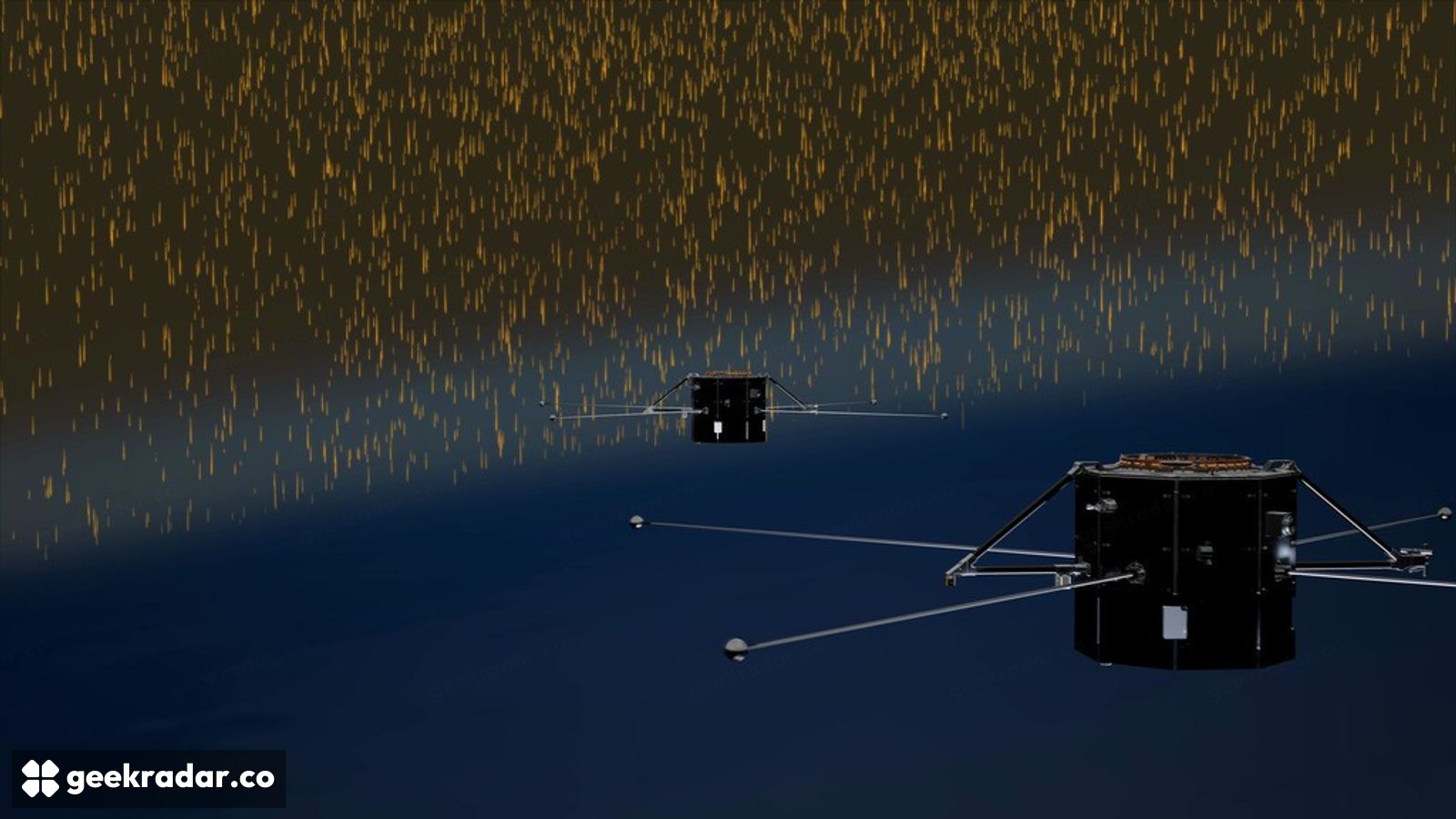
The accompanying illustration shows the satellites and the polar-cusp environment conceptually. It is not a photograph of visible orange particles around Earth. The physical processes being studied require instruments; the illustration makes their geometry easier to follow.
A foundation for understanding space weather
Reconnection helps explain how the solar wind transfers energy into Earth’s environment. Understanding it contributes to the broader study of geomagnetic storms and their effects on spacecraft, communications and electrical systems. This first result does not itself announce a new operational storm-warning service or a quantified improvement in forecast accuracy.
The advance is more basic and more durable: a way to determine whether a changing measurement means a changing process or movement through a changing place. Two satellites revisiting the same region can make that distinction visible in the data, even when no dramatic photograph can show it.