Mars’s long morning cloud is testing a familiar assumption about ice
An October study reproduces the Arsia Mons cloud by allowing ice to form without dust nuclei. The images and the model provide different kinds of evidence.
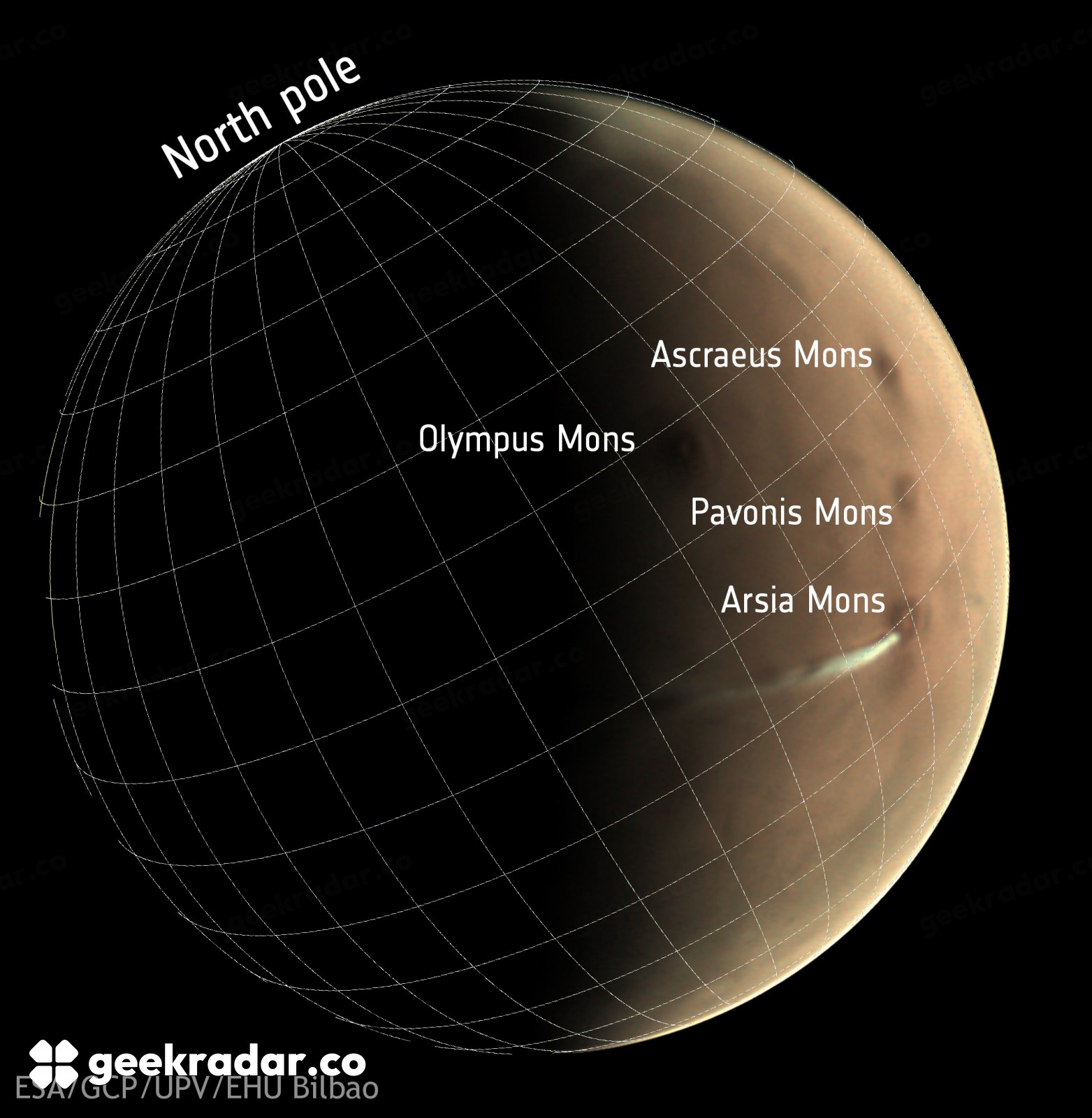
A long white cloud beside a Martian volcano may be exposing a missing ingredient in how scientists model alien weather. Researchers found that allowing water vapor to form ice without first collecting on dust helped their simulation reproduce the Arsia Mons Elongated Cloud. The result is evidence for an unusual formation mechanism, rather than a spacecraft directly catching individual ice crystals being born.
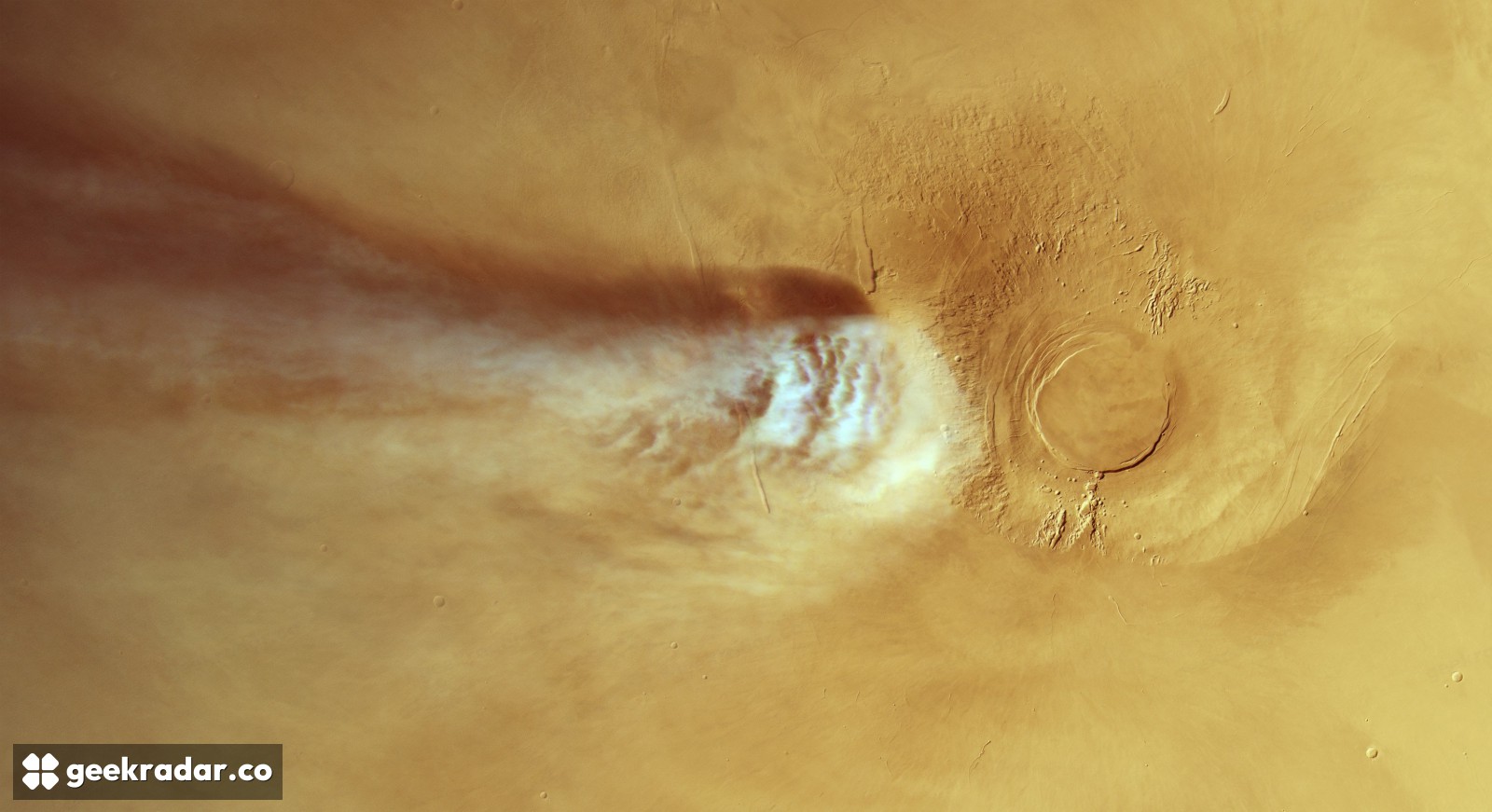
The study described by ESA on October 7 has drawn renewed attention this week. Its subject is a recurrent water-ice cloud, sometimes stretching roughly 1,800km. Despite appearing to trail from a volcano, it is a weather phenomenon shaped by the mountain and atmosphere, not evidence of a present-day eruption.
A mountain can make a cloud without erupting
As air passes the enormous Arsia Mons, the terrain generates a wave that can lift moist air rapidly. Rising air cools. The team's modeling describes particularly abrupt cooling, creating the extreme supersaturation needed for water vapor to form ice in the proposed way. The cloud grows and disappears on a daily cycle during the relevant Martian season.
The distinction between water content and relative humidity matters. Very cold air can become highly supersaturated without containing the amount of water that a reader might imagine from a humid day on Earth. Reporting an extreme relative-humidity number as if it meant a water-rich Martian atmosphere would obscure the mechanism being studied.
The researchers' freely available preprint frames the result as a challenge to the assumption that this process is irrelevant under natural atmospheric conditions. The preprint predates the version published in Nature Geoscience; its central comparison is between a model using conventional cloud microphysics and one that also permits the additional mechanism.
The photograph and the model answer different questions
The sharp spacecraft image accompanying this article was captured on June 24, 2024, and released with the October 2026 research coverage. According to ESA's image record, the visible cloud extends about 980km across the photographed region. It is not a picture taken this week, and its measured length is not the cloud's maximum possible extent.
That image establishes the structure visible to the camera. Modeling asks what combination of atmospheric conditions and physical processes can produce such a structure. A successful simulation is valuable because the proposed explanation has to generate an observable result. It does not become a direct sample of the particles inside the cloud merely because the result looks convincing.
ESA also notes that some aspects of the simulated cloud do not match the observations exactly. Those differences matter. They provide places to test the explanation and improve the model, rather than reasons to pretend that the picture is either fully solved or scientifically useless.
Timing is part of the instrument
Mars Express can observe the morning hours when the cloud is present and follow changes over short periods. The study draws on its Visual Monitoring Camera, High Resolution Stereo Camera and OMEGA. A spacecraft with excellent resolution but the wrong observing time could miss a short-lived daily phenomenon.
That gives a different perspective on the value of long-running orbiters. Our look at Mars Odyssey's 25 years concerned the combination of scientific observation and support for surface missions. Here, repeated views at the useful hour let researchers connect an atmospheric pattern to a physical explanation. Longevity matters when it produces a sequence, rather than merely an old spacecraft still sending occasional pictures.
The claim is exciting because an ordinary ingredient, water, may be behaving in a way usually excluded from planetary cloud models. Its strength comes from the connection between observed geometry and a mechanism that can reproduce it. The white streak is beautiful on its own; the scientific payoff is discovering which assumption had to change before the simulation could draw it too.