Space crops need disease tests as much as a good harvest photograph
Station experiments and a ground demonstrator address different steps toward a reliable growing system beyond Earth.
Astronauts on the International Space Station ended October with plant and cell experiments aimed at a difficult part of growing food away from Earth: understanding how living material develops and responds to stress when gravity changes. These are investigations in progress, not an announcement that astronauts have solved lunar farming.
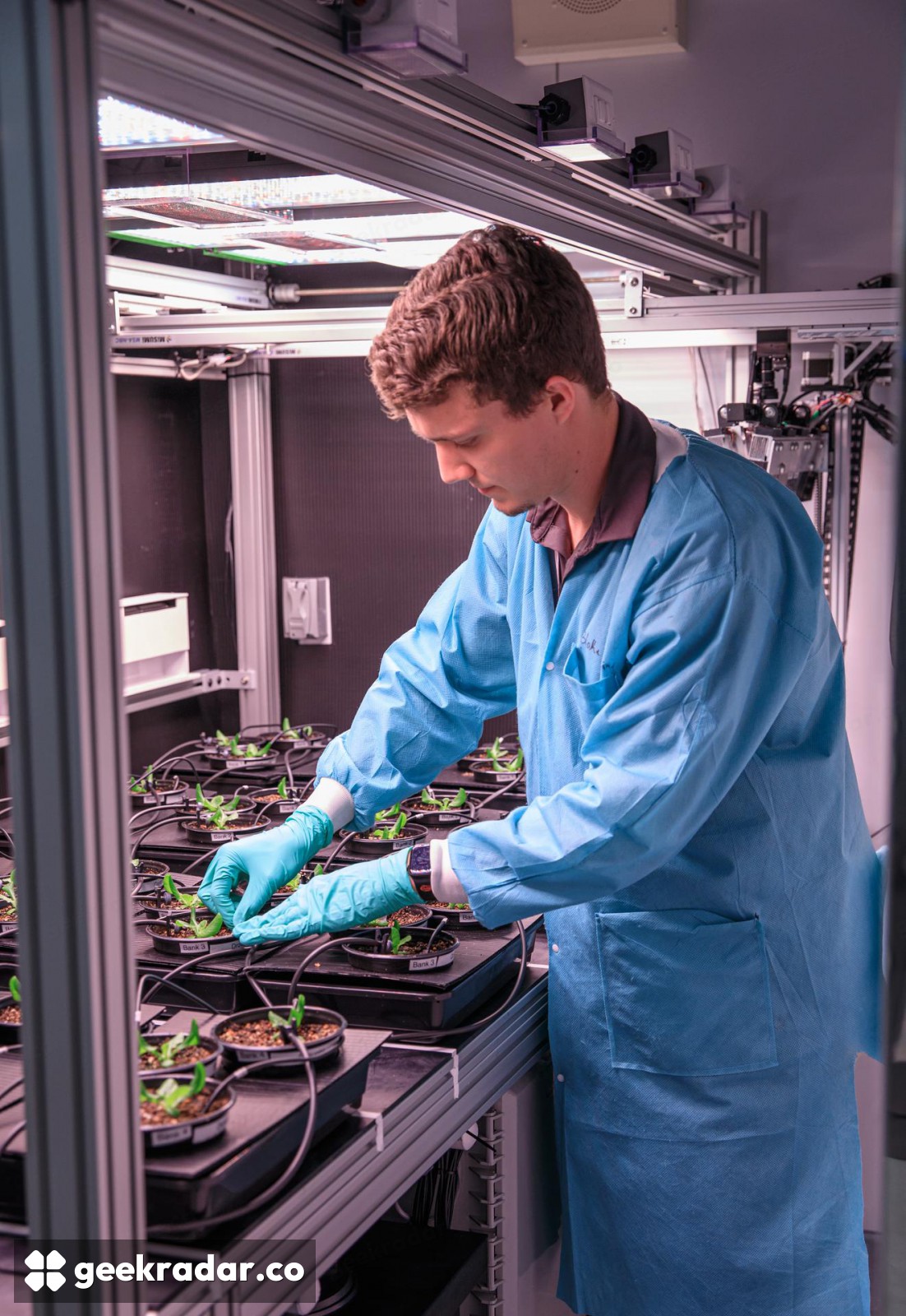
NASA’s October 30 station report describes two useful examples. Anil Menon worked with algae and cultured tobacco cells in Japan’s Kibo laboratory. Luke Delaney handled thale cress exposed to a fungal pathogen in an incubator that can provide artificial gravity.
A plant experiment is not necessarily a menu item
Algae, tobacco cells and thale cress are biological research subjects here. Their presence in a space-crop report does not mean those samples are being prepared as crew meals. A controlled cell system can help researchers examine division and growth without trying to manage every variable present in a complete food crop.
The disease-resistance work asks another practical question. Producing a plant once is different from maintaining a dependable growing system where a pathogen could damage the next harvest. In a remote habitat, the consequences of losing a crop include time, resources and the variety of food available to the crew.
Artificial-gravity equipment is useful because gravity becomes something an experiment can vary, rather than merely a background condition. It allows investigators to compare biological behavior under deliberately different conditions. The daily operations report, however, does not supply a finished result showing that a particular treatment improves resistance.
The lunar agriculture work has a ground stage
The experiments fit a wider interest in space agriculture, but should not be presented as identical to another project simply because both involve plants. In September, NASA, the Canadian Space Agency and Germany’s DLR set out preparatory work on a Lunar Agriculture Module Ground Test Demonstrator.
That effort concerns a controlled ground demonstrator for conditions relevant to a future lunar habitat. A joint statement of intent is a planning and coordination step. It is not confirmation that a complete agricultural module has been installed on the Moon, or that the station investigations have already validated its design.
The potential benefits reach beyond fresh produce. Plants can participate in air and water cycles, while adding variety to a diet. But an agricultural system must also consume power, occupy space and be maintained. Those demands remain even when a plant grows successfully in an experiment.
Reliability is the part that makes a crop useful
Our coverage of the station’s solar-array work looked at the infrastructure supporting experiments and operations. Agriculture has the same dependence on an environment that keeps working: lighting, temperature control and the equipment around the organism are part of the system’s performance.
That is why the less photogenic work matters. Sample handling, observing cell division and exposing a model plant to disease help define the conditions under which a growing system might fail. A beautiful leaf is evidence that something grew. A dependable food supply requires knowing why it grew, what can stop it and how consistently the process can be repeated.