Hera sees the sharp ridge on Didymos in 3D
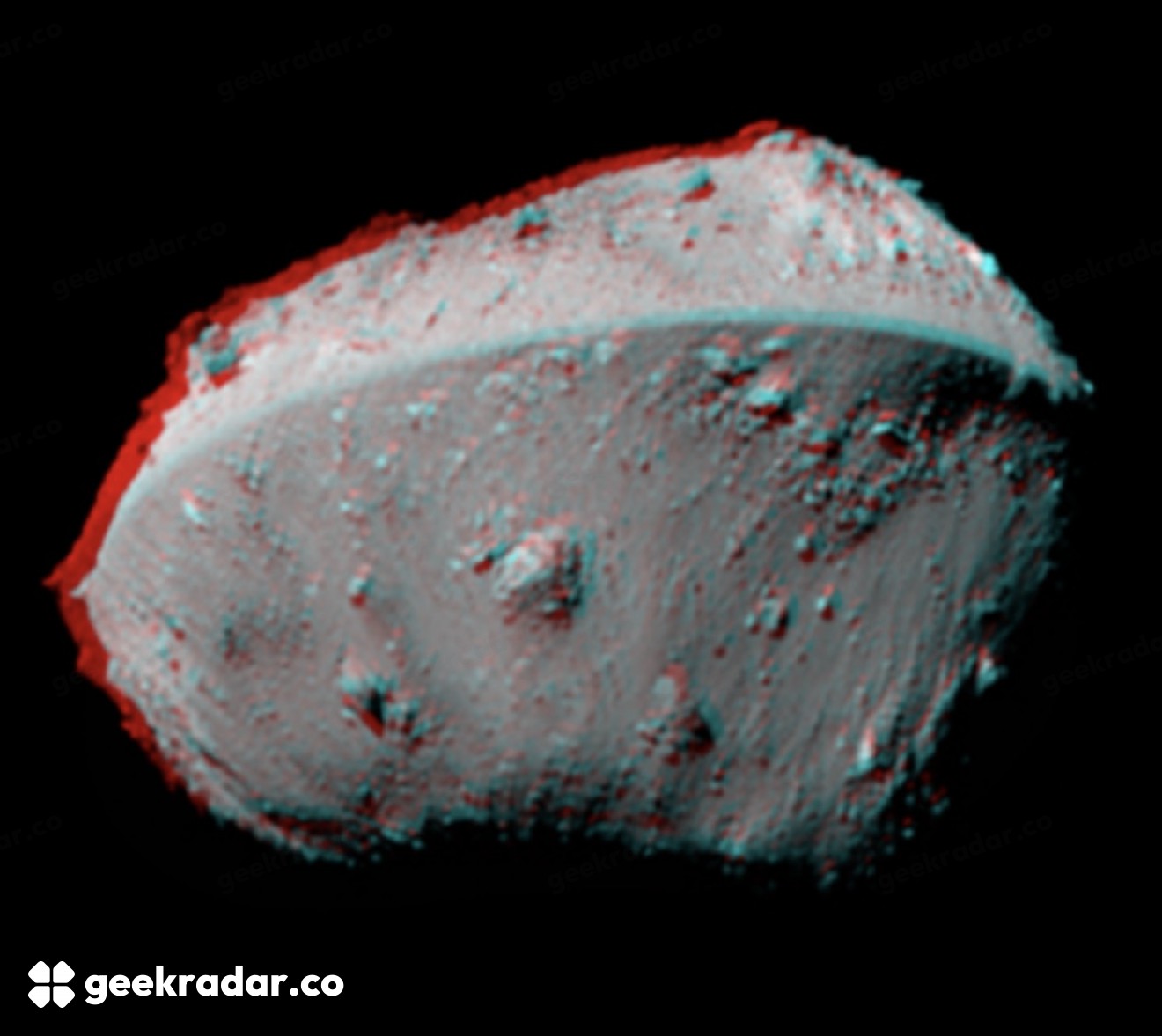
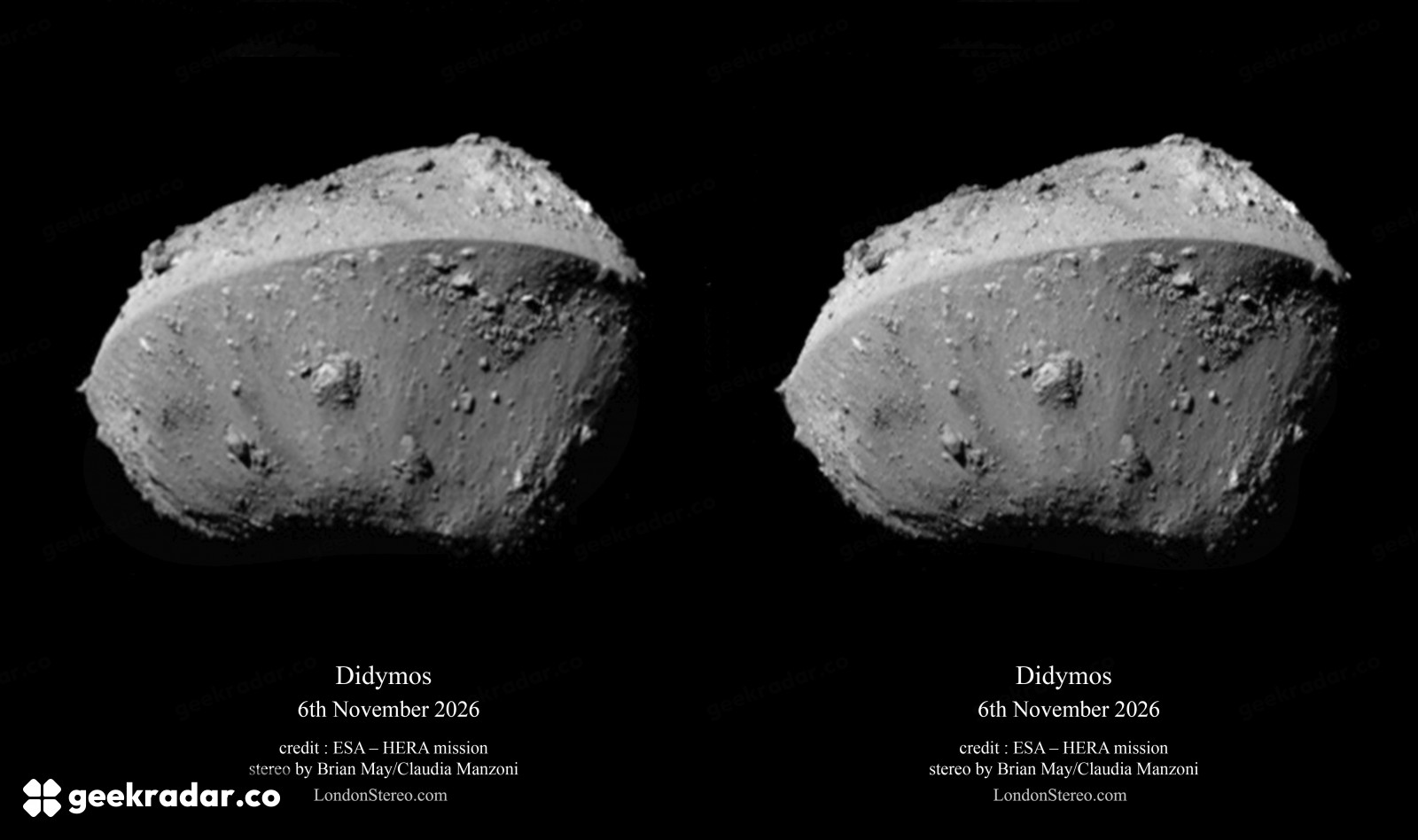
Brian May and Claudia Manzoni turned two spacecraft exposures into a stereo view. The ridge stands out even without special glasses if you use the paired frames.
Look along the bright belt that runs across Didymos. Its edge cuts a remarkably clean line above a slope dotted with boulders. In a single photograph, some of that contrast could be a trick of the light. In the stereo images released by the European Space Agency on November 19, you can follow the ridge as it projects from the asteroid. Two exposures from the same camera give each eye a slightly different view.
Astrophysicist and Queen guitarist Brian May made the stereo views with Claudia Manzoni. They worked with observations acquired by Jean-Baptiste Vincent, the scientist in charge of Hera’s Asteroid Framing Camera at the German Aerospace Center (DLR). Hera took the exposures moments apart on November 6, from 29.7 kilometres away. Each pixel spans about 2.8 metres of surface.
Look at the ridge first
The red and cyan fringes in the lead image are deliberate. This is an anaglyph: the colours carry the left-eye and right-eye views in one picture. Red-blue 3D glasses separate them again. If you have none, the black-and-white pair offers another way in. Open it at a comfortable size and gently cross your eyes until a third image forms between the two. If that feels uncomfortable, look at either frame on its own. The ridge and the boulders are visible in both.
DLR had already identified a sharp equatorial ridge in an earlier frame taken from 56 kilometres away. The new pairing makes it easier to distinguish the smooth sweep along the ridge from the rougher ground below. There is a limit to what “smooth” means here. At nearly three metres per pixel, gravel and smaller rocks could disappear into the same patch of grey. The stereo pair reveals the relief a viewer can resolve, without telling us what the surface would feel like underfoot.
The asteroid next door
Didymos is about 780 metres across. Its smaller companion, Dimorphos, was the body NASA’s DART spacecraft struck in 2022. Dimorphos is outside these frames. Hera’s earlier visible-light and infrared observations showed why even the side in shadow can turn up in a thermal image. Stereo answers a different question about the sunlit ground: which features stand proud of their surroundings?
ESA plans to show the first detailed post-impact views of Dimorphos on November 25, beginning at 18:45 UTC. Until then, the most revealing detail in this particular picture belongs to its larger neighbour. Find the equator in one frame, then look again in stereo: what first reads as a boundary between light and shade takes on an edge of its own.