Hera sees an asteroid hidden in shadow. The heat is only part of the story
New visible, spectral and thermal images separate surface shape from reflected light and heat. Together they prepare a closer explanation of DART’s asteroid-deflection experiment.
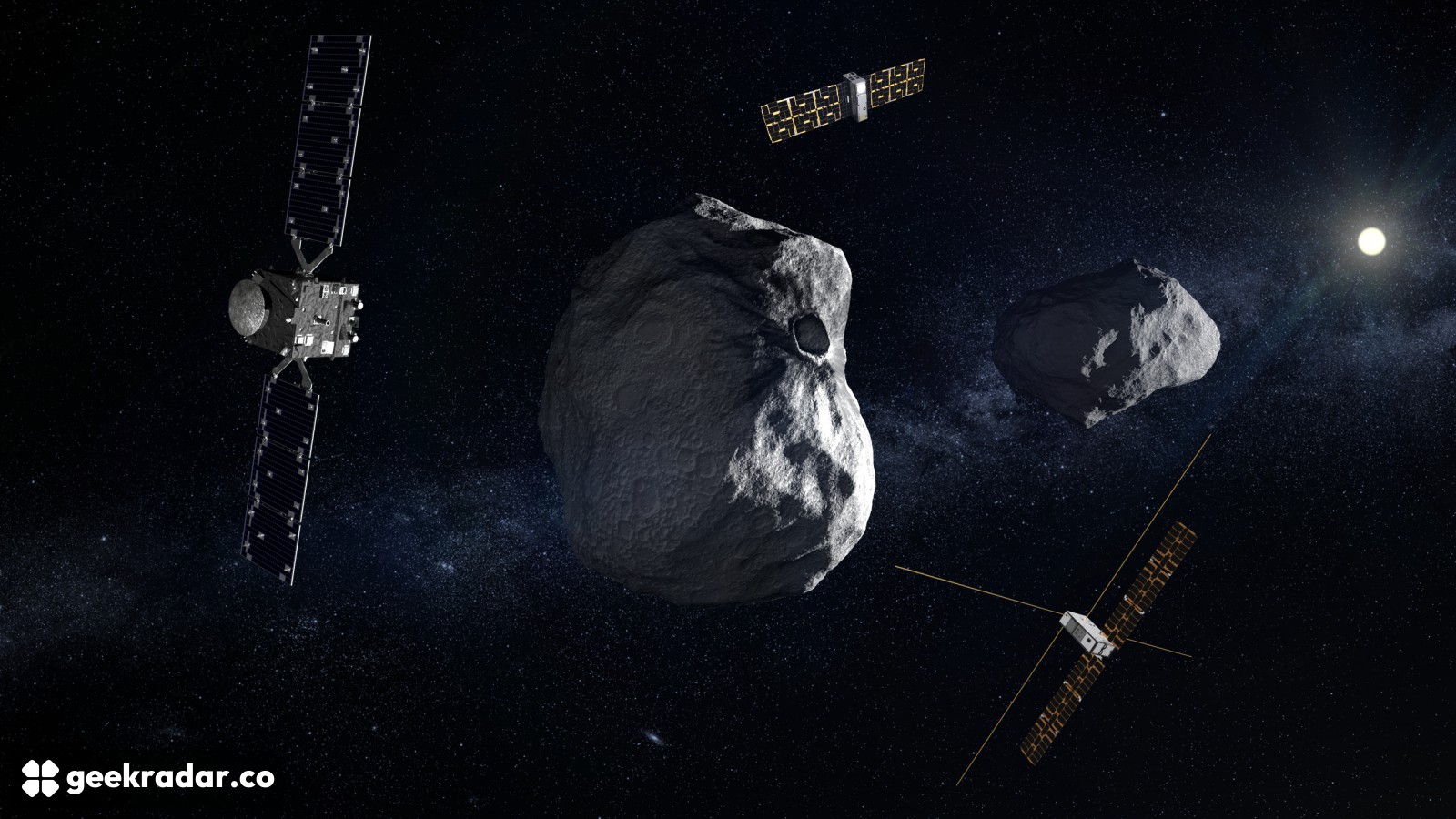
Hera’s latest asteroid pictures show why a spacecraft needs more than a better camera. In the views released by the European Space Agency on November 17, the small moonlet Dimorphos is almost lost in shadow beside Didymos. Switch to thermal infrared and the moonlet becomes visible: a surface that reflects little sunlight towards the camera can still emit heat.
The observations, acquired on November 6 from about 28.5 kilometres away, combine three instruments aboard ESA’s planetary-defence mission. They are an early look at how Hera will investigate the aftermath of NASA’s DART impact. They do not yet settle what the collision did to Dimorphos’s interior or explain its full response. Their immediate value is more specific: shape, reflected light and temperature give researchers different ways to question the same patch of rock.
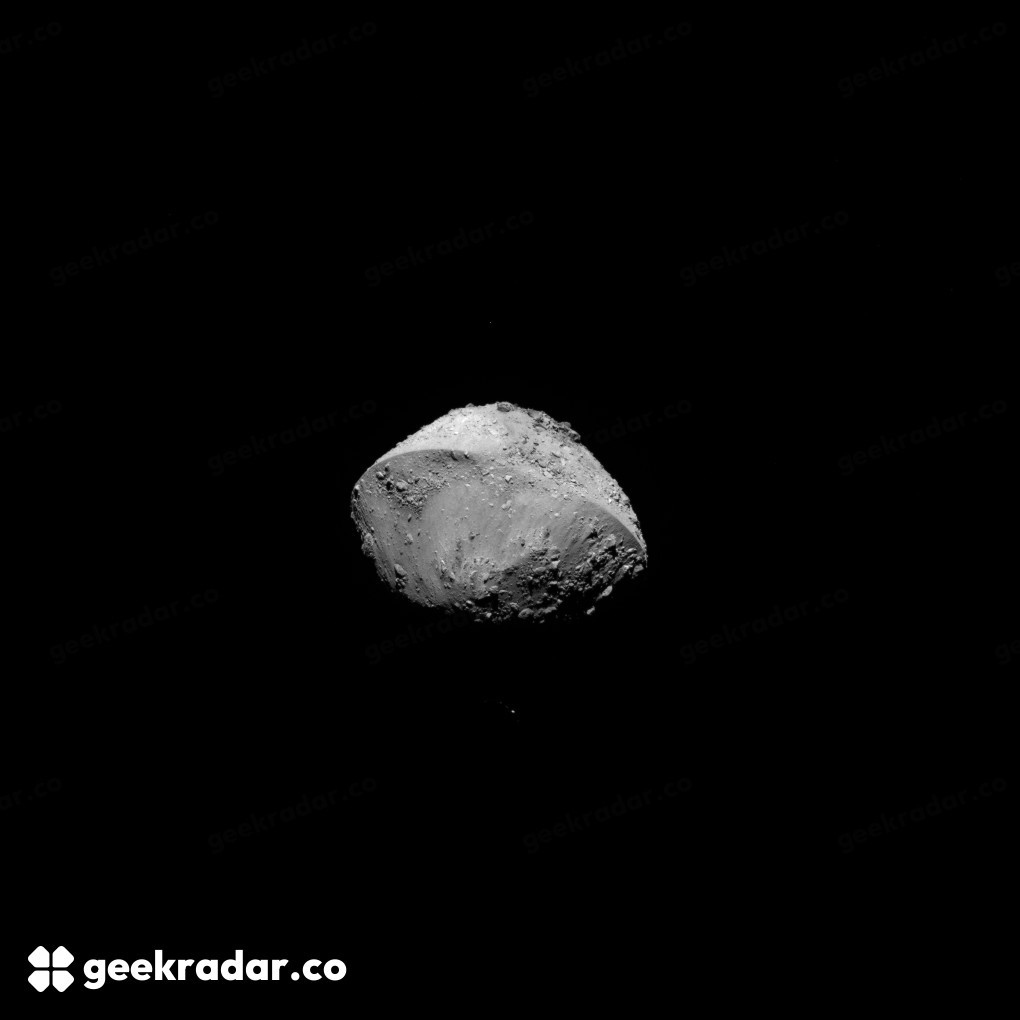
First, separate the ridge from its explanation
The Asteroid Framing Camera image resolves roughly 2.7 metres per pixel. It shows the larger asteroid Didymos with a pronounced equatorial ridge, rough areas and smoother-looking terrain. The DLR camera team’s report, updated on November 17, describes these observations as part of the mission’s developing survey.
That is a useful place to separate something visible from something inferred. The ridge is there in the image. The suggestion that rapid rotation encourages material to migrate towards the equator is an explanation to investigate. In ESA’s account of the new views, principal investigator Patrick Michel treats possible landslides and the role of rotation cautiously. Didymos spins in about 2.2 hours; the picture alone does not reconstruct how every boulder reached its present position.
The camera also helps the spacecraft navigate. Later, overlapping observations will provide material for three-dimensional models and surface maps. A striking first portrait is therefore both a scientific observation and one contribution to a larger measurement campaign.
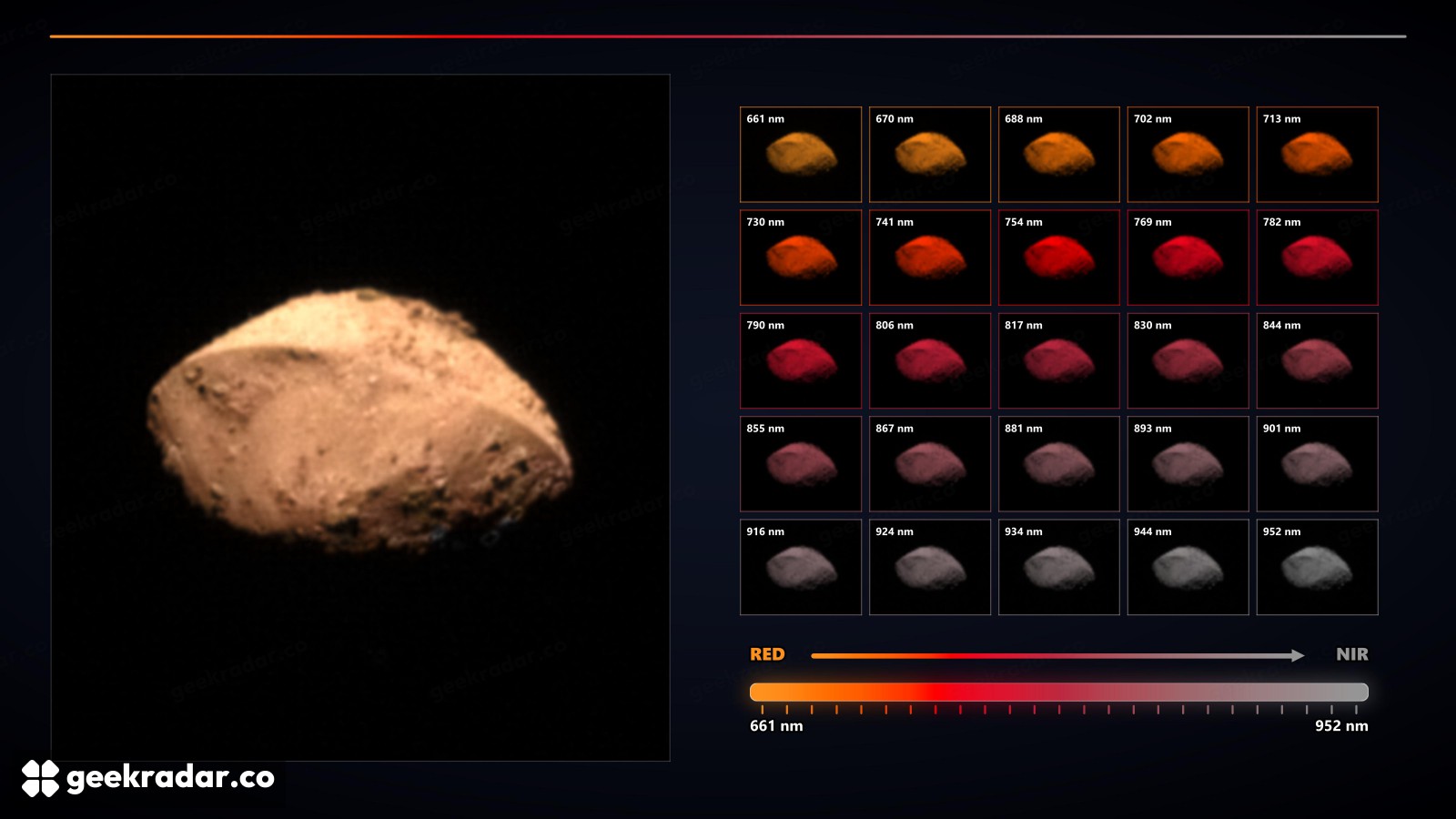
Twenty-five bands are not twenty-five mineral labels
HyperScout H adds a different measurement. Its maker, cosine, reports 25 spectral bands spanning approximately 650–950 nanometres, from visible red into near-infrared. Instead of compressing the scene into an ordinary colour photograph, the instrument records how strongly the surface reflects sunlight across those bands.
Researchers can compare the resulting spectral patterns with laboratory measurements of meteorites and minerals. The useful information is the relationship between wavelengths: two areas that look similarly grey to a conventional camera can have different reflectance signatures.
The published chart keeps the wavelength labels alongside the images. Read those labels before interpreting the colours. Its orange-to-grey presentation is a way of displaying measurements across the spectrum, not evidence that Didymos has an orange hemisphere or that each coloured tile identifies a different substance. The instrument has begun delivering data; a finished composition map requires analysis of those data.
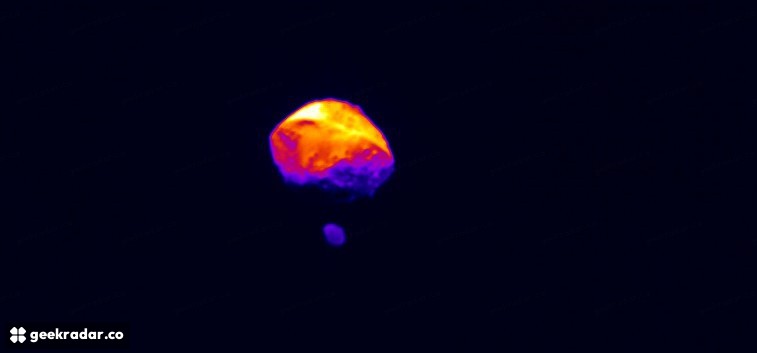
Heat reveals what sunlight hides
JAXA’s Thermal Infrared Imager, TIRI, provides the third view. In the November 6 thermal observation, the smaller Dimorphos appears beneath Didymos despite being largely in shadow in the visible-light image. The thermal colours represent differences in emitted infrared radiation, rather than the colours an astronaut would see.
Watching that signal change matters as much as taking a single picture. Solid rock, porous material and loose grains respond differently to heating and cooling. JAXA’s published observation plan includes continuous thermal imaging across a complete rotation of Didymos, alongside repeated observations with Hera’s other instruments. That time dimension helps distinguish a momentary illumination pattern from a persistent property of the surface.
Our NEO Surveyor explainer discusses another use of asteroid heat: finding objects from a distance. Hera’s task is a close examination of a known pair. The distinction changes the question from where an asteroid is to what kind of material a future deflection attempt might encounter.
From a successful impact to a predictable one
DART struck Dimorphos in September 2022 and shortened its orbit around Didymos by about 33 minutes. Hera is examining the physical result: the body’s shape, mass, structure and surface, including whether the impact made a crater or changed the asteroid more broadly. Those remain research questions, not conclusions established by the newly released colours.
ESA says more detailed images will be presented on November 25. The larger payoff will come from connecting measurements: a surface feature located by the camera, a spectral signature compared with laboratory samples, and a thermal response followed through rotation. DART showed that a spacecraft could change this asteroid’s motion. Hera’s job is to make the next calculation depend less on assumptions about the rock being hit.