GTA VI’s Leonida Keys make the crossing part of the destination
Islands, bridges and waterfront gathering places give the region a readable identity without relying on guessed map dimensions.
In this guide
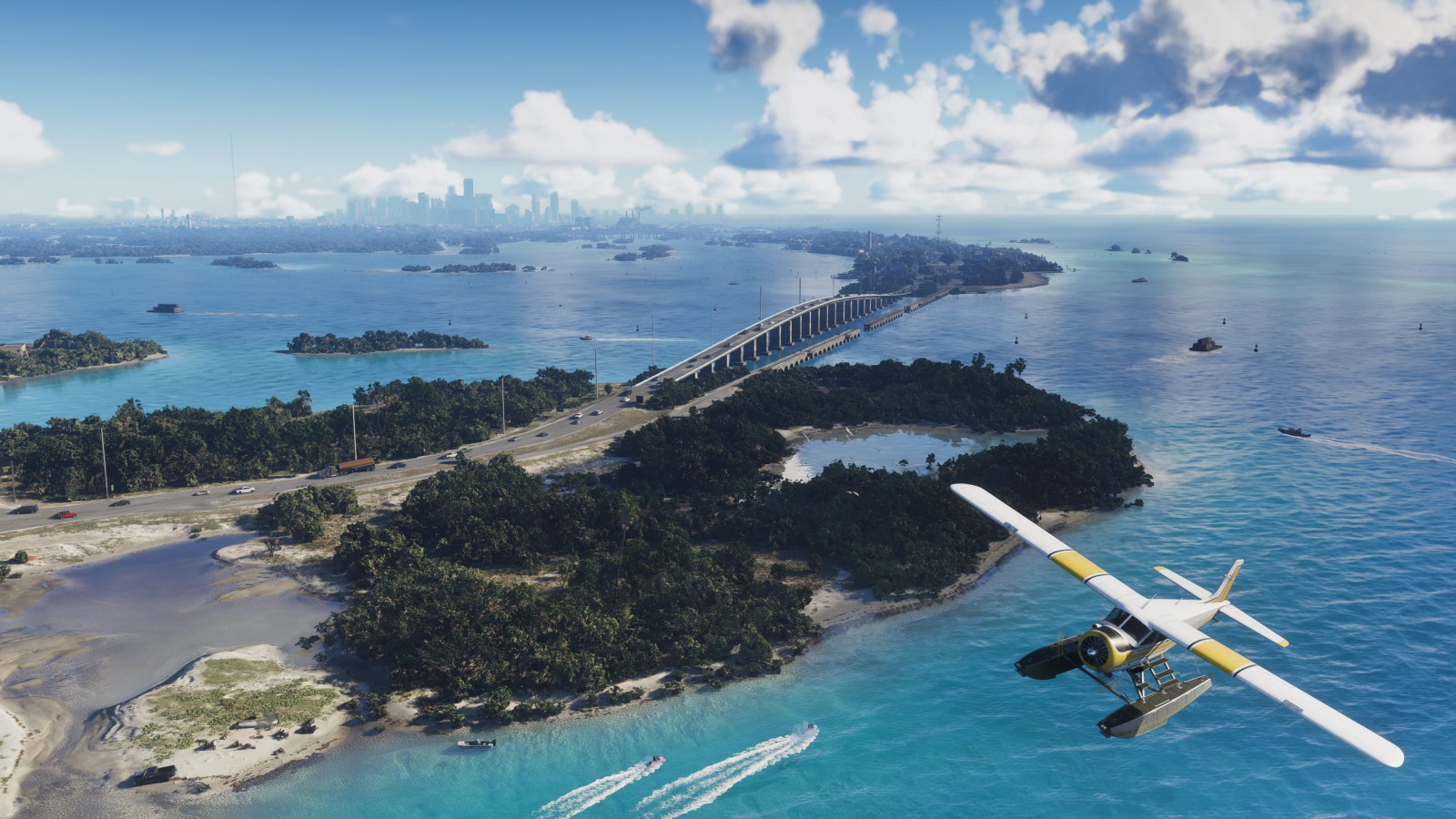
The Leonida Keys give Grand Theft Auto VI a different kind of geography from Vice City: islands, water and connections that stand out because land is no longer continuous. Rockstar’s official images make that structure unusually clear, especially the seaplane view of a bridge joining two islands.
This is a reading of the published region description and official screenshots, not a measured map analysis. Rockstar presents the Keys as a tropical archipelago with a relaxed surface and dangerous waters. The images let us examine how that setting is communicated without inventing distances or hidden routes.
A bridge becomes more than background scenery
In the aerial view, the crossing is easy to follow because open water surrounds it. It connects two pieces of land whose relationship is visible in a single frame. That is a different visual problem from finding a route through a dense grid of streets.
A connection like this can become a landmark in its own right. In a city, a player may remember a district through a building or junction; among islands, the transition between places can be just as distinctive as either destination.
The screenshot does not establish how many alternate routes exist, whether a particular bridge can close, or what missions use it. Nor should the apparent scale of an aircraft or vehicle be used to calculate the final map’s dimensions from a promotional perspective. The composition tells us about the setting’s visual structure, not a reliable surveying method.
The social spaces are close to the road
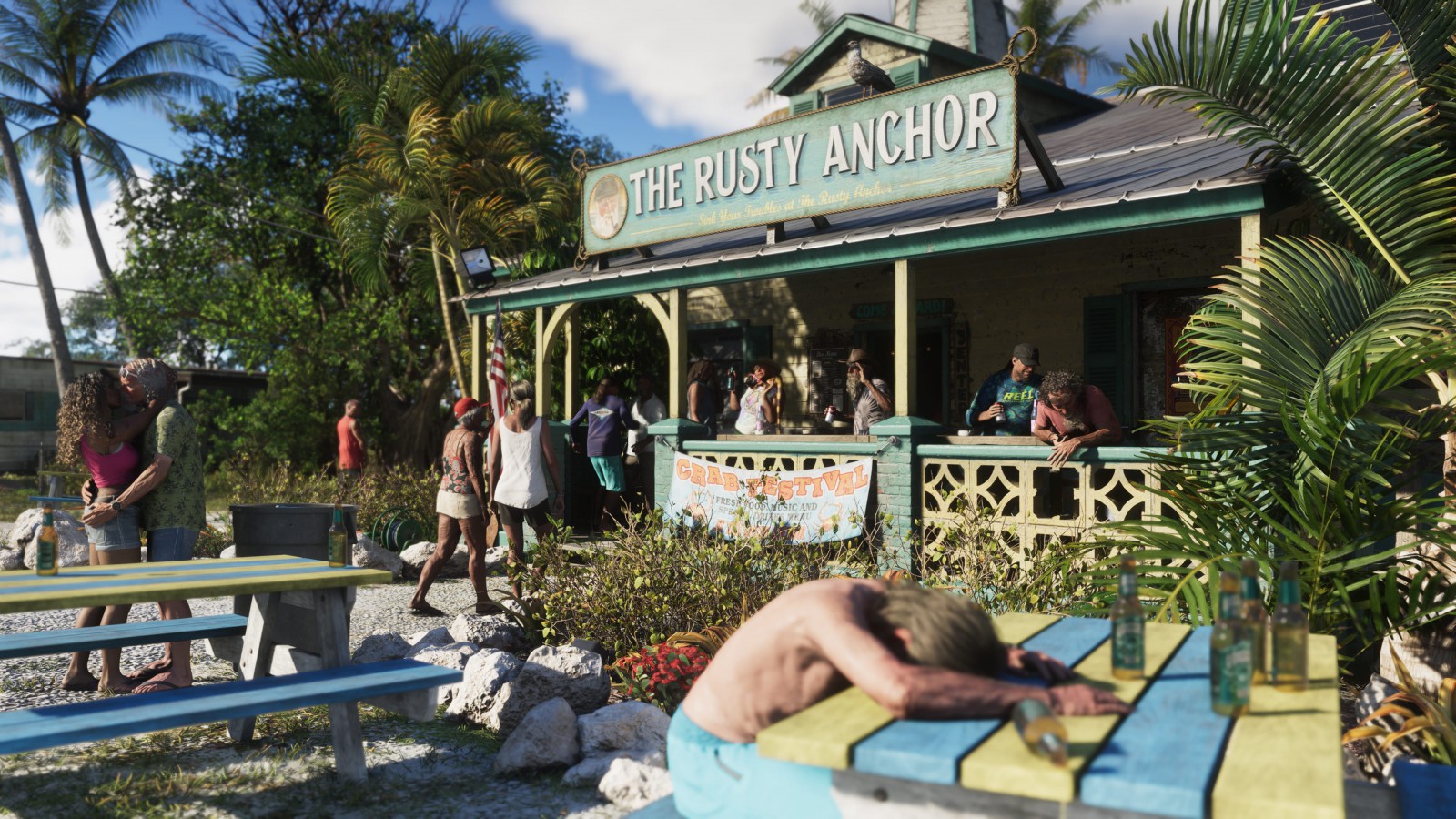
The beach-bar image provides a useful counterpoint to the aerial view. People occupy the porch, entrance and picnic tables, with activity extending into the space around the building. It presents a social stop that is visible from outside rather than an anonymous facade.
The contrast is part of the Keys’ identity. From above, the region is a chain of connected landforms. At ground level, it is a collection of places where people linger. A large world needs both scales if travel is to lead somewhere recognizable.
This gives the region a different emphasis from the Grassrivers, where the landscape is introduced through wetlands and less obvious boundaries. Water can define a setting in more than one way: surrounding an island is not the same visual experience as moving through a wetland.
A relaxed appearance is part of the contrast
Rockstar’s description pairs the easygoing island atmosphere with danger. That establishes a tone rather than a checklist of encounters. There is no need to reveal character-story material or speculate about particular criminal events to understand the contrast.
The setting’s appeal is partly that its ordinary spaces already carry a clear mood. A bar porch, a bright crossing and a seaplane over shallow water can identify the Keys without reproducing Vice City’s skyline. They give the larger state more than a change of scenery; they change the way places relate to one another.
Our overview of Leonida treats the regions as distinct settings rather than pieces in an unverified size contest. The Keys make the value of that approach obvious. The important journey may be the one between two islands you learn to recognize, even before you know how many square kilometres surround them.