ANR’s new frame-generation beta targets the car that breaks apart in motion
B16 changes model weights, while the preceding memory fix explains why 4K still needs spare VRAM.
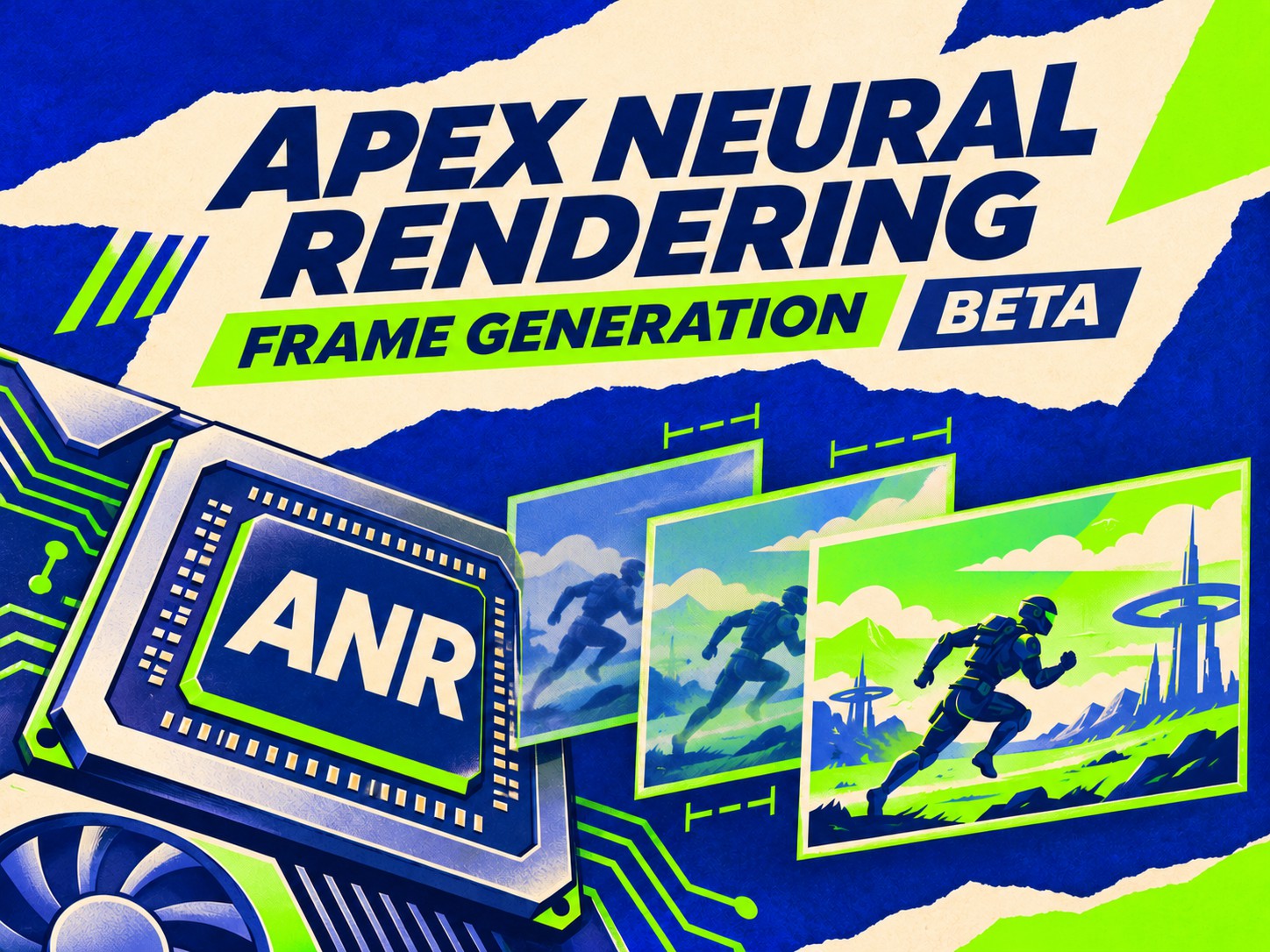
Apex Neural Rendering’s newest frame-generation beta targets a particularly distracting problem: the rear of a car breaking apart as it moves across the screen. The November 14 B16 release supplies new model weights intended to reduce doubled bodywork, road flicker and bright artifacts in third-person driving. These are the developer’s reported improvements, rather than results from an independent image-quality test.
That is a more useful way to understand this update than treating a higher frame counter as a complete verdict. Frame generation inserts predicted images between rendered frames. A scene can become smoother while a thin edge, moving object or interface element becomes less stable. A driving camera makes the distinction easy to notice: the car stays prominent while the road moves quickly beneath it.
The distinction between generated frames and reconstructed pixels also underpins our DLSS and FSR comparison. ANR’s current beta concerns the former.
A broad hardware target with a narrower current release
The project repository describes a wider neural-rendering effort, but frame generation is the component currently in beta. Super resolution and ray reconstruction are separate planned capabilities. Their appearance in the project description does not mean installing this package enables all three.
B16 lists NVIDIA RTX 20-series and newer, GTX 16-series, Radeon RX 5000-series and newer, Steam Deck, and Intel Arc A and B. The supported environments listed for this package are Windows 10 and 11, plus Linux and SteamOS through Proton. The macOS test kit remains at B15; it should not be described as having received the same package update.
Installation also depends on what is already present. Apex offers a full package for games without OptiScaler and an add-on for an existing installation. Mixing that distinction into a generic instruction to copy files risks creating a problem unrelated to the model itself. The release page supplies the package-specific installation and removal directions.
The previous fix explains why memory matters
B15 addressed a Windows D3D12 issue in which recreating frame generation, for example after a resolution change, could retain copies of game textures. According to the developer, repeated recreation could accumulate hundreds of megabytes at 4K until performance collapsed or the game crashed. Fixing that leak removes an unintended cost; it does not make frame generation free of memory requirements.
The same notes warn that a game already filling an 8GB GPU at 4K can still exceed the budget with frame generation enabled. Lower output resolution or texture quality may therefore be a more effective adjustment than changing the interpolation setting alone. The distinction is between memory that should have been released and memory the running workload genuinely needs.
A beta that should be judged in motion
B16 also signs its provider library as Apex Compute. That supplies a publisher identity for the binary, not an independent guarantee about every game combination. Likewise, the public repository’s recording utilities and OptiScaler source packages do not mean all of ANR’s core implementation is already published; the project still describes core code as forthcoming.
For a player trying this beta, the car’s silhouette, the road immediately underneath it and sudden changes in direction are more revealing than a static screenshot. A successful update should make those details less noticeable during play. A larger number in the corner is welcome only if the scene between the numbers remains convincing.