The small details behind GTA VI’s more convincing crowds
Different body proportions, overheard dialogue and reactions to proximity solve three separate problems on the same street.
In this guide
A convincing GTA VI street needs more than a large crowd. It needs people whose bodies fit the spaces they occupy, conversations that sound as though they began before the player arrived, and reactions that acknowledge when someone is standing too close.
Those are three connected problems in Rob Nelson's October interview with IGN. His explanation of Grand Theft Auto VI's pedestrians is particularly useful because it moves beyond the vague promise of a more alive city. It identifies technical and creative work behind the effect, while leaving the consistency of the finished game to be established after release.
Different bodies need compatible movement
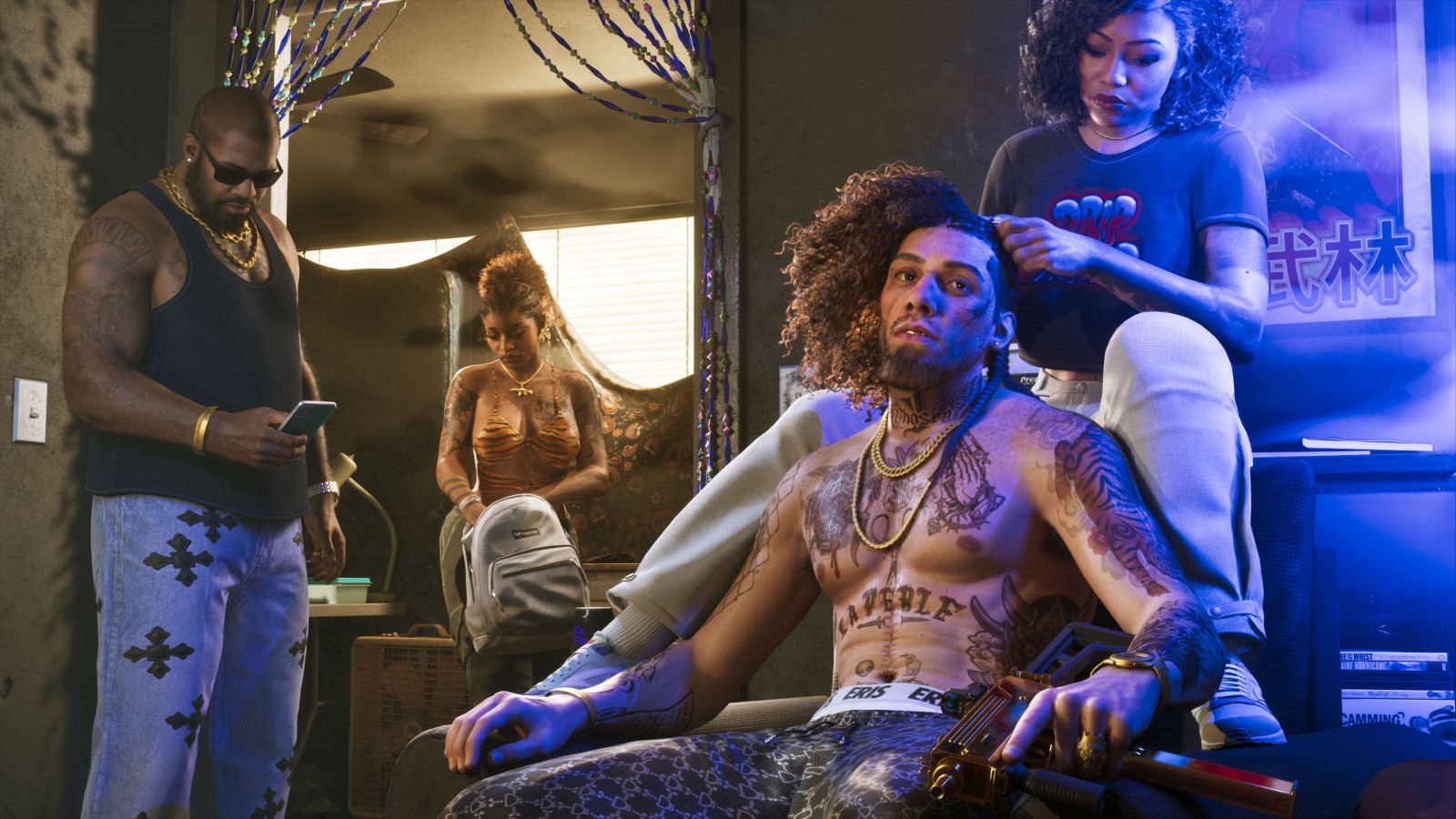
Nelson describes greater variation in character height and body shape, supported by a system that retargets animations as the game runs. Retargeting means adapting a movement to a different character's proportions. Its purpose here is to let varied bodies participate in shared actions without requiring every person to have the same build.
A sitting animation illustrates the problem. The seat occupies a fixed position, but a taller person's joints and reach differ from those of a shorter person. Reusing motion without suitable adaptation can make hands, feet or contact points appear misplaced. Similar issues arise when two characters interact with each other.
The broader consequence is visual variety that survives movement. Different silhouettes can make a crowd look less repetitive in a still image; animation has to preserve that variety once people walk, sit and interact. Rockstar's account describes its solution, not a guarantee that clipping or awkward transitions have disappeared.
An overheard conversation has a beginning elsewhere
The writing challenge is different. A passer-by normally hears only part of a conversation, rather than arriving at the first line of a neatly packaged exchange. Nelson describes studying that rhythm and expanding the writing, directing and production work supporting incidental dialogue.
That matters because background speech is easy to make conspicuous. If everyone seems to begin performing precisely when the protagonist approaches, the street can feel like a set of audio triggers. Giving an exchange a sense of context beyond the player's arrival can make the surrounding people seem occupied with their own concerns.
The account describes authored dialogue and behavior systems. It does not establish that pedestrians are powered by a large language model, that every line is generated dynamically, or that conversations are unlimited. More variety is a concrete production ambition; infinite conversation would be a different and unsupported claim.
Listening changes the encounter
Nelson also describes pedestrians noticing prolonged close attention. Someone who listens nearby or follows too closely may prompt a reaction, rather than remaining an invisible audience member. The exact outcome can vary; the point is that proximity becomes part of the exchange.
This creates a subtle tradeoff for exploration. Richer dialogue rewards stopping to listen, while reactions prevent the player from always hovering without consequence. The design has to make curiosity enjoyable without making ordinary observation feel like a punishment. The interview explains the intention, but does not provide a complete catalogue of thresholds or responses.
Rockstar's official character and setting presentation supplies the larger premise of a state containing different communities. The Leonida overview and our analysis of the launch gallery examine those contrasts geographically and visually. Pedestrian behavior is the smaller scale at which those places must become credible.
An attractive skyline can establish a city in a second. Convincing people take longer: a hand meeting a chair, a fragment of conversation, a glance when the player gets too close. Those are the details that can make stopping on the pavement feel worthwhile, even when no mission marker asks for it.