LISA could find planets in gravitational waves. Webb would test a different clue
New studies outline a detection method for double white dwarfs, with important differences between the two instruments’ reach.
The future LISA gravitational-wave observatory could find planets by detecting their influence on pairs of tightly orbiting white dwarfs. Two studies described in NASA's November 10 research report work through that possibility and ask how the James Webb Space Telescope might confirm some candidates. No planet has been discovered by LISA: the mission is still in development.
The proposed method is interesting because it changes the signal astronomers would read. Instead of watching a planet cross a star or measuring changes in starlight alone, researchers would look for the planet's gravitational imprint on a continuing gravitational-wave source.
A planet adds a wobble to a nearly steady signal
White dwarfs are the compact remnants of stars like the Sun. In a sufficiently tight binary, two of them orbit rapidly enough to emit gravitational waves in LISA's intended observing range. Their signal can be close to continuous, giving researchers a reference against which to look for modulation.
An orbiting planet pulls on the binary as a whole. That small reflex motion changes the gravitational-wave signal through the Doppler effect, producing sidebands at frequencies above and below the principal signal. The proposed analysis uses that structure to infer properties such as a planet's mass and orbital period.
The analogy is to radial-velocity planet searches, which use shifts in a star's light as it moves toward and away from the observer. Here, the information carrier is different. A gravitational-wave observatory could therefore investigate systems that are awkward targets for familiar light-based methods.
NASA notes that planets have been found around some isolated white dwarfs, but none around a double-white-dwarf system. A confirmed detection would therefore establish a distinct population, rather than merely add another example to an already well-sampled class.
Webb would check a different piece of evidence
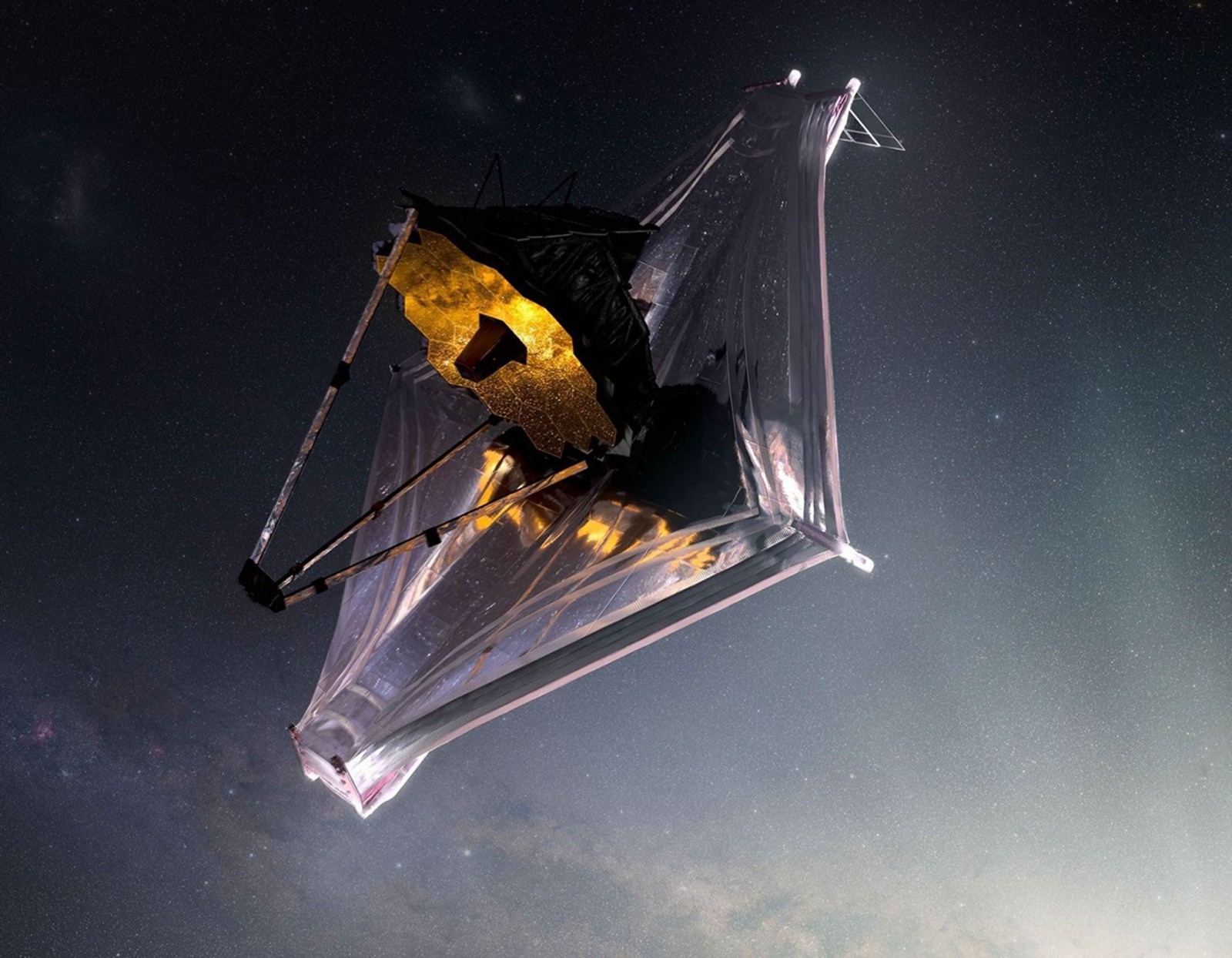
The second study considers infrared confirmation. A planet can contribute more infrared light than expected from the two white dwarfs alone. Webb could look for that excess in sufficiently nearby systems, giving a different observational test of the gravitational-wave interpretation.
The sensitivity figures must not be merged. In the example NASA describes at about 500 light-years, Webb could detect a planet around five times Jupiter's mass, whereas LISA could detect a sub-Jupiter planet under ideal conditions. Those are different thresholds for different instruments. They do not imply that every potential LISA planet would be confirmable by Webb.
Our retrospective on Webb's first science images explored the difference between an attractive picture and a measurement that answers a scientific question. This proposal is another reminder of that distinction: an infrared excess may be useful evidence even when it does not resemble a sharp photograph of a new world.
The detector itself is a future mission
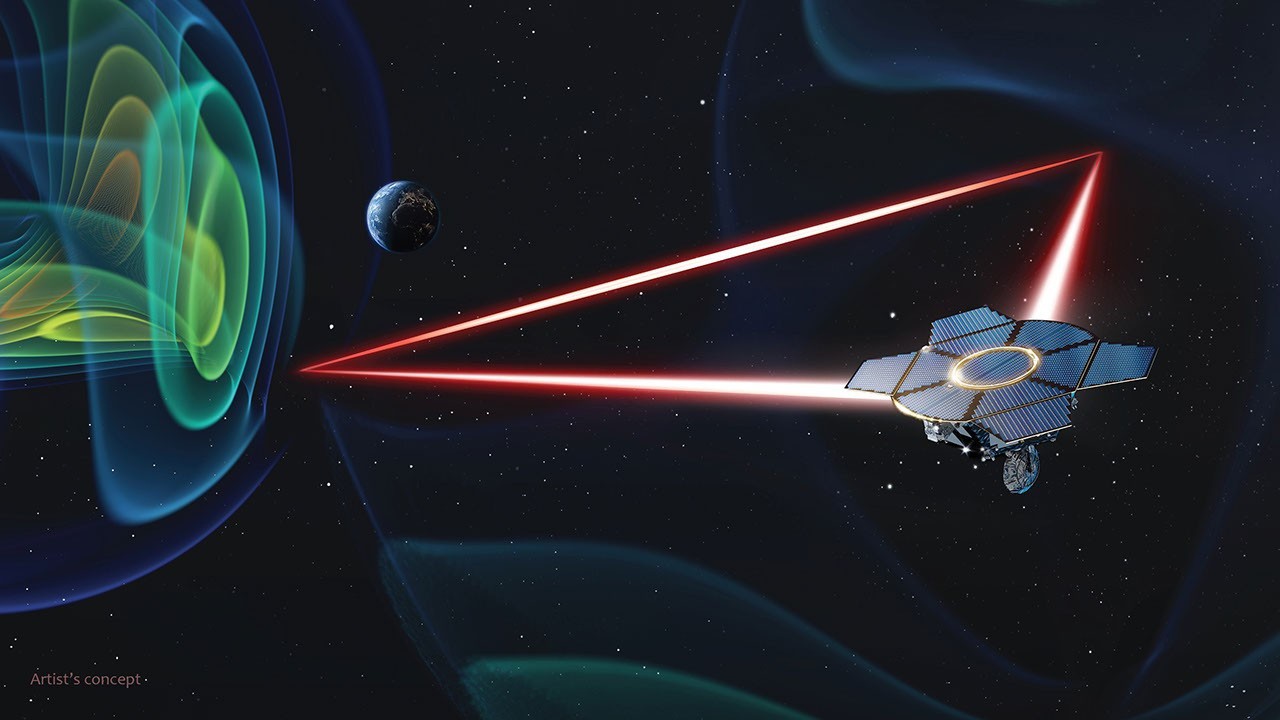
ESA leads LISA, with NASA contributing hardware and scientific support. Launch is planned for the mid-2030s. Three spacecraft would form a triangle with sides approximately 2.5 million kilometres long, using laser measurements to detect tiny changes in their relative distances.
Researchers expect the observatory to resolve around 10,000 individual double-white-dwarf systems. That is an estimate of accessible gravitational-wave sources, not a forecast of 10,000 planet discoveries. Only some systems may contain detectable planets with suitable masses and orbits.
The two studies refine an idea first proposed in 2008. Their contribution is to make the potential detection and confirmation chain more concrete. If it works, the discovery will begin with a subtle variation in an almost steady rhythm—and become persuasive when a different telescope finds the extra light that the same unseen companion should supply.