Webb's first images turned an engineering achievement into evidence
The July 2022 images were more than a spectacle: they demonstrated an observatory ready to support new scientific measurements.
The first full-color science releases from the James Webb Space Telescope made a technical achievement visible to an enormous audience in July 2022. The pictures were arresting, but their deeper importance was that an observatory assembled, launched and commissioned through years of engineering could now deliver measurements for scientific work.
A small patch of sky, a crowded view
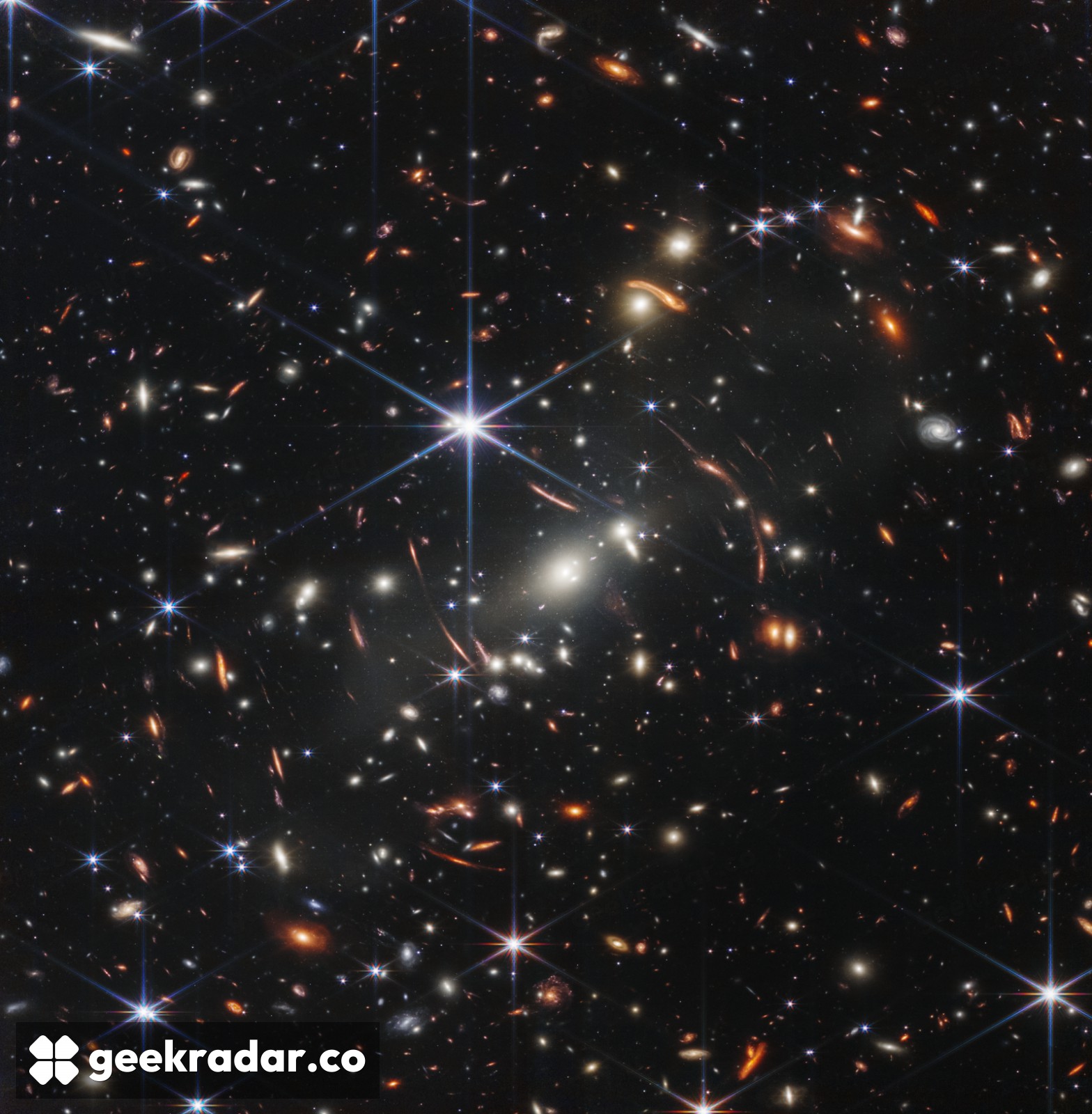
Webb's first deep field showed the galaxy cluster SMACS 0723. NASA described thousands of galaxies in a patch of sky comparable in apparent size to a grain of sand held at arm's length. The image was previewed on July 11, ahead of the broader release the following day. NASA's account of the deep field explains how the observatory's infrared observations and gravitational lensing revealed faint, distant objects.
Gravitational lensing is not a camera feature switched on by an engineer. Mass bends the path of light, and the foreground cluster changes how more distant galaxies appear. The result is scientifically useful as well as visually unusual: distorted forms can contain information about both the distant objects and the mass between them and the telescope.
The image should therefore be understood as a measurement interpreted through physics, not simply a sharper holiday photograph of space.
More than one instrument demonstration
The wider July 12 release included the Carina Nebula, the Southern Ring Nebula, Stephan's Quintet and spectroscopic observations of the exoplanet WASP-96 b. Together with the deep field, the selection demonstrated different ways of studying the universe, from structures in clouds of gas to information carried by light split into its component wavelengths. NASA's first-images collection preserves the releases and their scientific context.
Spectroscopy is especially easy to overlook when spectacular images dominate a story. Its value lies in measurement: changes in the strength of light at different wavelengths can help researchers investigate physical conditions and composition. A beautiful picture can communicate an achievement instantly; a spectrum may support the harder work of explaining what is there.
The start of a research program
The release marked the transition into Webb's science operations, rather than the completion of its scientific task. An early observation can demonstrate that a capability works without answering every question that capability will eventually be used to investigate.
For technology readers, that is the enduring lesson of the first images. A telescope's mirrors, detectors, thermal design, communications and analysis software exist to produce trustworthy observations. July 2022 offered an unusually clear view of that entire engineering effort reaching its purpose: not merely showing more of the universe, but giving researchers better evidence with which to ask questions about it.