The Leonids reward a dark predawn sky, not a promise of a meteor storm
NASA’s November guide identifies a viewing window, while its background page shows why hourly counts need caution.
The Leonids offer a reason to spend time under a dark sky before dawn next week, but not a sound basis for promising a meteor storm. NASA’s November observing guide recommends the early hours of November 17 and 18 after moonset. Its upper estimate of around fifteen meteors an hour applies to ideal conditions, with fewer expected for most viewers.
There is a qualification worth keeping beside that number: NASA’s dedicated Leonids page currently lists a November 16–17 peak night and a much lower typical rate. The pages do not provide one consistent forecast. The responsible plan is therefore a window of predawn opportunities, weather permitting, rather than a countdown to a guaranteed burst of activity.
A dark, open sky matters more than magnification
Meteor watching rewards a wide view. NASA recommends moving away from city and street lighting and giving the eyes roughly half an hour to adapt. A telescope’s narrow field would work against the task: a meteor can appear across a large part of the sky, and the observer needs time and coverage rather than a highly magnified view of one point.
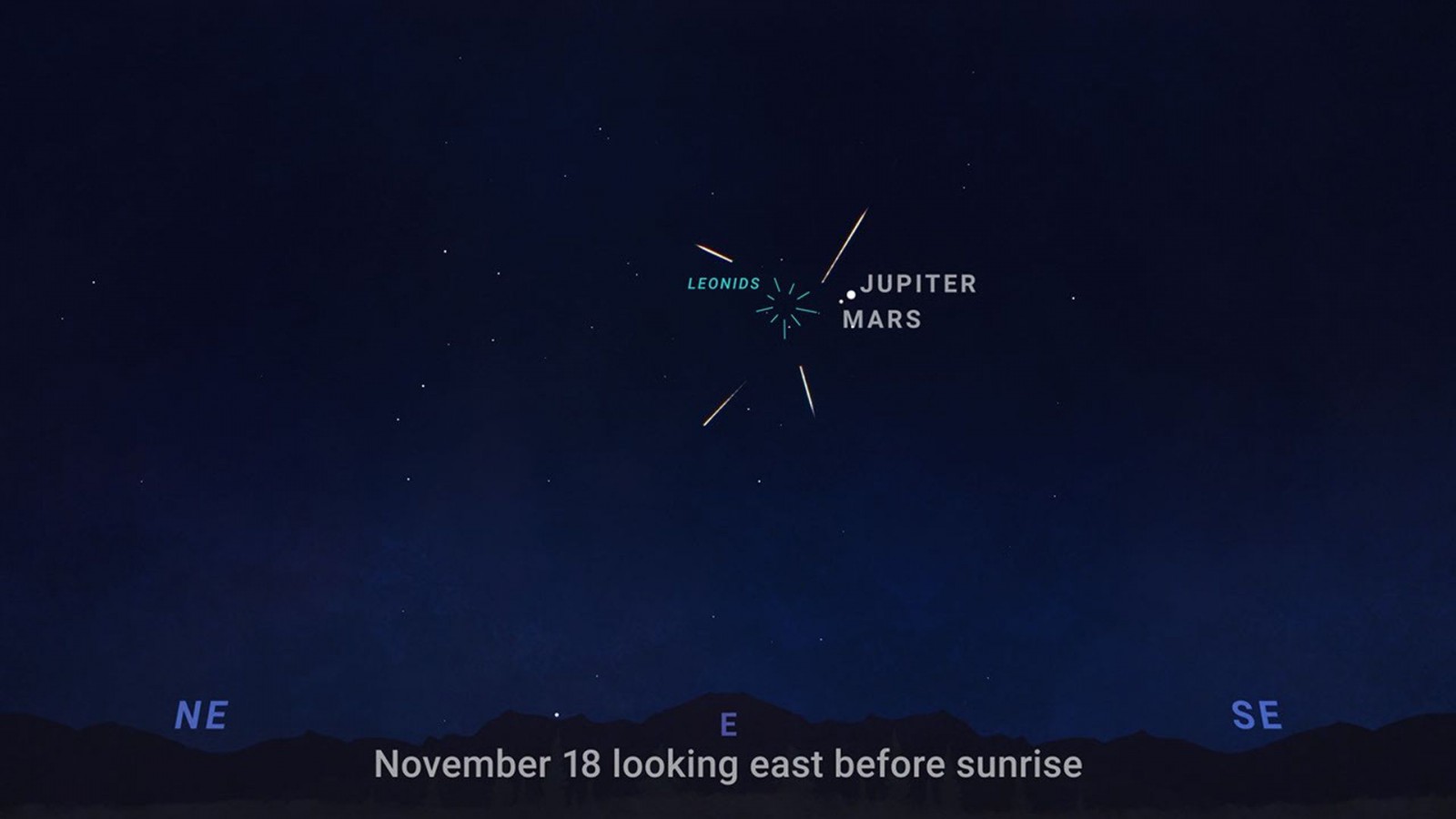
The shower’s radiant lies in Leo, which is where the paths appear to converge when traced backward. That does not mean all the meteors will be confined to the constellation. Looking away from the radiant can reveal longer-looking trails; close to it, perspective shortens their apparent paths.
The chart accompanying NASA’s monthly guide illustrates the radiant and nearby planets. It is a directional aid, not a promise that those drawn streaks will appear together. Its horizon layout is also not a custom sky map for every latitude. Local moonset, sunrise, cloud cover and the available horizon determine the useful interval from a particular observing site.
The comet supplies the debris, not a fixed hourly quota
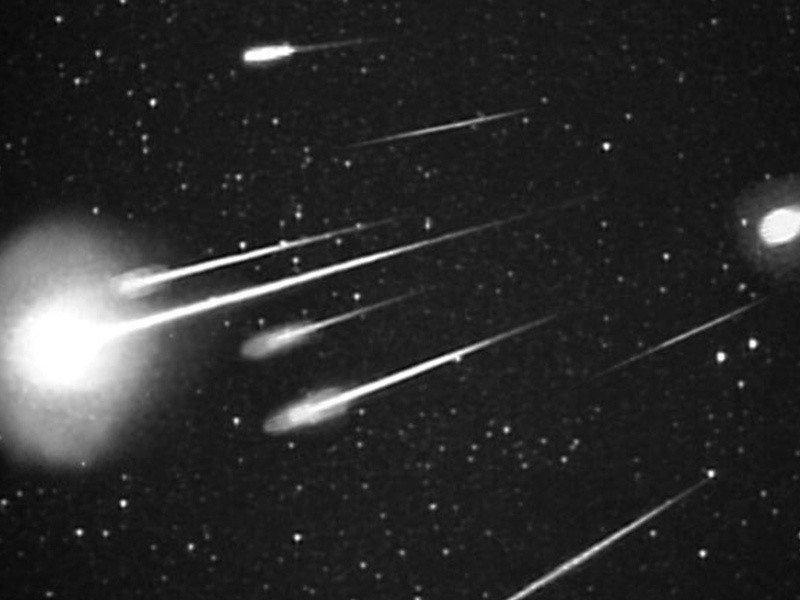
Leonid meteors originate in debris associated with comet 55P/Tempel-Tuttle. Earth encounters that material along its orbit, and particles entering the atmosphere produce the visible streaks. The geometry and concentration of debris matter, which is why a shower’s famous historical storms should not be treated as its annual baseline.
NASA’s background page recalls the exceptional 1966 storm and identifies 2002 as the most recent Leonid meteor storm. It defines a storm as at least a thousand meteors per hour. Neither that history nor the comet’s approximately thirty-three-year orbit establishes that 2026 will reproduce such a display.
The disagreement between the current NASA pages is another reason to avoid making an hourly count the measure of a successful outing. An idealized upper estimate is not the number an observer will see through clouds, urban glow or a restricted patch of sky. Even a clear rural site cannot turn a sparse debris encounter into a dense one.
There is another reason to look up beforehand
The same monthly guide highlights Mars and Jupiter appearing about 1.2 degrees apart on the mornings of November 15 and 16. Jupiter is the brighter point, with reddish Mars nearby. Their apparent proximity is a line-of-sight effect from Earth; the planets remain widely separated in space.
That pairing gives an earlier predawn outing a more predictable target than waiting for a particular meteor. For the Leonids themselves, the worthwhile expectation is quieter: a dark sky, enough time for the eyes to adjust and the possibility of a brief trail that would be easy to miss from a lit street. A modest forecast makes room to appreciate what actually appears.