This magnetic origami robot changes shape to change how it moves
Two stable configurations let the small device roll, slide, turn and grip. Its laboratory demonstration still depends on an external magnetic apparatus.
A miniature folding robot can crawl, roll, jump and close around an object because part of its control system is built into its geometry. In a Nature Communications paper published November 6, researchers led by a Wuhan University team demonstrate a bistable origami structure driven by an external magnetic apparatus.
The engineering idea is to reduce how precisely the magnetic field must control every deformation. Instead of asking the field to hold the robot in every intermediate shape, the structure has two stable configurations and an energy barrier between them. Small inputs move it within a configuration; a stronger pulse can push it across the barrier and make it snap into the other state.
The body does some of the control work
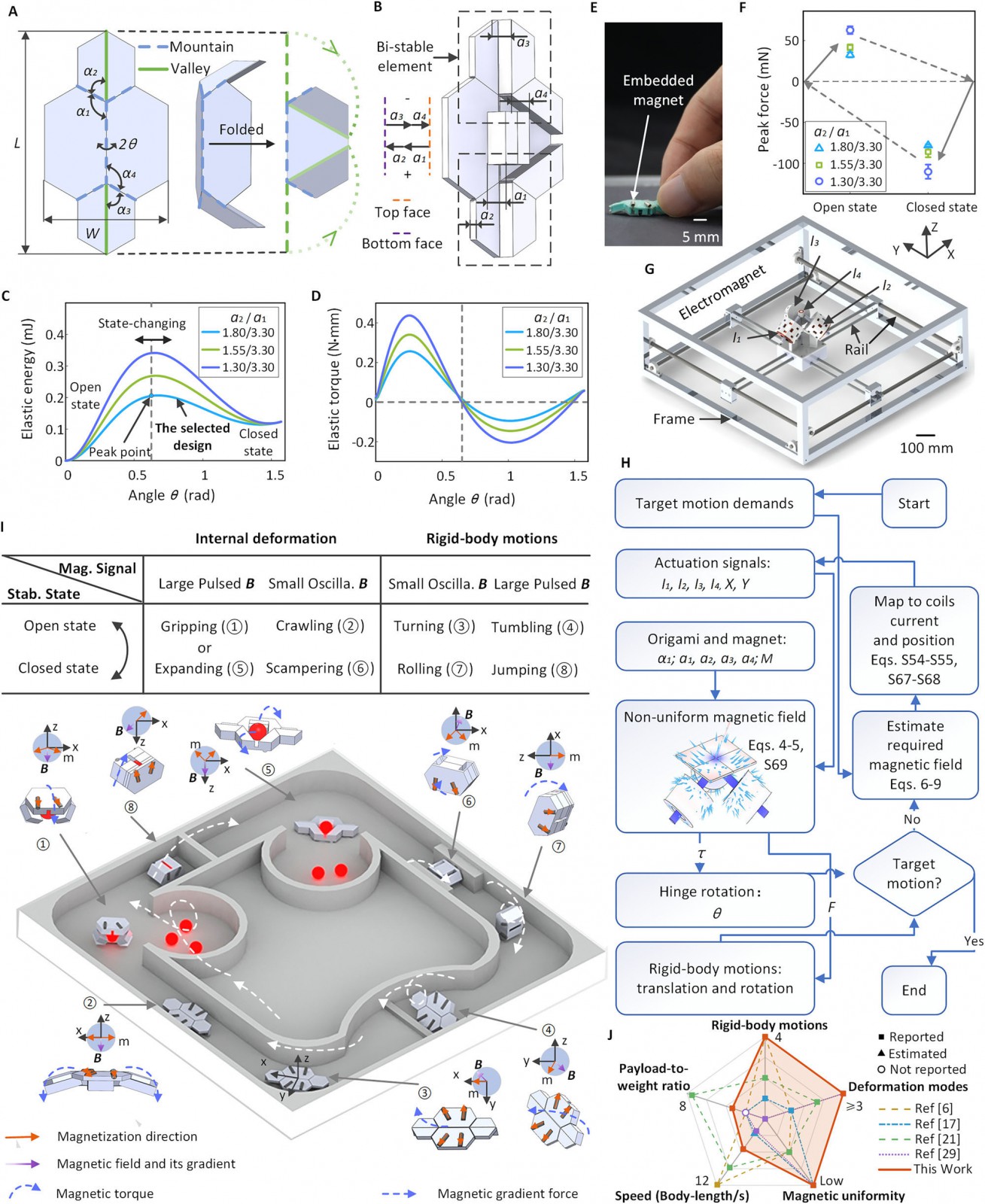
The full paper describes thick panels joined by flexible hinges, with four small permanent magnets attached. As the structure folds, interactions between panels deform the hinges and store elastic energy. The selected geometry makes the open and closed configurations stable.
That is the meaning of “bistable” here. It is not an AI system choosing between two strategies. The mechanical design makes certain shapes natural resting states, allowing the external controller to use those states rather than continuously reproduce them from scratch.
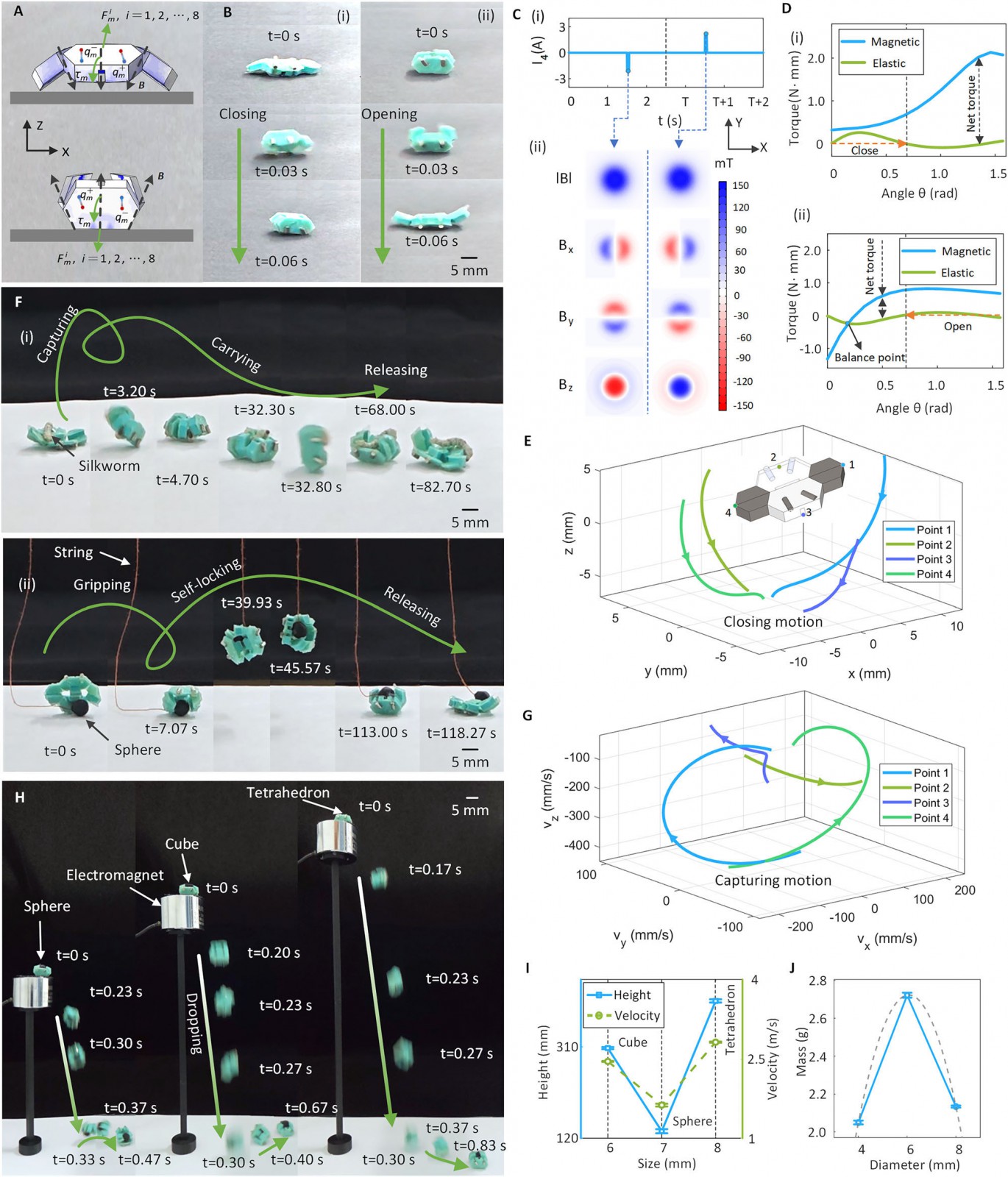
This can simplify a task such as gripping. The researchers show the structure closing around an object and maintaining that closed configuration without continued actuation. The energy needed to trigger the transition is different from the energy that would otherwise be needed to hold a continuously deformable gripper shut.
Wireless motion still needs a substantial external machine
The robot is untethered, but it is not self-powered in the everyday sense of a battery-operated toy. Four electromagnetic coils mounted below its operating area, on two perpendicular sliding mechanisms, generate the fields that drive it. The apparatus moves with the working region.
The team deliberately accepts a less uniform field than some conventional magnetic-control arrangements require. Geometry and the field work together to determine the resulting motion. The laboratory demonstrations include movement in open and closed configurations, configuration switching and travel through obstacle courses.
This is the central tradeoff. More capability is built into the small structure, but control has not disappeared: it resides partly in the external platform, its positioning and the applied signals. A photograph of the robot alone would omit a large part of the system that makes it function.
The figures reproduced here show the design and experimental apparatus, followed by configuration switching and gripping tests. They are from Huang and colleagues’ paper, shared under Creative Commons Attribution 4.0, with the original figure content retained.
A laboratory capsule is not a clinical device
The prototype is sub-centimeter in size and resembles a capsule when closed. The authors discuss possible future endoscopic uses, but they also specify the work still needed: biocompatible materials, testing in more realistic viscous environments, improved actuation hardware and navigation inside opaque spaces.
Their discussion places ex vivo gastrointestinal validation and later animal studies in the future. The reported demonstrations on dry surfaces and in simple aqueous settings do not establish performance inside a human digestive tract. It would be misleading to jump from the capsule-like shape to a claim of a ready medical robot.
Even outside medicine, the experiment is a useful illustration of a broader design choice. A controller does not always need to calculate and enforce every detail if the object’s mechanics can make the desired behavior easier to reach and maintain. Here, the fold is doing some of the work that a more demanding magnetic field would otherwise have to do.
The result is a capable laboratory system with visible limits, not an autonomous miniature assistant. Its strongest lesson is mechanical: sometimes the most effective improvement to a robot’s control is a better-shaped robot.