Swift has re-entered the atmosphere. Its observations are still here
NASA confirms the November 4 re-entry over North Sumatra, closing a different milestone from the earlier end of science operations.
NASA's Neil Gehrels Swift Observatory has re-entered Earth's atmosphere, ending the spacecraft's physical journey almost 22 years after launch. The US Space Force confirmed re-entry on November 4 at 12:39 UTC, over the North Sumatra region of Indonesia, according to NASA's updated mission notice.
The confirmation follows the earlier end of Swift's observations. These are separate milestones: stopping scientific operations did not mean the spacecraft had already left orbit. The new report establishes the later event, while the measurements collected during the mission remain its continuing scientific resource.
What NASA has confirmed
In the updated re-entry notice, NASA gives the reported location as approximately 3.4° north and 98.6° east. It says most of the spacecraft was expected to burn up, while some components might have survived. That is not confirmation of recovered debris or a precise impact map for every surviving piece.
The date attached to the page is November 2, but the editor's note says it was updated on November 4 to include the confirmation. Reading that update is important: the earlier forecast and the later observed event should not be reported as though they were the same information.
A telescope built to turn an alert into observations
Swift was designed to investigate gamma-ray bursts, brief and powerful cosmic explosions. Its three telescopes observed different parts of the electromagnetic spectrum, allowing a single mission to connect several views of a rapidly changing event.
Speed mattered because an astronomical outburst does not wait for a convenient observing schedule. NASA describes Swift's ability to point quickly and alert other facilities, helping them coordinate follow-up work. That made it part of a wider observing system: the information sent elsewhere could be as valuable as the measurements made on board.
Over its lifetime, the mission also studied active galaxies, stellar flares, supernovae and objects in our own solar system. That breadth helps explain why a spacecraft planned for two years remained useful for so much longer. A rapid-response instrument could answer questions beyond the narrow category for which it was first designed.
The farewell image is an archive, not a last photograph
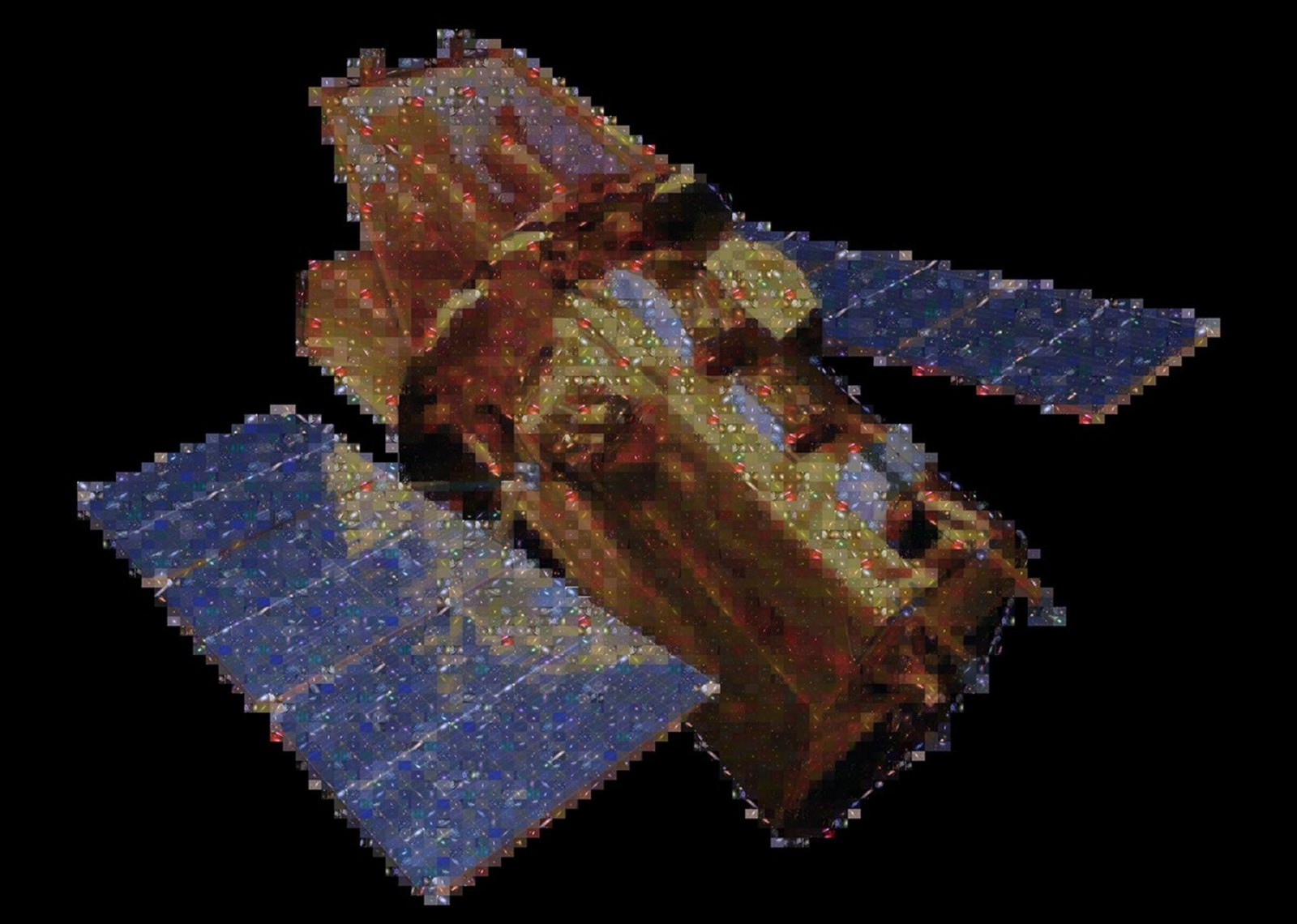
NASA's November 6 Astronomy Picture of the Day marks the farewell with a mosaic made in 2018 from the first million images taken by Swift's Ultraviolet/Optical Telescope. It is an appropriate visual summary of accumulated work, but it is not an image of the November re-entry.
The distinction captures the lasting part of the mission. The spacecraft can no longer turn towards a new event, yet existing observations can still be revisited, compared with other surveys and used to frame later questions. Losing the instrument ends new data collection; it does not erase the information already returned.
Swift's final orbit is now a dated event rather than a forecast. Its more durable legacy is less dramatic than a streak through the atmosphere: a record of changing skies that researchers can continue to interrogate after the machine that gathered it has gone.