The 2026 ozone hole was unusually large. That does not erase the recovery
NASA and NOAA rank the season seventh-largest by average area. Weather amplified the damage while reductions in ozone-depleting chemicals still limited it.
The Antarctic ozone hole was unusually large in 2026, yet NASA and NOAA say the long-term recovery remains on course. Their November 4 assessment ranks this season seventh-largest in 48 years by average area. An unusually strong polar vortex helped sustain the conditions for ozone destruction; a large single season does not, by itself, establish that the decades-long recovery has reversed.
The result is a useful example of two processes operating on different clocks. Weather can strongly influence the size and persistence of one season’s depleted region. International restrictions on ozone-destroying chemicals change the background conditions over much longer periods.
Area and depth answer different questions
The agencies report an average area of about 25 million square kilometers over September 7–October 13. The maximum daily extent was 27.1 million square kilometers on September 18. Those figures describe different summaries of the season: the largest single-day footprint is not the seasonal average used for the ranking.
Ozone quantity is another measurement. Instruments over the South Pole recorded a minimum of 105 Dobson units on October 17. That is a local overhead measurement, not a global ozone average and not another expression of the area in square kilometers.
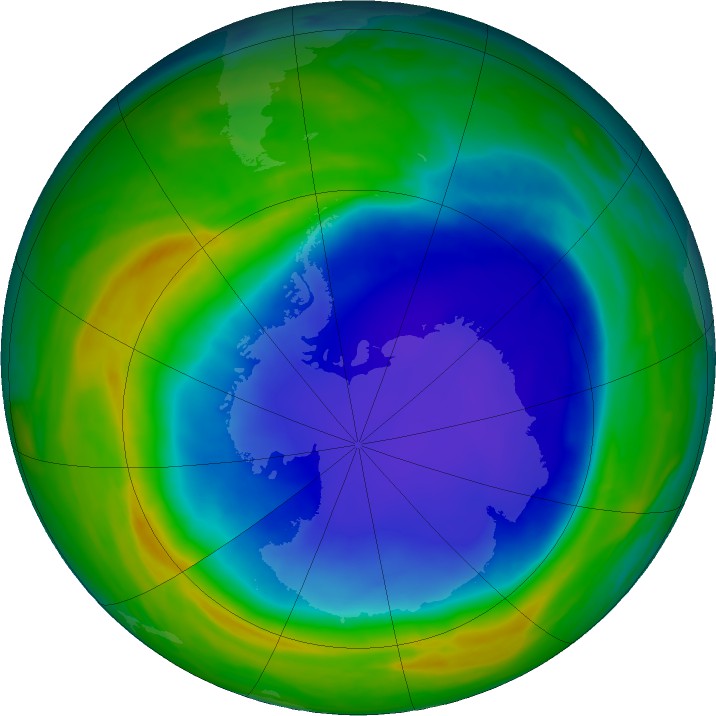
NASA’s Ozone Watch explanation defines the hole’s area using the region below 220 Dobson units. Its false-color maps show ozone amount, with blue and purple indicating less and yellow and red more. The map accompanying this article is dated November 2; it is a later snapshot, not an image of the September maximum.
The vortex helps maintain the chemical setting
The polar vortex corrals cold air over Antarctica. Under suitable stratospheric conditions, cloud particles help reactions involving chlorine and bromine destroy ozone. The agencies attribute this year’s enlarged region partly to weak planetary-scale disturbances in August and September, which allowed a strong vortex to persist over a wider area.
That does not make the chemical controls irrelevant. The annual assessment estimates the hole could have been roughly 3.5 million square kilometers larger if ozone-depleting substances remained at their peak abundance around 2000. This is a scientific counterfactual estimate, rather than a second observed hole alongside the real one.
The distinction explains how a disappointing annual result can coexist with evidence that a policy is working. The relevant comparison is not only with the previous year’s weather; it is also with the atmosphere that would have existed without the reductions in damaging compounds.
A recovery measured over decades
The chemicals responsible can persist for decades, including material released from older products and waste. The agencies’ recovery outlook extends into the 2070s. That is a long-range projection with a physical reason for the delay, not a guarantee that each intervening year will have a smaller hole than the last.
Stratospheric ozone also should not be confused with ozone near the ground, where it is a pollutant. The protective layer being monitored here absorbs harmful ultraviolet radiation high above the surface; “more ozone” is not a useful environmental judgment without specifying where it is.
The 2026 season is therefore a setback in the annual measurements, not sufficient evidence to discard the larger recovery story. The value of sustained monitoring is precisely that it can hold both facts together: this year was unusually severe, and reducing the chemicals still made it less severe than it otherwise could have been.