Mars’s long white cloud is not an eruption. Its ice may be the real surprise
A 2018 Mars Express image highlighted by NASA meets new research into an unusual way for atmospheric ice to form.
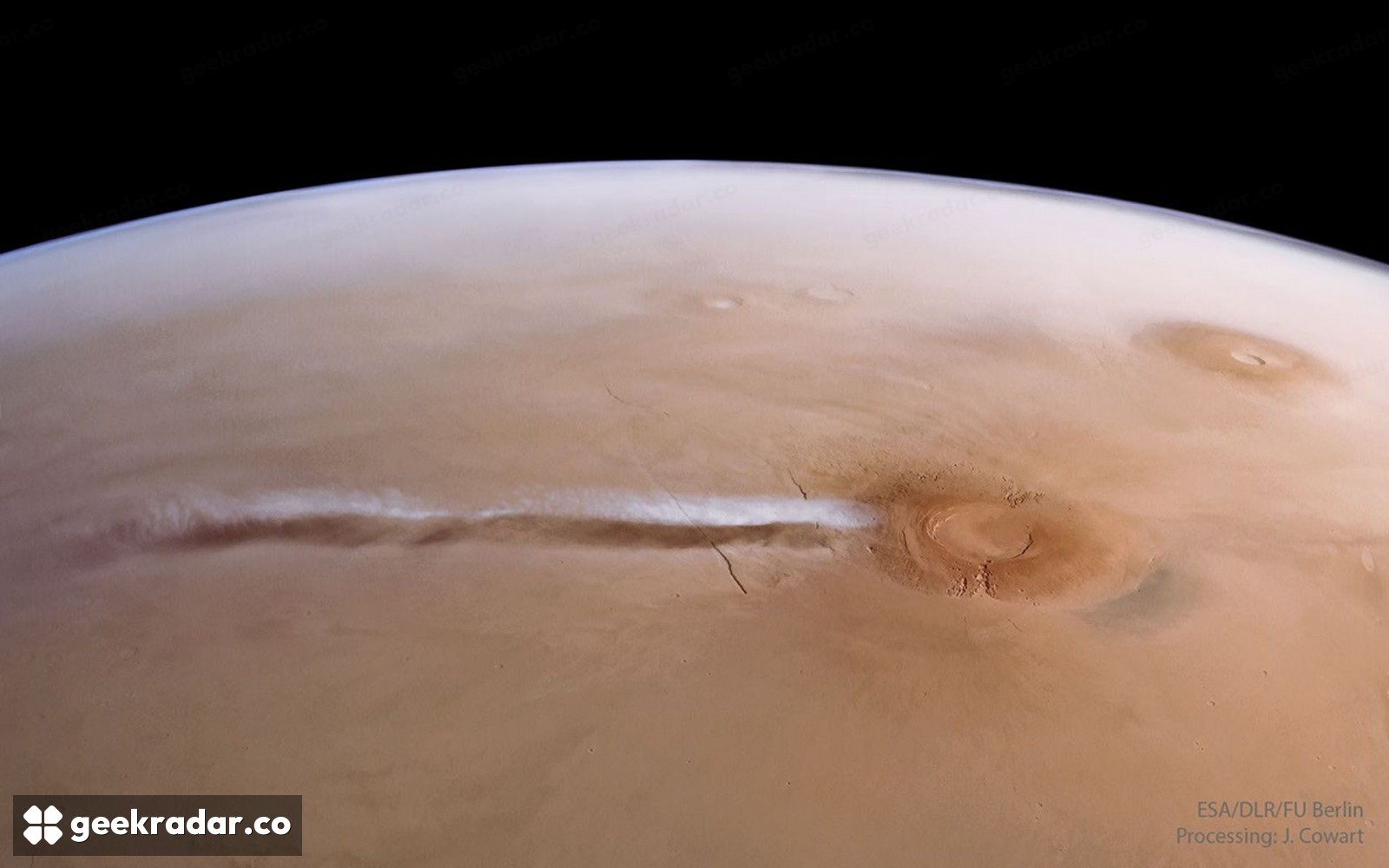
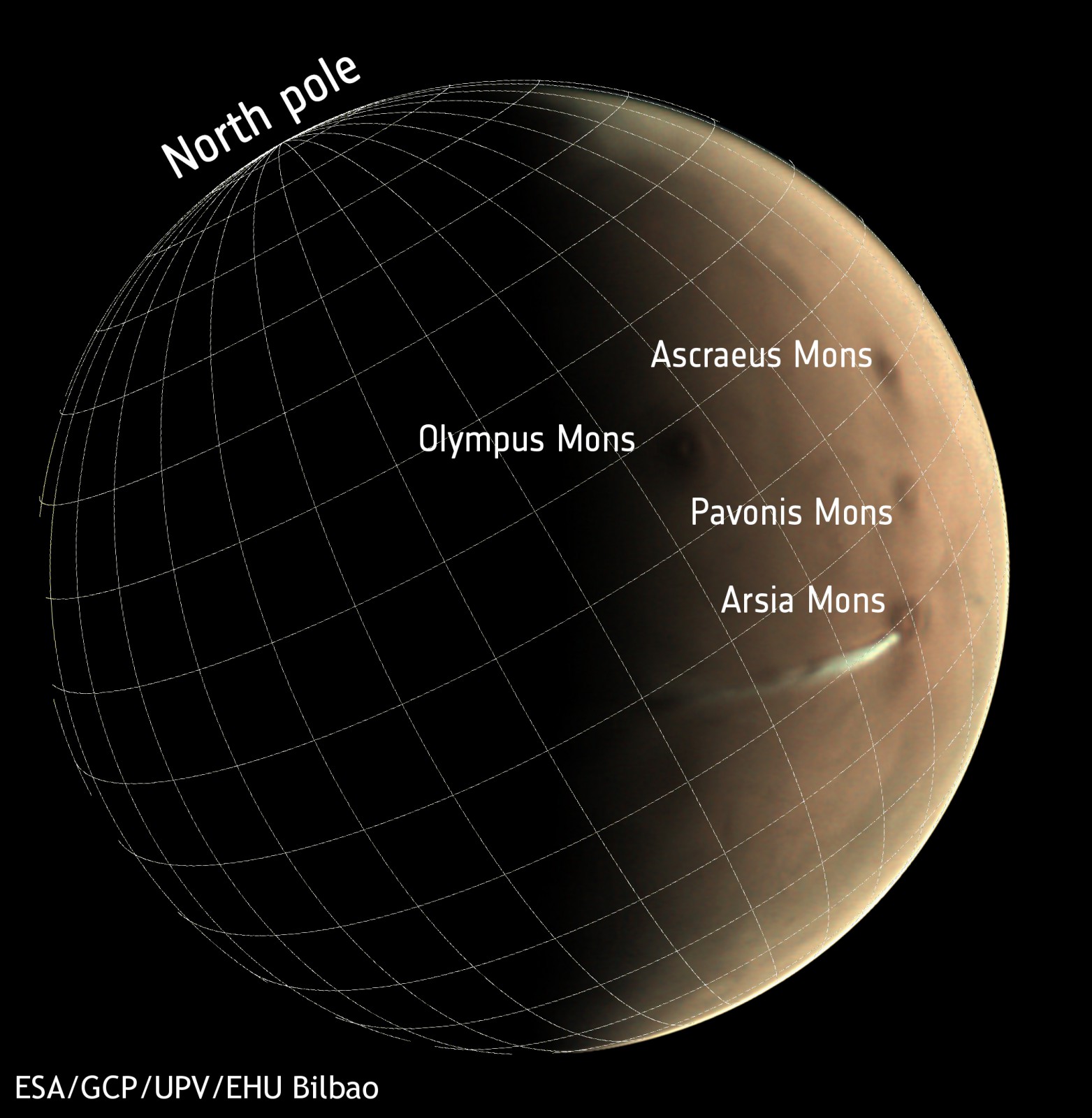
The long white plume beside Arsia Mons is a cloud of water ice, not evidence of an erupting Martian volcano. NASA's November 2 image feature returns attention to a striking Mars Express view from 2018, while research published in October offers a more interesting explanation than volcanic smoke: the cloud may form through an unusual route from water vapor to ice.
Keeping those dates separate is important. The image highlighted by NASA is an archival observation, not a photograph of a new event on November 2. The fresh scientific context comes from ESA's account of the cloud-formation study, published October 7.
A volcano can shape weather without erupting
Arsia Mons is roughly 20km high. Air moving around such a large obstacle can be forced upward, changing its temperature and allowing water ice to form. The resulting elongated cloud appears seasonally and extends downwind; the volcano matters as terrain rather than as a source of an ash plume.
That distinction changes how the image should be read. A white feature attached visually to a mountain can resemble smoke, especially when viewed from orbit. Its shape alone does not identify the material or mechanism. Repeated observations, atmospheric conditions and measurements across different views supply the context a single dramatic picture lacks.
ESA reports that the cloud can reach about 1,800km in length. The annotated 2018 observation shows a roughly 1,500km example and locates it among the neighboring volcanoes. Those values describe different observations and the phenomenon's extent, rather than an inconsistency that needs to be solved by choosing one universal length.
The proposed surprise is in how ice starts
Cloud particles commonly form with the help of existing particles that act as starting points. The new Nature Geoscience paper explores a different process: homogeneous ice nucleation, in which ice forms from water vapor without a pre-existing particle providing that initial support.
The researchers incorporated that process into a Mars meteorological model and found that it reproduced important characteristics of the elongated cloud that conventional cloud microphysics had struggled to explain. ESA describes a powerful atmospheric wave lifting moist air rapidly, with modeled cooling of about 30 degrees in ten minutes.
That is a proposed physical explanation supported by a model's agreement with observations. It is not a spacecraft directly filming individual molecules as they freeze, and the paper's title deliberately describes the mechanism as suggested by the cloud. Some modeled details still differ from the observations.
A better match is evidence, not the end of the question
The distinction matters because an image can show that a cloud exists without uniquely identifying the microscopic process that made it. A model adds a causal account: under particular conditions, this mechanism can produce a cloud with the observed behavior. Agreement strengthens that account, while remaining mismatches show where the explanation is incomplete.
The study is therefore interesting beyond the length of the plume. It asks whether conditions in a planetary atmosphere can make a usually neglected route to ice formation important. The authors discuss implications for understanding other planetary clouds, but that is not proof that the same process dominates ordinary clouds on Earth.
The 2018 Mars image has acquired a different kind of value. It remains visually dramatic, but the question is no longer simply why a cloud trails a volcano. It is how an atmosphere can begin making ice where the usual starting particles may not be doing the work. The mountain supplies the lift; the unresolved detail lies in the first moments of the cloud itself.