Victoria 3’s next update makes exhaustion a cost instead of an automatic surrender
The free 1.15 update separates war support, mid-war objectives and fallback trade routes from the paid State and Revolution content.
Victoria 3’s forthcoming 1.15 update changes what it means to exhaust an enemy. War Support will run from 0% to 100%, rise as well as fall, and impose mounting political and military consequences when it is low. Reaching the bottom will no longer automatically force a country to capitulate.
The preliminary changelog published October 29 sets the update and State and Revolution for November 5. The distinction between them matters: the broad War Support and war-goal changes sit in the free update, while the expansion adds its own Russia-focused systems and narrative content. The developer warns that the final release notes can still change.
Exhaustion becomes a pressure, not a switch
Under the described system, initial support depends partly on how willingly a country joined the war. Battles, occupation, progress toward objectives, devastation, economic decline and duration can then affect it. Low support radicalizes the population, weakens forces and increases the liberty desire of subjects taking part. If both sides become fully exhausted, the conflict can eventually end in stalemate.
That moves the consequence away from a single automatic surrender threshold. A country can remain in a war while paying a growing price at home and in the field. Continuing therefore becomes a decision with deteriorating conditions, rather than simply waiting for one meter to complete its journey.
The change also makes the reason for entering a war more relevant. An ally joining reluctantly need not begin with the same political commitment as a country pursuing a central objective. The announced mechanics create room for that difference; their balance in an actual campaign remains something the final version must demonstrate.
Objectives can change hands before peace
The second major adjustment allows some war goals to be enforced during a continuing conflict. Holding an objective builds enforcement progress until the goal takes effect. The losing side, or an ally in cases such as annexation, can receive a corresponding recovery goal without additional infamy. Territory and subjects can consequently change hands more than once before the wider war ends.
This separates two achievements that players may otherwise treat as identical: winning the immediate objective and ending the conflict on acceptable terms. Taking a province can create something new to defend. A successful advance does not automatically make the remaining war strategically pointless for the other side.
There are exceptions. Goals such as Regime Change and Cut Down to Size still require capitulation or a peace agreement. The system should not be summarized as every demand resolving automatically through occupation. The kind of goal remains part of the strategic calculation.
Trade routes get alternatives, with a cost
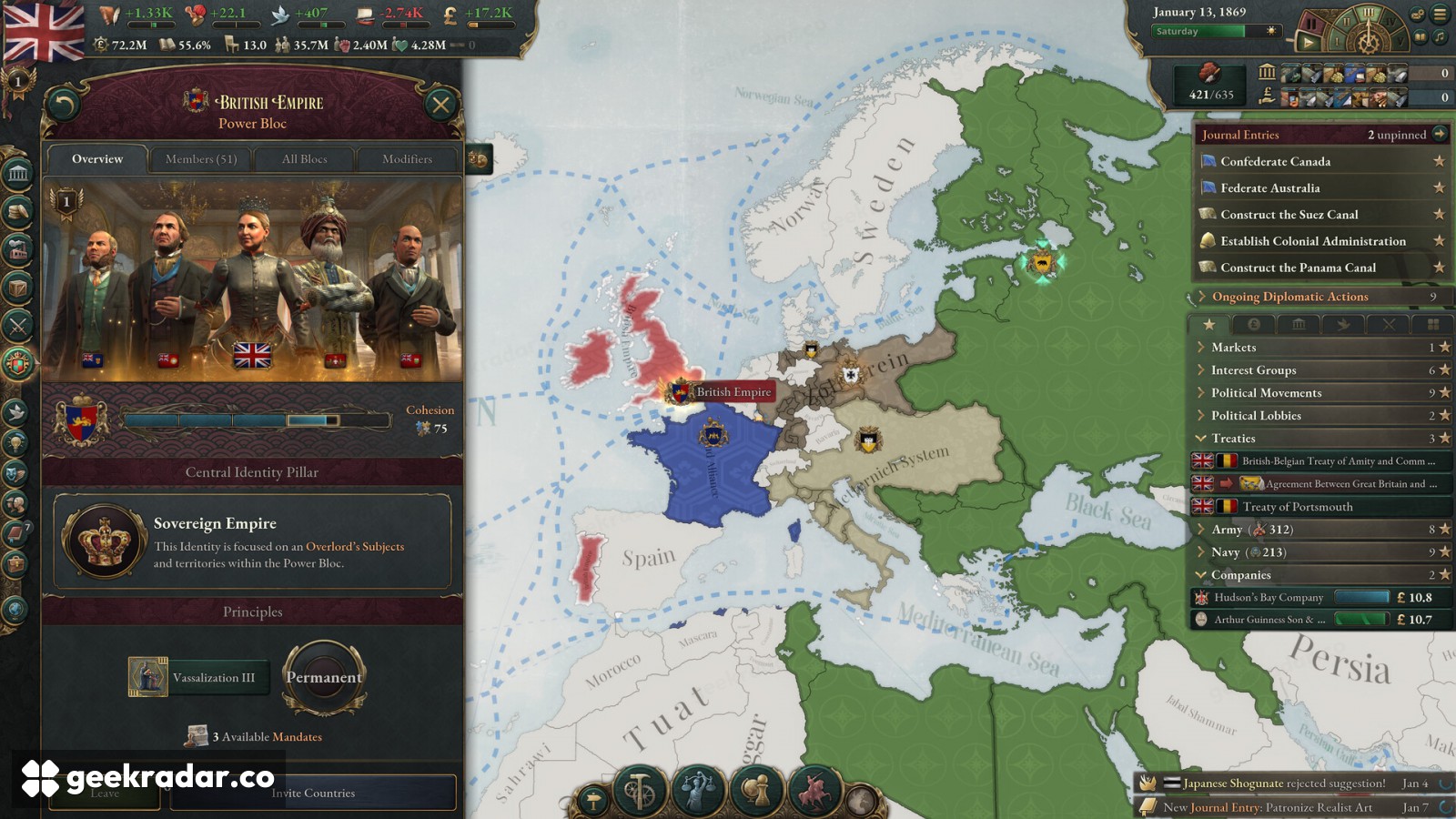
The same free-update feature list adds multiple world-market hubs per market area, up to four depending on geography and size. If one is blocked, trade centers can switch to another, taking a market-access penalty based on the distance to the fallback hub. A new cold system can also slow ships, reduce connected trade access and increase overseas supply-route demand.
These details connect the military changes to the economic simulation. A disrupted route need not become an all-or-nothing failure, but the replacement can be less efficient. An alternate port is useful precisely because it offers a costly way to continue, rather than making the original blockade irrelevant.
Taken together, the proposed changes give setbacks more intermediate states: a country can be exhausted without immediately surrendering, lose an objective without ending the war, or reroute trade without preserving full efficiency. The strongest promise of 1.15 is that surviving a setback may become a decision in its own right, with consequences that remain on the ledger after the immediate crisis passes.