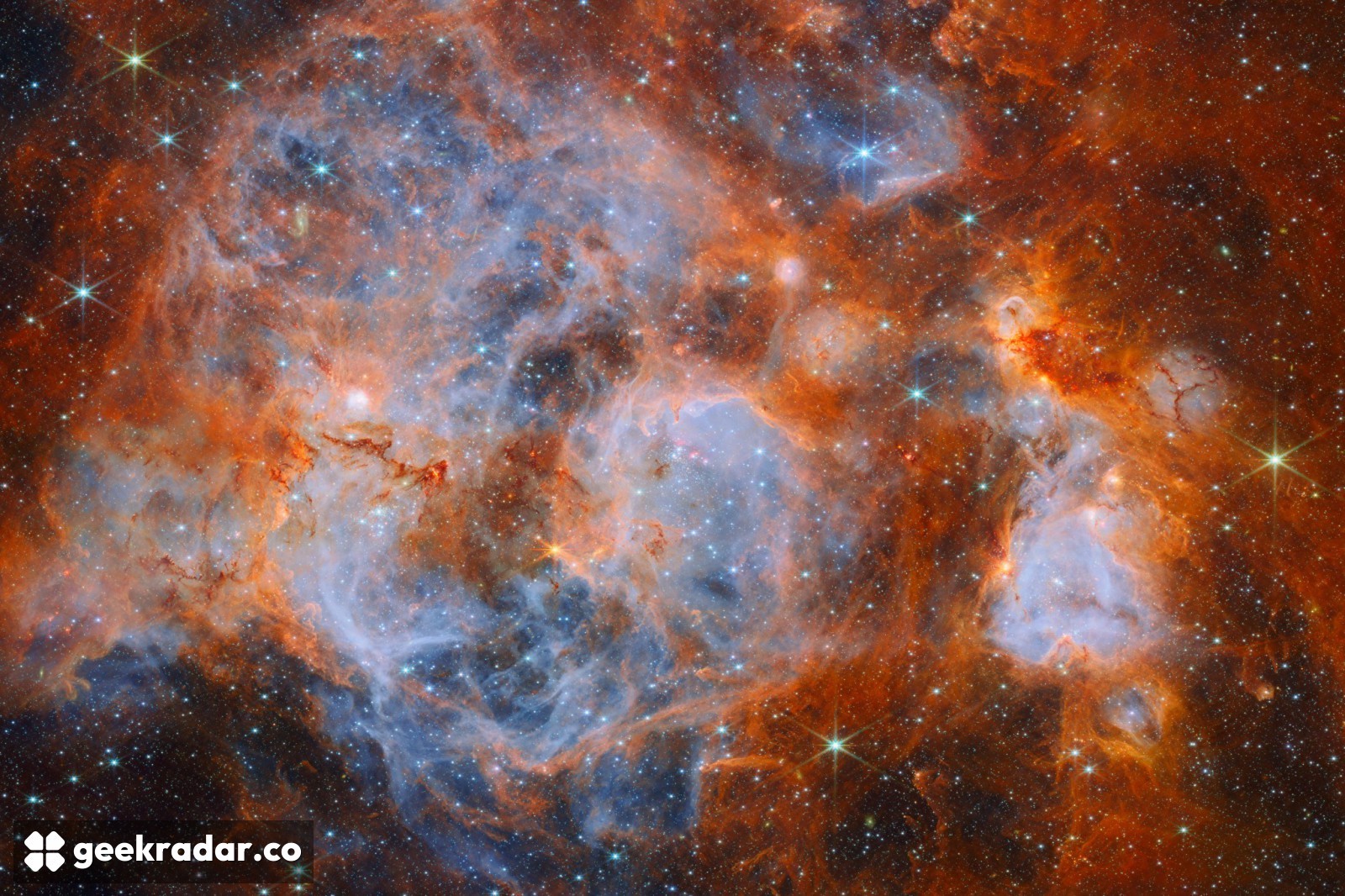
Webb’s N159 image shows a stellar nursery at several stages at once
Infrared colours separate ionized gas, molecules and dense filaments. The nearby galaxy offers a comparison with less chemically enriched conditions.
The bright blue cavities in Webb’s image of N159 are places where young stars have already started reshaping their nursery. The darker red filaments tell the complementary story: dense material still shelters stars being born. Reading those structures together makes this more than an attractive space photograph. It shows different stages of star formation occupying the same cloud.
The ESA/Webb image release appeared on October 22 and was highlighted by NASA this week. N159 lies about 161,000 light-years away in the Large Magellanic Cloud, a satellite galaxy of the Milky Way. The view spans roughly 230 light-years. Its importance is the detail available in a relatively nearby environment with a different chemical composition from our own galaxy.
The colours identify different material
Webb’s Near-Infrared Camera, NIRCam, recorded the observations. The displayed colours map infrared filters into a picture our eyes can read; they are not a promise that a person looking through a spacecraft window would see the same palette.
In the release’s interpretation, pale blue traces ionized hydrogen around hot stars. Ultraviolet radiation removes electrons from hydrogen atoms, and the gas emits light. Orange highlights emission from carbon-containing molecules called polycyclic aromatic hydrocarbons. Darker red filaments include cooler molecular hydrogen, the dense material in which stars can continue forming.
Zooming into the image reveals small points of light within pillars and filaments. Their surroundings are part of the evidence: material that protects a forming star can later be dispersed by radiation and stellar winds. The apparent emptiness of a blue cavity is therefore also the result of energetic activity, rather than proof that little is happening there.
A nearby comparison for a less enriched universe
Astronomers use “metallicity” to describe the abundance of elements heavier than hydrogen and helium. The Large Magellanic Cloud has a lower metallicity than the Milky Way. That makes its stellar nurseries useful comparisons for conditions that were more common earlier in cosmic history.
This does not mean the image is showing the early universe directly. The distance is about 161,000 light-years, not billions. The comparison concerns the conditions in which stars form, rather than the age of the light alone.
The observations come from Webb programme 5114. ESA’s account of the associated research says the team detected faint stars with less than one-tenth the Sun’s mass and separated young objects still wrapped in cloud from more evolved stars. The western part of N159 contains a more concentrated young population, consistent with an earlier stage of the cloud’s collapse.
That is the rewarding detail behind the picture, and the reason it belongs in the Science section: one frame can contain several different stages without being a time-lapse. The cloud’s colour and texture become clues to which parts of the stellar nursery have already been transformed, and which are still doing the work of making stars.