Vulcan’s next flight would give Amazon Leo its largest satellite batch yet
Amazon targets November 13, pending range approval. The mission combines revised booster nozzles with a low-orbit version of Centaur V.
Amazon is targeting November 13 for the first Vulcan launch carrying its Leo internet satellites. The mission would put 40 spacecraft on one rocket, the largest Leo payload announced so far, and begin a contracted series of 38 Vulcan flights. Its significance is therefore as much about repeatable launch capacity as the size of this particular load.
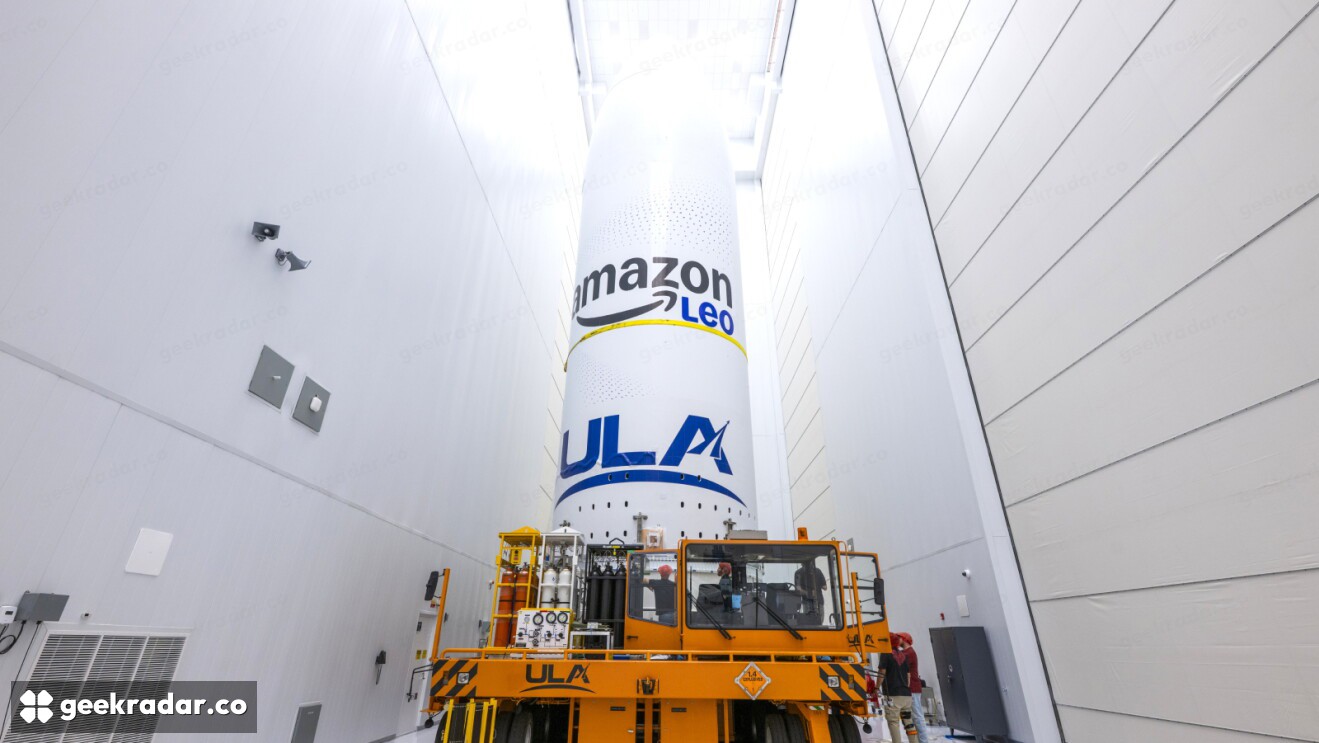
Amazon’s mission update makes the date conditional on range approval. It has not supplied an exact launch time. LV-01 is planned from Space Launch Complex 41 at Cape Canaveral Space Force Station, using the VC6L configuration and its long, 70-foot payload fairing.
The hardware changes are part of the story
The flight is also a return-to-flight milestone for Vulcan. Amazon says its solid rocket boosters will use an improved nozzle design, while further testing and analysis continue alongside mission preparations. That wording matters: a planned launch does not establish that every question about the earlier booster problems has been closed.
The payload will sit above a Centaur V upper stage optimized for low Earth orbit. Amazon describes it as a shorter variant suited to the constellation’s deployment needs. This is not simply the same rocket carrying a different logo. The mission combines a particular booster configuration, fairing and upper-stage arrangement around a relatively large batch of satellites.
Preparations are taking place in Amazon’s dedicated vertical integration facility, VIF-A. The company says a second Vulcan mission is already being readied in parallel at VIF-G. Parallel preparation can reduce the gap between campaigns, but it is not itself a demonstrated launch cadence. That will only become visible once successive missions actually fly.
Satellites launched are not subscribers connected
Leo, formerly Project Kuiper, has launched nearly 400 satellites across 14 full-scale deployment missions, according to Amazon. The update also targets another Ariane 6 mission no earlier than November 23, carrying 36 spacecraft. Multiple launch providers give the programme more than one route to orbit, although each vehicle still has its own schedule and constraints.
A deployment number should not be read as a service-availability map. Satellites must be checked and brought into their operating configuration, and a consumer network also needs ground infrastructure, terminals and permission to serve its intended markets. The LV-01 announcement does not open subscriptions in every country below its flight path.
That distinction is central to the space coverage: getting hardware into orbit is a necessary step, not the finished service. Forty satellites would be a substantial addition. The more revealing result would be Vulcan repeating the mission reliably enough that a launch contract starts behaving like dependable network construction.