Pinal turns protein descriptions into candidates; the laboratory still decides what works
The researchers combine a large language model with experimental checks. A generated sequence and a useful biological function remain different claims.
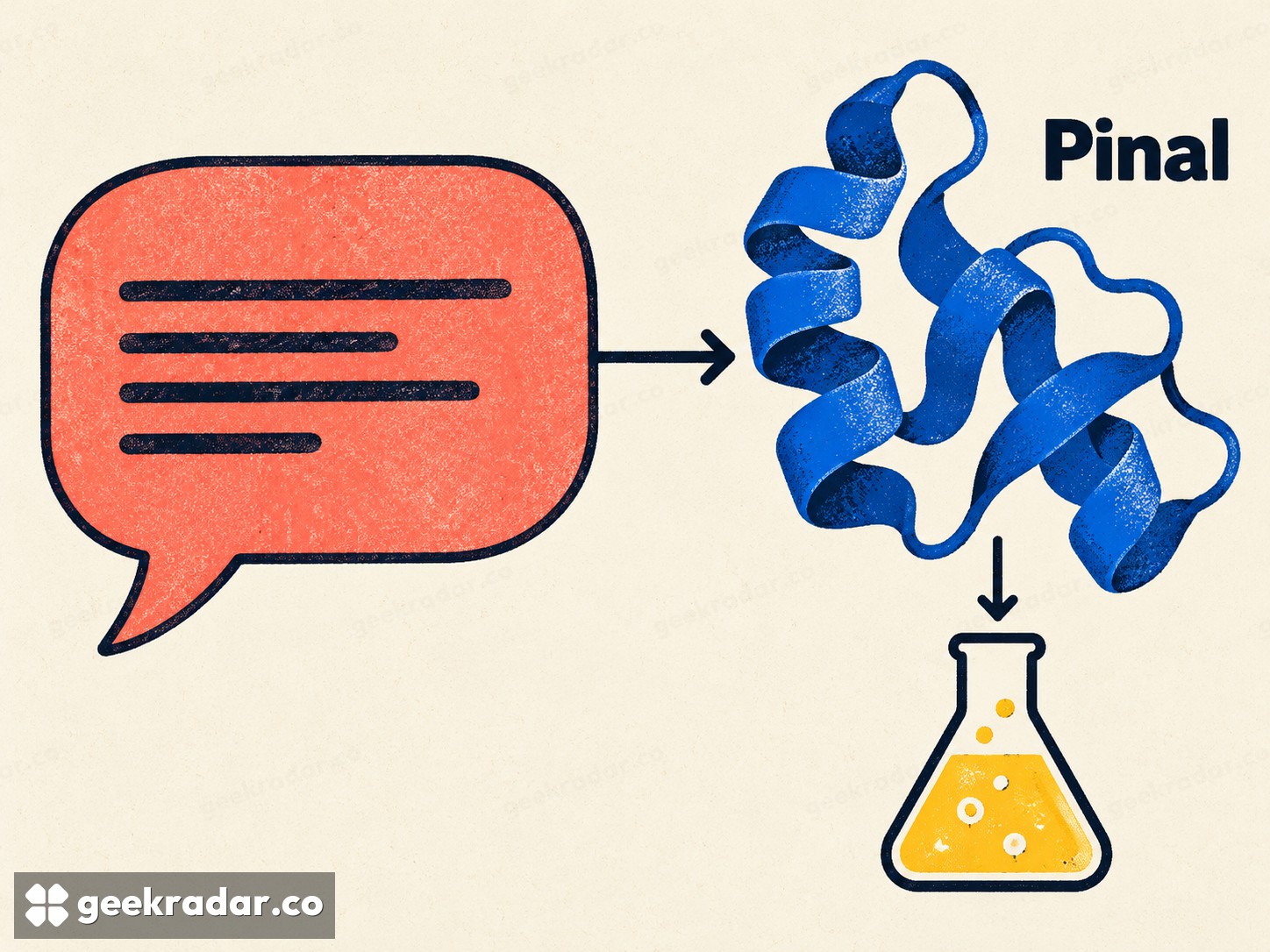
Pinal brings a familiar interface to an unfamiliar design problem: describe a protein's intended function in ordinary language, and a model proposes candidates. The important word is candidates. A fluent instruction and a plausible molecular design are not the same as a protein that performs the requested job in a laboratory.
The Nature paper introducing Pinal reports a 16-billion-parameter model trained on 1.7 billion synthetically annotated protein–text pairs. Its aim is to connect functional intent with sequence and structure, reducing the need to translate every design goal manually into detailed geometric constraints.
The interface moves the expertise; it does not remove it
Traditional computational design can require a researcher to specify molecular features that a candidate must preserve. A language-driven system attempts to interpret the higher-level goal before proposing a structure and sequence. That could make the first stage of exploration easier for researchers who understand the biological question but do not routinely operate every specialist design tool.
The difficulty has not disappeared. Words can leave requirements underspecified, training examples can be uneven, and a predicted structure is still a prediction. The researcher must decide whether the candidate addresses the intended question and what evidence would demonstrate that it does.
Pinal uses a two-stage design approach, connecting text to structural information and then generating sequences with that information. This separates the requested purpose from the material proposal, while allowing them to inform each other. The interface may resemble a conversation; the output still has to survive chemistry.
Four demonstrations are evidence, not a universal success rate
The authors report experimental observations of the intended function across four classes: a fluorescent protein, two enzymes and a metabolic H-protein. Those results are stronger evidence than a model merely assigning favourable scores to its own output.
But they do not establish that any prompt will produce a working protein, nor that every generated candidate works. Candidate selection and experimental validation remain central. As Ars Technica's account of the study explains, the path from a large generated set to a small tested group is an important part of interpreting the result.
One reported H-protein improved product titre by 1.7 times relative to the corresponding native protein in the researchers' particular multi-enzyme pathway. That is a bounded result in a defined system, not a claim that the model makes all biological production 70% more efficient.
The useful gain is a better starting point
Pinal's broader significance is the possibility of expressing a research goal without first encoding every structural detail by hand. That can widen exploration and reduce friction between a scientific question and the software used to pursue it.
The value will ultimately be measured in useful, validated designs relative to the time and resources spent finding them. A more approachable prompt is welcome, but the decisive conversation still happens between the proposed molecule and the experiment that tests it.