Perseverance finds the Mars dust that keeps clinging to spacesuit materials
Years of observations reveal persistent fine particles on calibration samples. The findings inform contamination control, not a measured astronaut exposure limit.
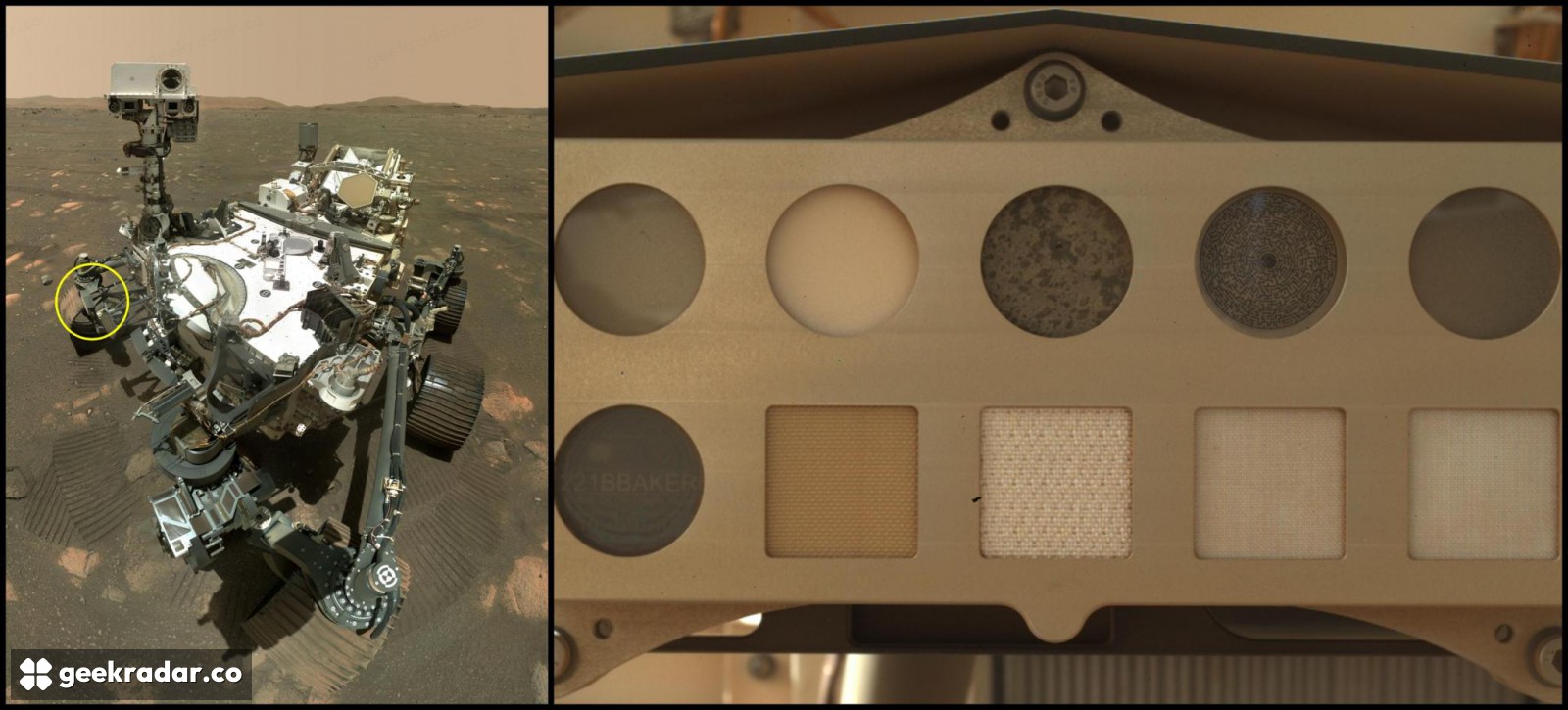
Small patches of spacesuit material carried by Perseverance have become a long-running experiment in what Mars dust refuses to let go of. NASA reports that very fine particles remained attached through years of driving and drilling, providing evidence relevant to the design of future suits and habitats.
The new account of measurements spanning 1,645 Martian days describes particles much smaller than the grains resolved by earlier observations. Some measurements extend down to around 100–300 nanometres. The engineering question is not simply how much dust lands on a suit, but which fraction stays after movement removes the larger clumps.
A calibration target becomes an environmental experiment
Perseverance carries reference targets that help its instruments check their measurements. SHERLOC's target includes small samples of spacesuit materials. PIXL, an X-ray instrument used to study elemental composition, has its own target containing Teflon and basaltic glass.
The Teflon provides a useful contrast because it contains no elements that PIXL can directly detect. Signals measured from that surface can therefore reveal dust deposited on it. Hardware intended to support reliable instrument operation also becomes a way to examine the environment over time.
NASA reports average particle sizes of about two micrometres on some surfaces, with smaller particles identified on others. A micrometre is one-thousandth of a millimetre; a nanometre is a further thousand times smaller. These are different scales of material, not merely different names for the same visible coating.
The surface changes what remains
The researchers identify static electricity as an apparent influence on which particles adhere to which materials. Grains acquire charge as they collide, and surfaces interact with that charge differently. The particles left behind on a polymer are therefore not necessarily a representative sample of everything moving through the surrounding air.
The distinction prevents an important overreach. Particle size and persistence can inform protective design, but exposure also depends on how dust reaches the living area, how much enters and how effectively it is removed. The rover findings do not establish a safe exposure threshold or a clinical outcome for a future crew.

Cleaning begins with keeping dust outside
NASA discusses material selection, protective coatings, airlock design and suitports, which allow a suit to remain attached outside a habitat while a person enters it from within. These approaches address different stages of the contamination route. A surface that retains less dust and a layout that transfers less of it indoors can complement each other.
The Neretva Vallis panorama supplies the larger setting: an ancient channel in a landscape now shaped by dust and wind. The tiny calibration samples show what that environment does at the scale of a material surface.
For future explorers, the difficult residue may be the part that no longer looks dirty. Perseverance's contribution is to make that persistent fraction measurable before people have to live with it inside the same small rooms where they eat, sleep and work.