Iceberg A-81 slows near South Georgia, where the unseen seabed matters
A new satellite account follows the berg’s route from the Brunt Ice Shelf. Slower movement is not yet proof of permanent grounding.
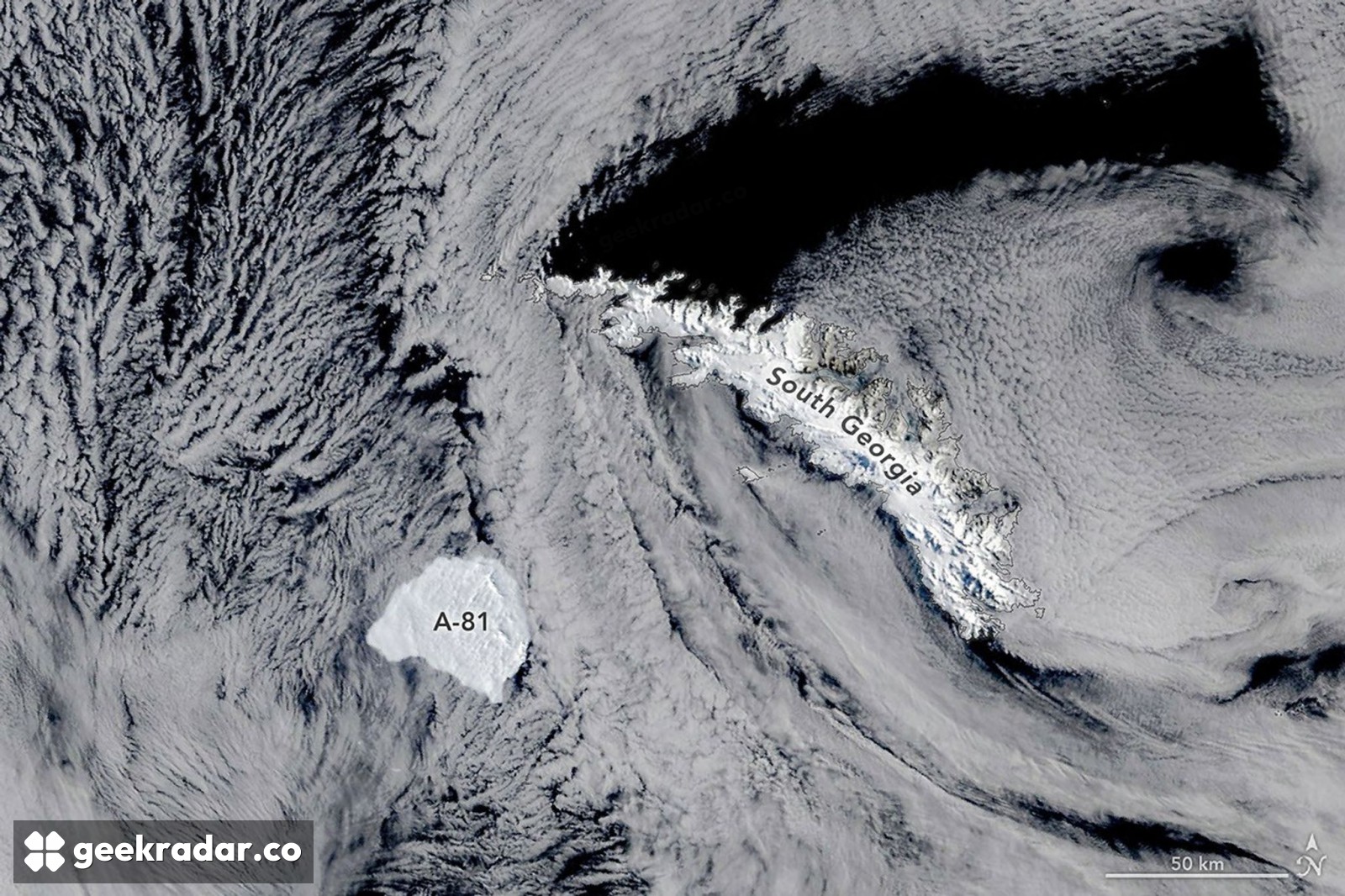
Iceberg A-81 has reached the waters near South Georgia after a journey from Antarctica's Brunt Ice Shelf, and its movement has slowed near the island's underwater shelf. A satellite image acquired on October 20 and published by NASA on October 27 captures this stage of the drift. It does not, by itself, establish that the iceberg has permanently grounded.
That qualification matters because the obstacle is mostly invisible in an ordinary overhead image. An iceberg's exposed surface can appear to have open water ahead while its submerged body encounters shallower seabed. The shape of the ocean floor can become as important as the currents carrying it.
A fast journey that still took years
A-81 broke away in January 2023. Its area at calving was approximately 1,550 square kilometres; that historical figure should not be treated as a fresh measurement of its current size. It then spent more than three years in the Weddell Sea, moving with the clockwise circulation of the Weddell Gyre.
By May 2026 it had reached the tip of the Antarctic Peninsula. It subsequently entered the Scotia Sea and travelled towards South Georgia, roughly 2,300 kilometres north-northwest of the part of the Brunt Ice Shelf where it originated.
Calling that a quick exit is a comparison with other Antarctic icebergs, some of which remain close to their source for decades. It is not a description of rapid motion on a human timescale. Tracking needs a sequence of observations, rather than one dramatic image and an assumed speed.
The shelf can change the route
NASA's account cites researchers who observed A-81 slowing and apparently bumping along the edge of South Georgia's shelf. The island has interrupted other icebergs before: A-23A grounded there in 2025 and later broke apart.
That earlier example explains why the location is significant, but does not determine A-81's future. Different size, submerged shape, currents and contact with the seabed can produce a different outcome. A slowdown is evidence about current movement, not a guaranteed breakup schedule.
A single iceberg is not a complete climate diagnosis
Calving is a normal part of an ice shelf's life. Brunt is closely watched because it has shed several large bergs in recent years and hosts the British Antarctic Survey's Halley station. The sequence gives researchers reasons to monitor the shelf, but an individual calving event does not by itself establish its climatic cause.
The US National Ice Center's tracking records provide a continuing reference for named Antarctic icebergs. Such records are valuable precisely because the story keeps changing as a berg moves, shrinks or fragments.
A-81's visible white outline is only the top of the object. The next stage of its journey may be decided by the much less photogenic meeting between ice below the waterline and the shallow ground around an island.