Orion’s beautiful gas clouds are also a hostile neighborhood for young planets
Hubble’s archival mosaic shows a stellar nursery shaped by ultraviolet light. Brightness, color and structure each tell a different part of the story.
Orion's great nebula is familiar enough to become a background image, but the bright cloud is an active environment in which young stars reshape the material around them. NASA's October 26 Astronomy Picture of the Day returns attention to M42 with a deep view by Roberto Palaia. The occasion is a featured image, not an announcement that the nebula or its star formation has just been discovered.
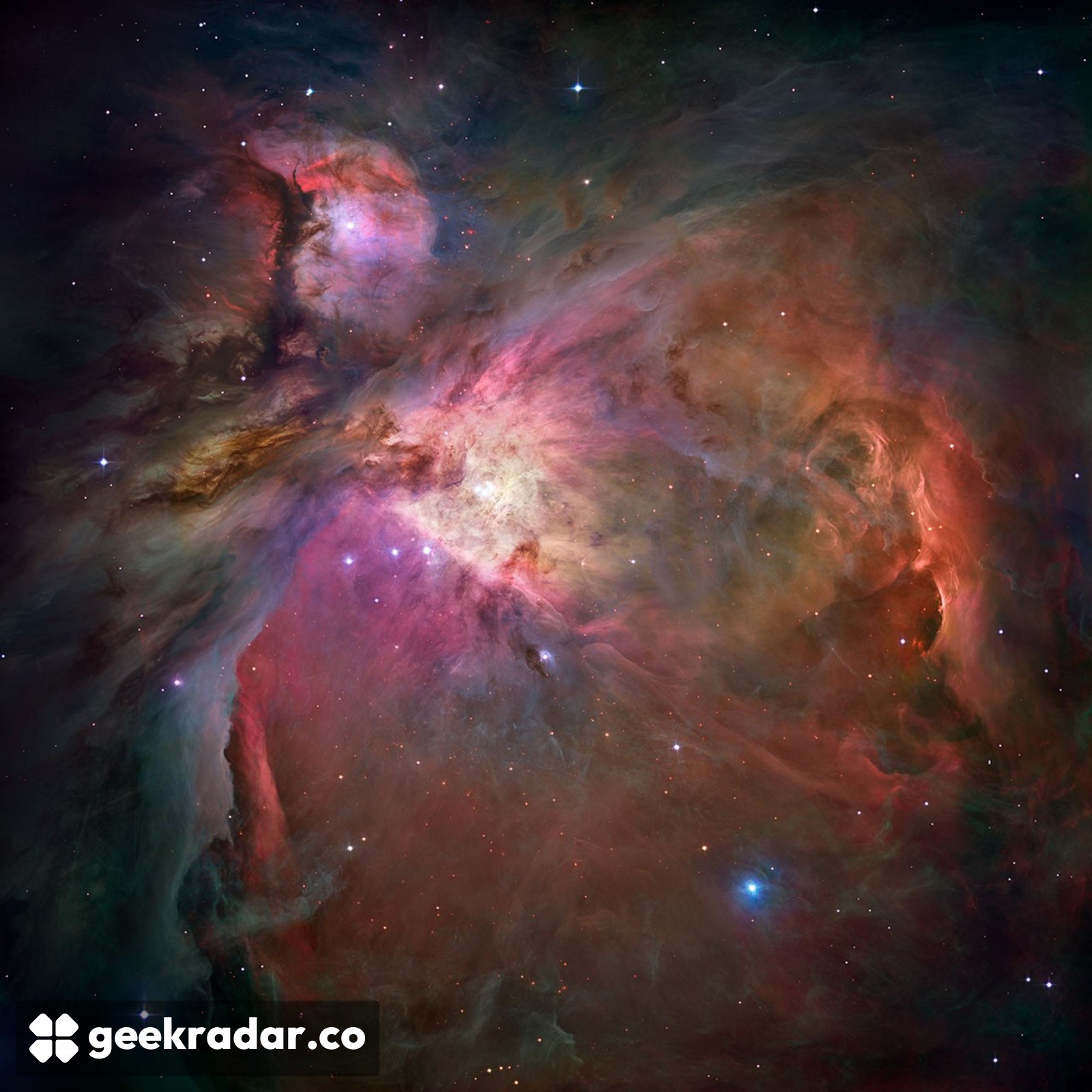
The archival Hubble view accompanying this article provides a separate, documented perspective. NASA's description of that mosaic identifies observations taken in 2004–2005, combined with ground-based data. Keeping the images and dates distinct matters: a new appearance on a science page does not make every photograph a new observation.
The brightest stars are changing the nursery
At the nebula's bright centre is the Trapezium, a group named for the arrangement of its prominent stars. Their energetic radiation illuminates and reshapes surrounding gas. The resulting cavity, bright boundaries and dark structures are clues to physical processes, rather than arbitrary decoration.
Star formation is therefore not simply a peaceful cloud steadily filling with points of light. Newly formed stars influence their environment. Radiation and stellar winds can erode or compress surrounding material, and the appearance depends on which structures are exposed along our line of sight.
The Hubble documentation also describes protoplanetary disks around young stars. These disks contain material associated with developing planetary systems, but their presence does not establish a completed planetary system around every object. A nursery contains different stages, not a row of identical finished products.
Color is a way to organize measurements
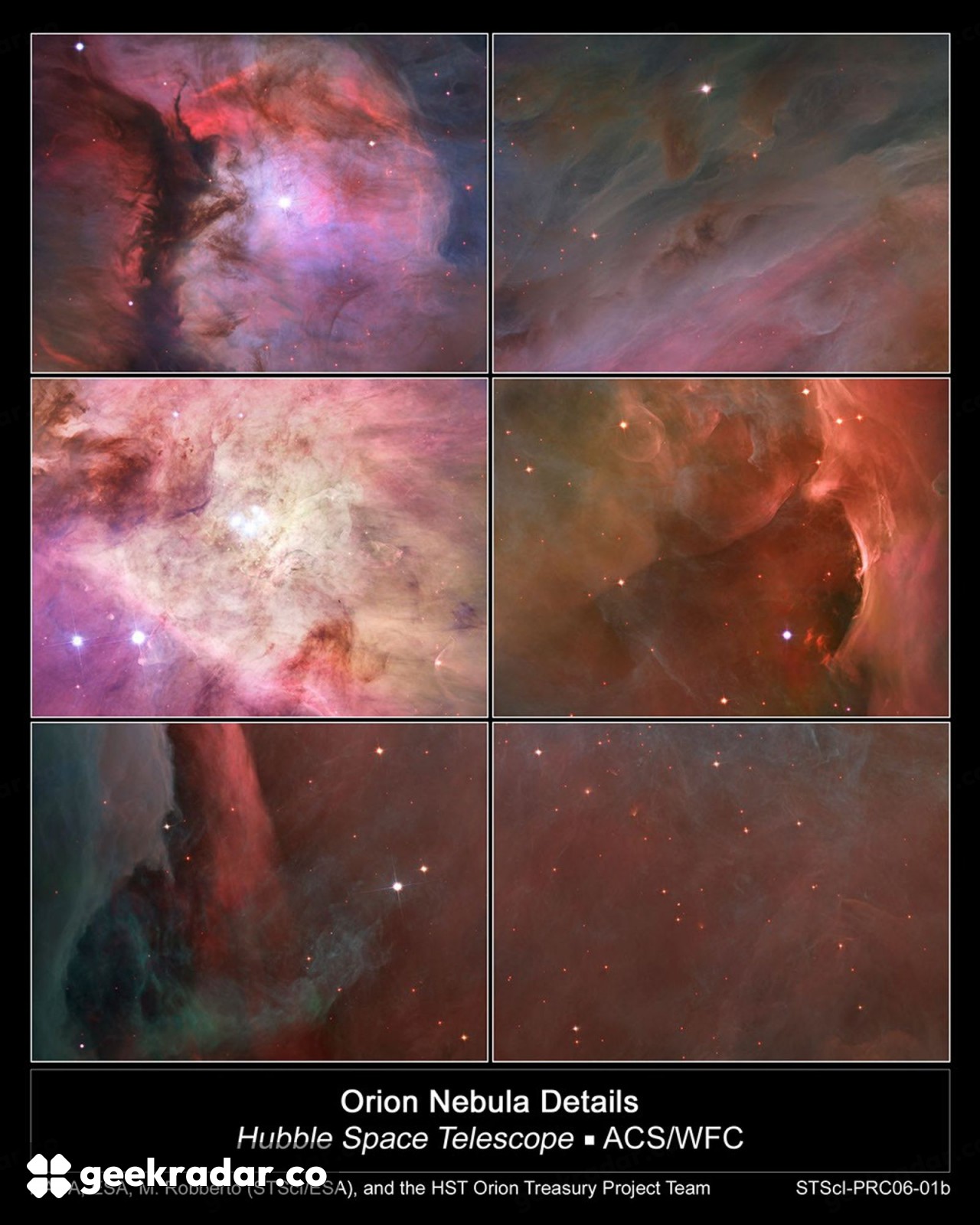
Astronomical images can combine exposures through several filters and assign display colors to the resulting measurements. In the Hubble mosaic, the published documentation explains the filter combinations used. The colors help separate structures and emissions that would otherwise be difficult to compare in one view.
This also explains why two legitimate pictures of Orion can look different. Exposure depth, wavelength coverage, field of view and processing choices change which features become prominent. The right comparison begins with what each image records, rather than asking which version has the “correct” wallpaper color.
As in Hubble’s view of NGC 1827, a visually dominant feature is not necessarily the whole scientific subject of the image.
A nearby example of a larger process
The APOD account places the nebula about 1,500 light-years away and describes a region spanning roughly 40 light-years. Those rounded figures describe the wider object; a particular telescope mosaic may cover a smaller field. Mixing an object's overall size with an image's field of view can make otherwise accurate captions appear contradictory.
Orion is valuable because many parts of star formation can be examined in one comparatively nearby region. The image rewards a second look when the bright centre stops being merely the prettiest part. Those stars are not just lighting the scene: they are helping to change what the next generation of stars and planets will have left to work with.