Hubble's NGC 1827 image puts a foreground star in the spotlight
The edge-on galaxy shares the frame with foreground stars, background galaxies and traces of the telescope's optics. Understanding those layers changes what the image shows.
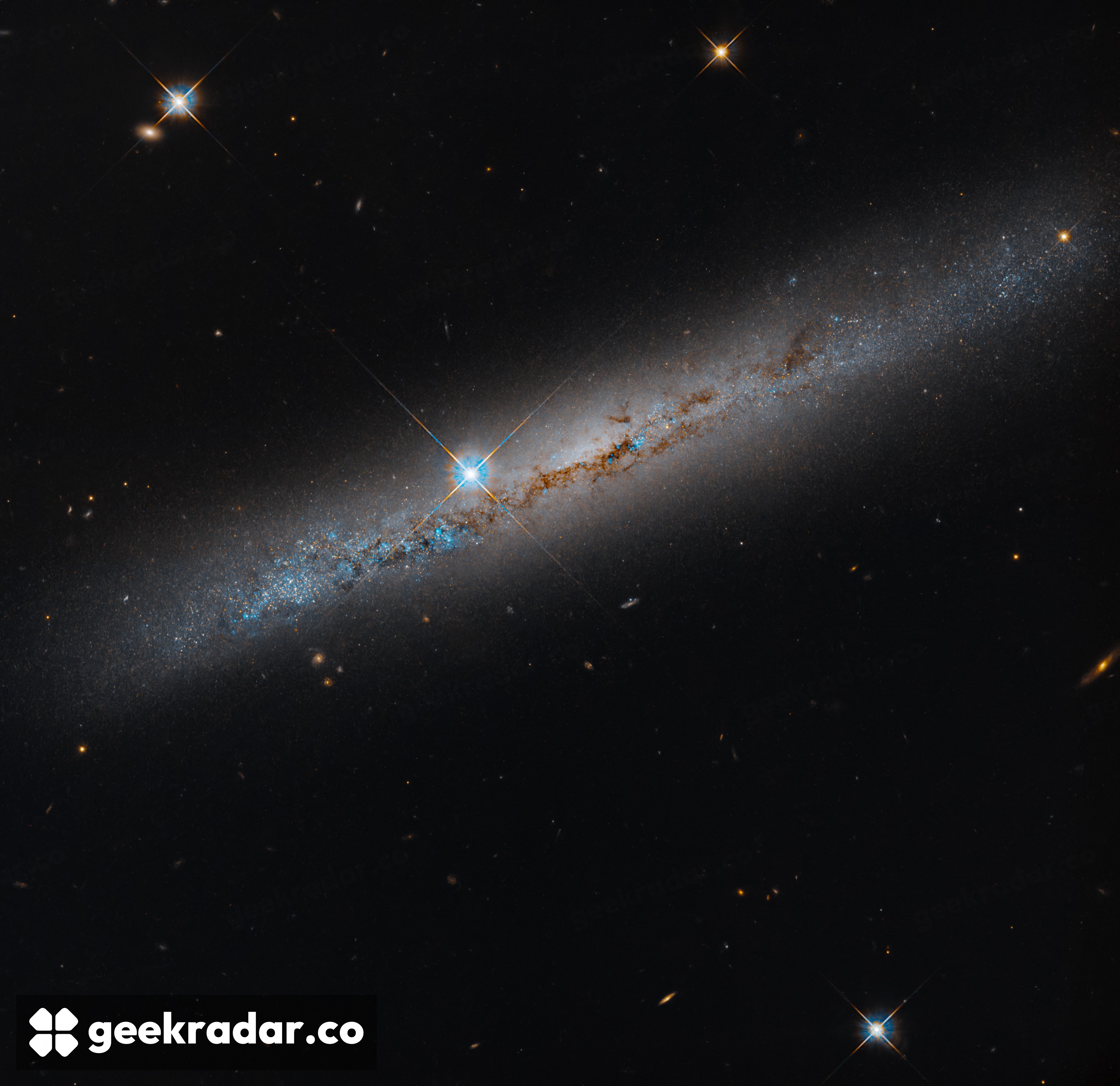
The bright point beside NGC 1827's center is an excellent reason to look twice at Hubble's latest galaxy image. It appears close to the central bulge on the screen, but it is a foreground star, positioned between Earth and the much more distant galaxy. The picture combines objects at different depths into one view, and reading it correctly means separating apparent proximity from physical association.
NASA released the NGC 1827 image on October 16. The galaxy lies roughly 37 million light-years away in Columba and is seen edge-on. Instead of the familiar face-on spiral, its dusty disk cuts diagonally across the frame. The angle makes the dust lanes conspicuous while compressing much of the spiral structure along our line of sight.
Image credit: NASA, ESA, Michael Jones (California Institute of Technology); Image Processing: Gladys Kober (NASA/Catholic University of America).
Three different kinds of detail share the frame
The galaxy's warm central glow, dark lanes and blue regions are not interchangeable decoration. NASA identifies the blue areas along the disk as regions where new stars are likely forming. The dark bands mark dust obscuring light behind it. Their contrast helps reveal structure that would be difficult to appreciate from a simple outline of the galaxy.
The foreground star contributes a different kind of information. As NASA's Hubble glossary explains, diffraction spikes arise from light interacting with the supports holding the secondary mirror. They are an imprint of the telescope's optics, not four beams emitted by the star.
Hubble records digital measurements: each pixel corresponds to a measured brightness, which software turns into a visible image. That invites a useful distinction between the underlying observation and its presentation. Changing a crop or display size can alter what a reader notices without changing the measured object. Identifying instrument effects is another part of interpreting those measurements.
The camera's history is part of the result
Hubble used its Advanced Camera for Surveys for the observation. The instrument's name describes an important part of its job: gathering detailed views across fields containing many objects, rather than treating every exposure as an isolated portrait.
NASA's ACS instrument overview records its installation in 2002 and the 2007 electronics failure that disabled its two most-used science channels. Astronauts subsequently repaired the Wide Field Channel during the 2009 servicing mission, although the High Resolution Channel could not be restored.
That history is a concrete example of the scientific value of repair. The telescope's continued usefulness cannot be reduced to how long ago it launched. A repaired instrument can keep contributing observations, while an unrepaired channel remains a limitation. Treating the observatory as a single aging object hides those differences within it.
A striking galaxy belongs to a larger observing program
NASA connects the observation to a survey of satellite galaxies around Milky Way-like hosts. Low-mass galaxies provide tests for cosmological models on scales where predictions and observations are difficult to reconcile. The release describes data collection supporting that work; it does not announce that this single image has resolved the discrepancy.
A survey's value comes from comparison. An unusually attractive object may capture public attention, but a scientific population cannot be represented only by its most photogenic member. Repeated observations make it possible to examine similarities, variation and exceptions using a consistent instrument.
That relationship between an image and the evidence behind it also runs through Webb's first science images. The public picture is an entry point into what the instrument measures. It is not a substitute for the wider observations and analysis needed to support a scientific conclusion.
NGC 1827 rewards that slower kind of looking. The dust belongs to the galaxy, the bright star sits in front of it, and the star's spikes reveal something about the telescope. Recognizing those three layers turns a handsome spiral portrait into a lesson in how astronomical evidence is made legible.