NASA’s 500-second RS-25 test measures an engine through the whole burn
Development engine 10001 ran at Stennis for a flight-length firing. Duration and operating margin explain more than the plume alone.
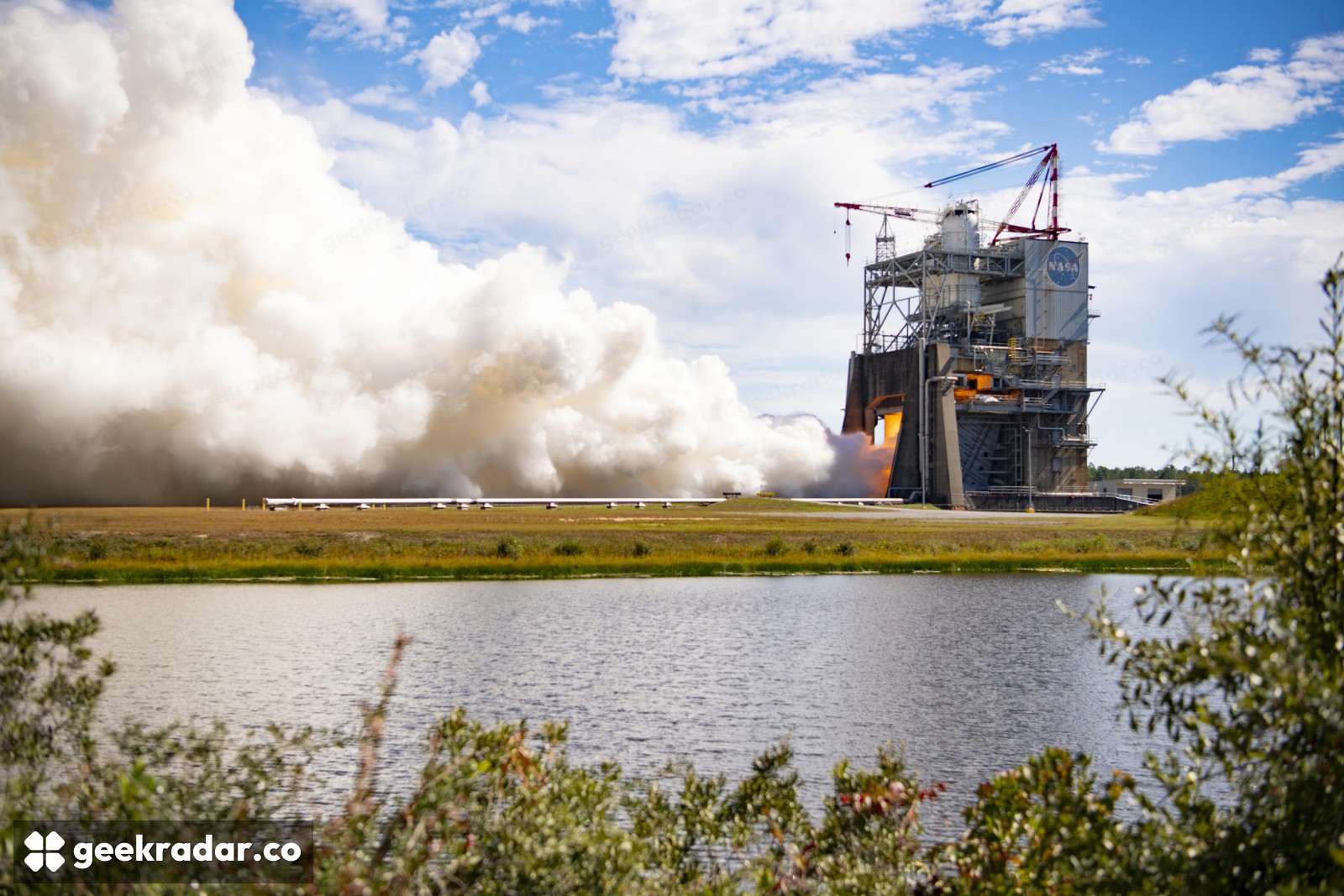
NASA’s latest RS-25 photograph shows a rocket engine spending almost an entire launch’s worth of time going nowhere. On October 21, engine No. 10001 fired for 500 seconds at Stennis Space Center. The agency’s October 23 account identifies it as a developmental engine that will not fly. Its job is to produce information for the engines that will.
That distinction is the reason a stationary test can matter to a flight program. Engineers can run an engine under controlled conditions, observe its behavior and examine the hardware afterward. A launch has to deliver its payload; a development test can concentrate on learning what a component does under demanding conditions.
Photo: NASA / Danny Nowlin.
Why the duration matters
Five hundred seconds is roughly eight minutes and twenty seconds. NASA says this matches the operating duration of the RS-25 engines during an SLS launch. A brief ignition establishes that an engine can start. A much longer firing exercises it across a sustained period of heat, pressure and flow.
The photograph is impressive, but the useful output is not the size of the cloud. NASA and contractor L3Harris use the test to gather performance and reliability data. The announcement does not publish a new launch date, a complete test report or a quantified improvement in engine efficiency. Those should not be inferred from the image.
The 111% figure also needs a reference point. A rated power level is an engineering baseline, not a mathematical claim to extract more than all the available energy. NASA’s earlier explanation of RS-25 testing already described 109% operation for initial SLS engines and 111% for later modified engines. The new test should not be presented as the first occasion on which the program crossed 100%.
Development hardware earns its place on the ground
There is a temptation to rank every space-program milestone by how directly it resembles a launch. That misses the value of hardware built to answer questions rather than reach orbit. A development engine can support repeated investigation without being counted as an available flight unit.
It also keeps different claims separate. Completing a firing is one event. Demonstrating a specific design margin is another. Certifying an engine for a particular mission and declaring the whole vehicle ready are broader decisions. The October announcement supports the first and explains the data-gathering purpose; it does not collapse the rest into a single success label.
Our look at NASA’s Artemis planning briefing concerns the sequence of missions. This test concerns the propulsion work beneath that sequence. Both belong in an account of the program, but a change in one should not automatically be reported as a change in the other.
Sustained ground testing helps expose the difference between an engine that ignites and an engine that can keep operating through the intended duty cycle. No. 10001 will not take a crew anywhere. Its useful contribution is helping the engines that do spend those eight minutes with fewer unanswered questions.