NASA’s revised lunar routes give Starship and Blue Moon different transport jobs
The 2028 target now rests on two distinct chains of refuelling, transfer stages and rendezvous. Neither provider has the first landing assigned.
NASA's revised Moon-landing plans give SpaceX and Blue Origin different routes to the surface. Starship would meet Orion in Earth orbit and take the combined spacecraft toward the Moon; Blue Moon would use transfer stages to reach a lunar orbit where Orion could join it. The change makes the transport architecture as consequential as the landers themselves.
The agency's October 23 explanation retains a 2028 landing target, but does not assign either company the first landing. Readiness will determine that choice. The target is a plan to be demonstrated, not evidence that the remaining engineering has been completed.
Starship becomes part of Orion's outbound journey
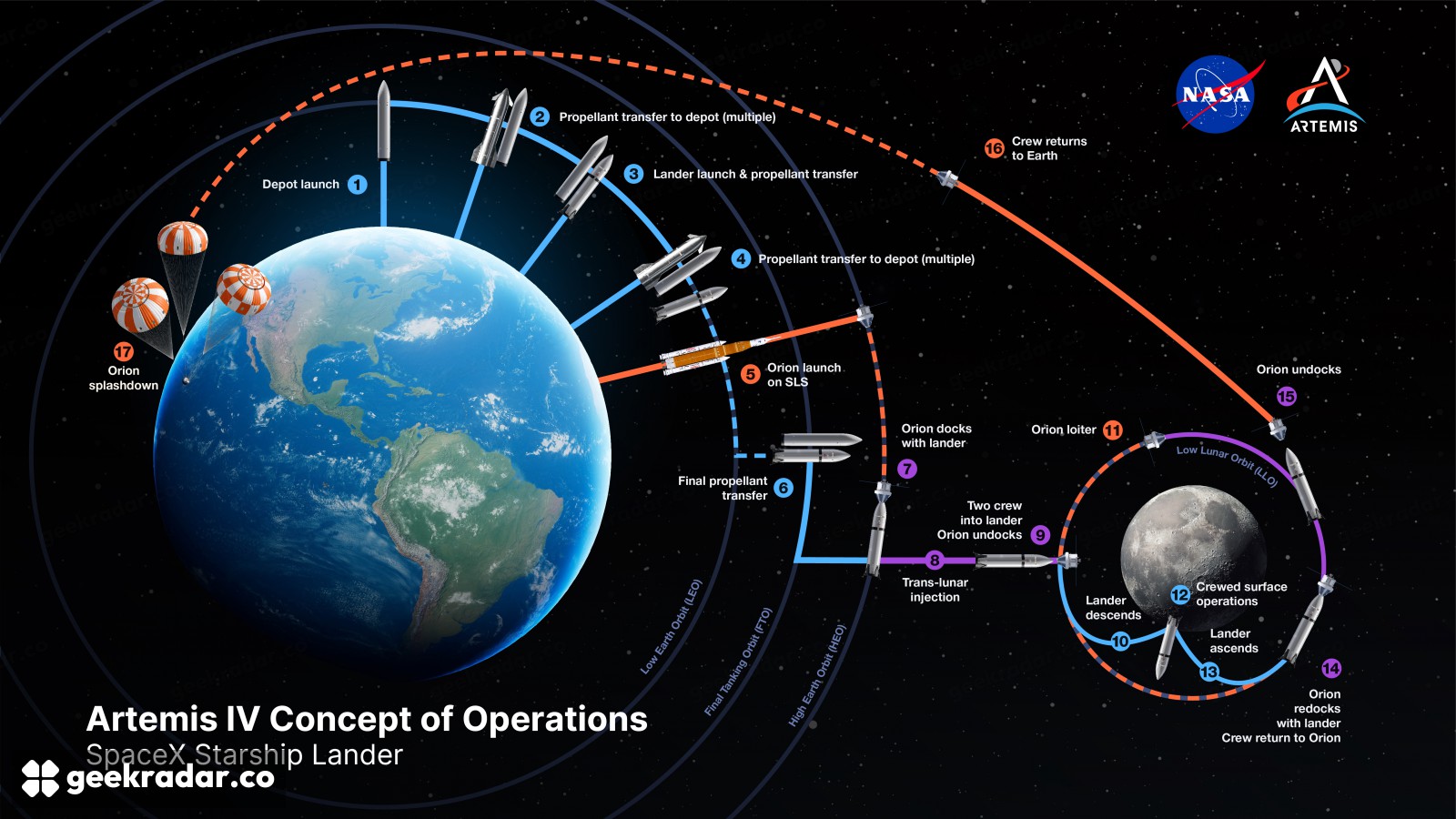
SpaceX's revised concept still requires propellant to be accumulated in Earth orbit. Tanker flights would supply a depot, which would fuel the lunar Starship. The lander would then dock with Orion before performing the burn that sends the combined stack toward low lunar orbit.
That changes the division of work between vehicles. Orion remains the crew's spacecraft for the launch and return, but NASA says it is working on modifications that would allow Starship to push it toward the Moon. An interface that lets two spacecraft dock is therefore only part of the story; the joined vehicles must also operate together through a major manoeuvre.
NASA says the revised orbit reduces Starship's propellant requirement and can shorten the return from the surface to Orion. These are benefits of the proposed architecture. The same description still requires a demonstration of the propellant-aggregation approach before the crewed mission.
Blue Moon trades early refuelling for transfer stages
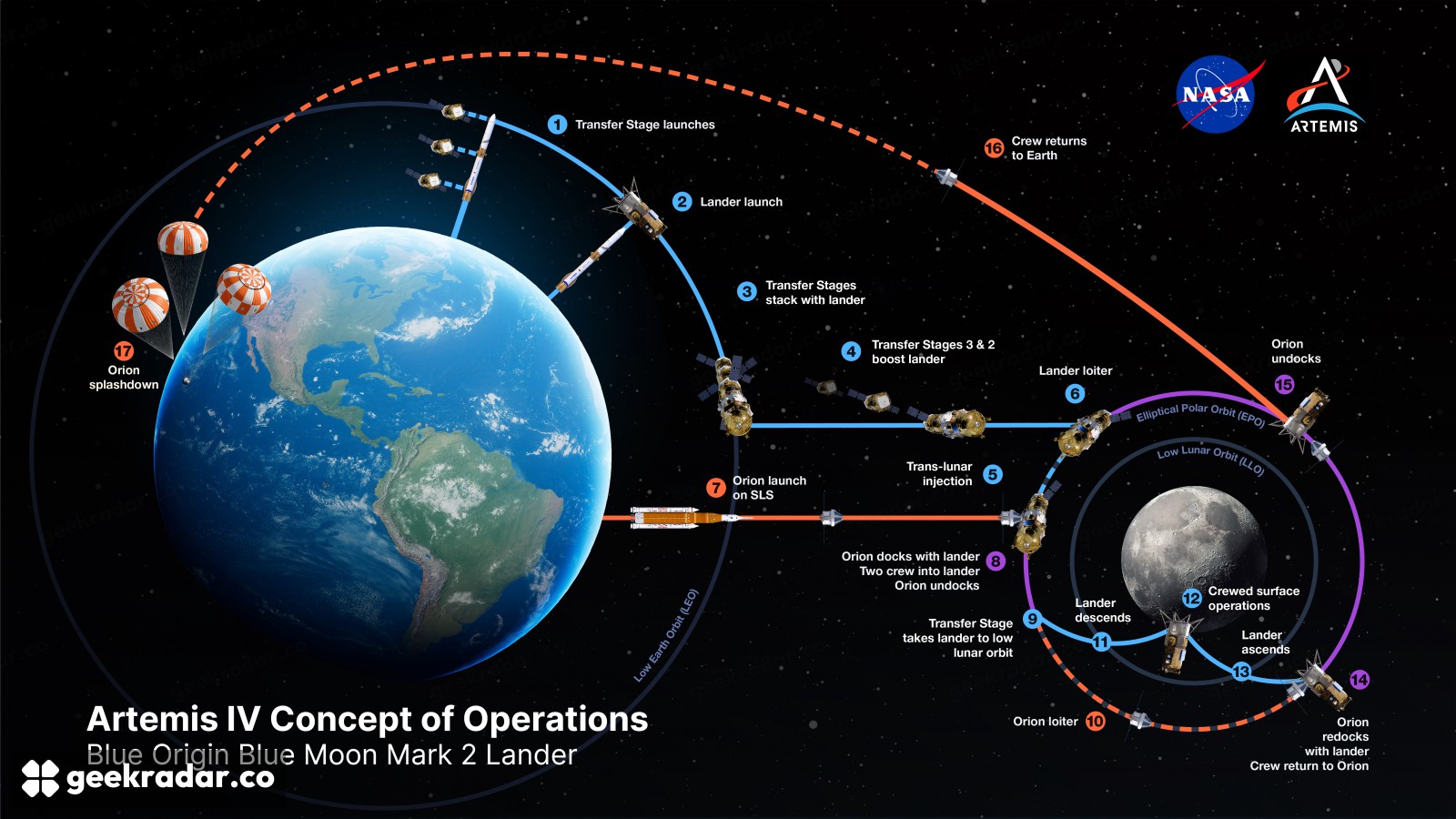
Blue Origin's accelerated approach defers propellant transfer. Three stages would help send the Mark 2 Alpha lander from Earth orbit toward an elliptical polar lunar orbit, separating as their propellant is used. Orion would meet the lander around the Moon.
The difference is not adequately captured by calling one design simpler. Deferring a particular operation can reduce one development burden while creating a different chain of launches, dockings and separations. Each chain needs to be demonstrated as a system, not only as a collection of successful components.
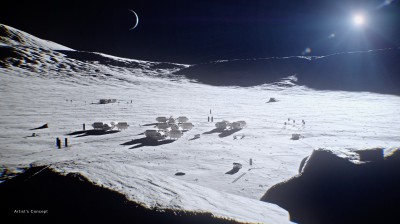
The official diagrams are useful because they expose those sequences. They also show why a single photograph of a lander cannot explain the mission: the surface vehicle depends on other vehicles and operations long before its engines approach the Moon.
The rehearsal has a narrower job
As covered in our Artemis briefing guide, Artemis III is now a test mission in Earth orbit. NASA's separate mission description explains the planned work with test versions of commercial landers and Orion. That rehearsal is distinct from a landing and cannot be counted as one.
NASA also requires uncrewed demonstrations and certification of the landers before astronauts use them for lunar missions. A successful docking rehearsal would retire a meaningful set of questions, while leaving other questions about the full transport and surface sequence to their own tests.
The revised plan is therefore best understood as a redistribution of dependencies. It changes which vehicle performs each job and where the handoffs occur. The meaningful progress toward 2028 will be those handoffs working in the required order, with enough margin to bring the crew home—not simply another date attached to an illustration of the Moon.