The important galaxy in Hubble’s new image is easy to miss
A faint arc near a foreground galaxy shows why sharp Hubble observations matter for Roman’s much wider surveys.
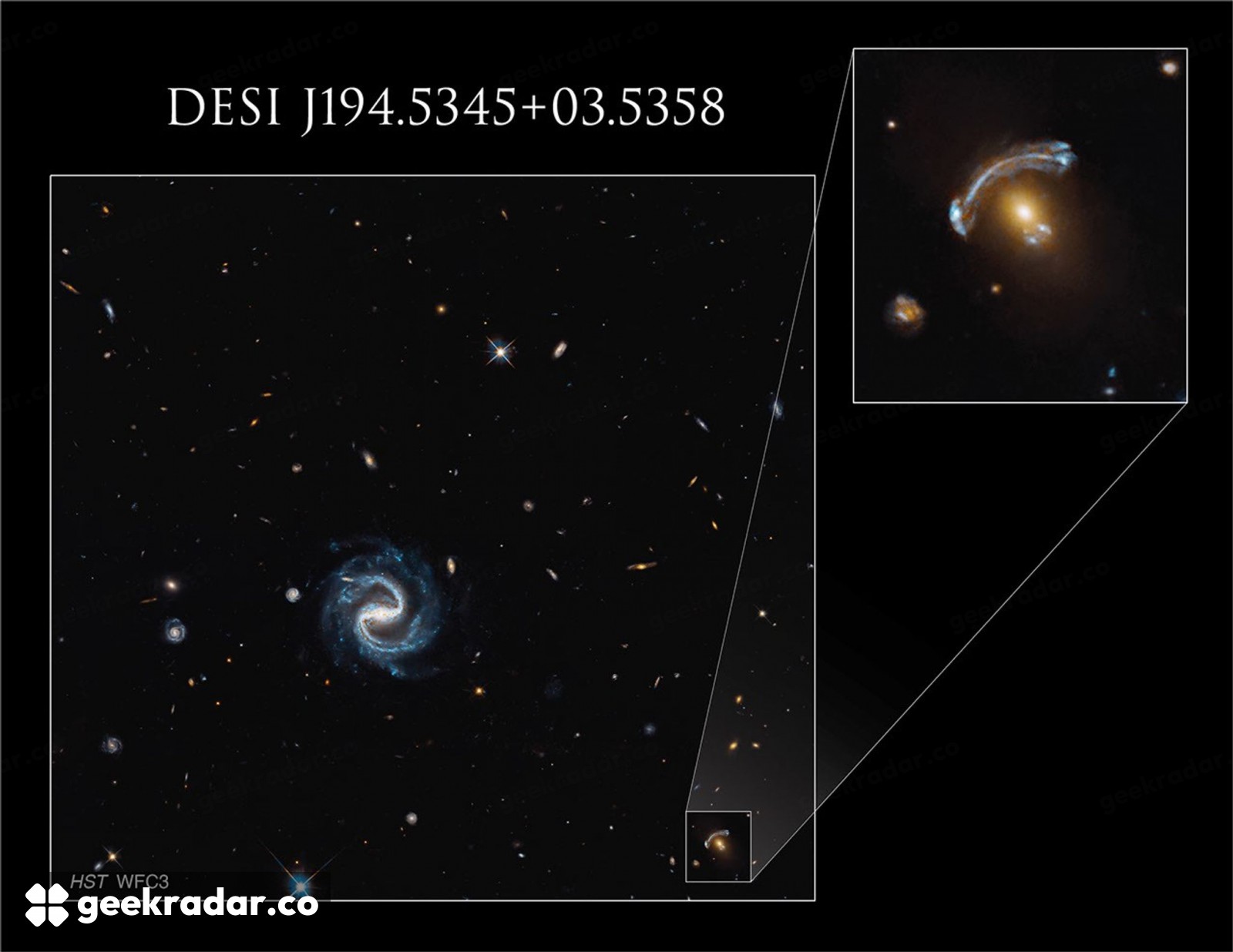
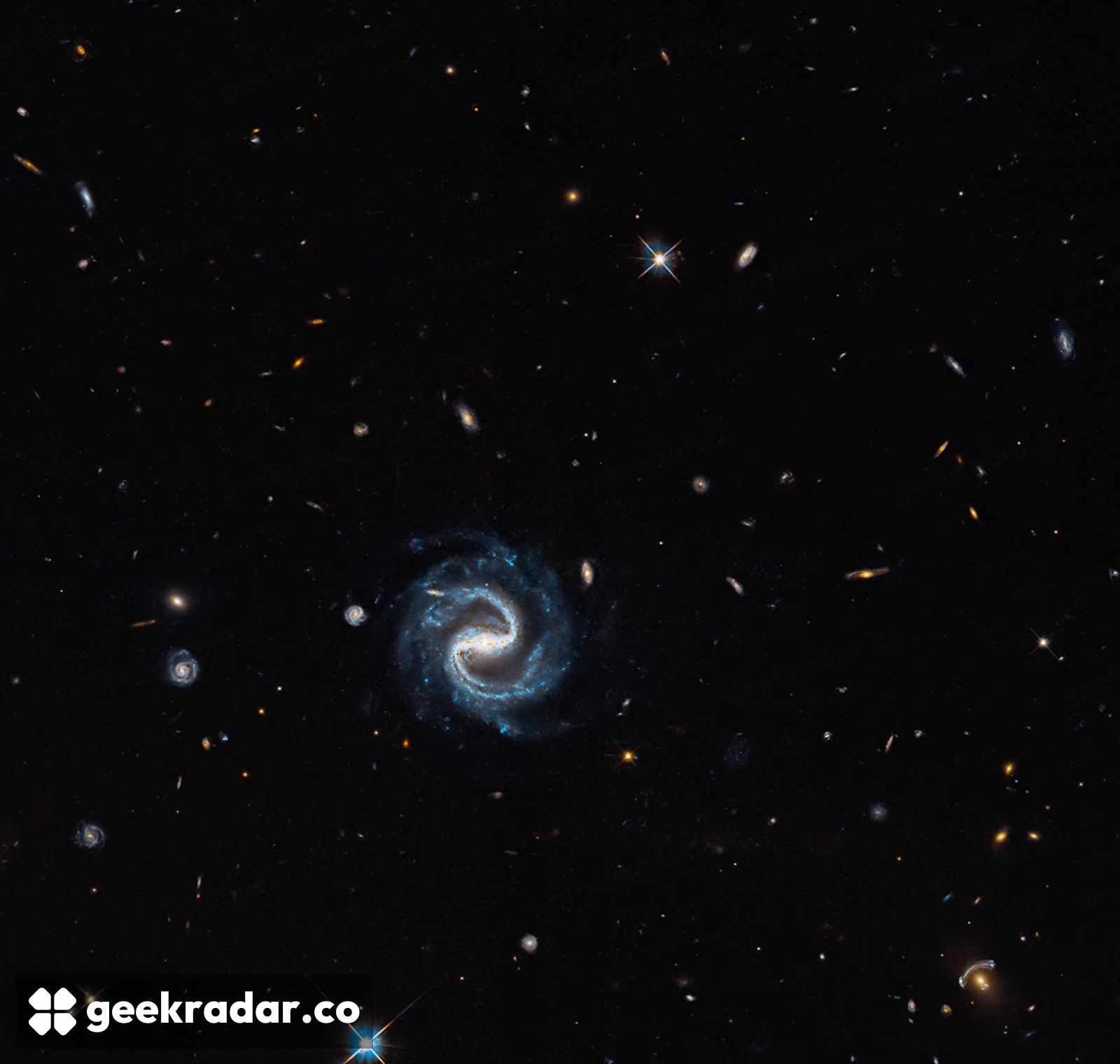
A large spiral galaxy dominates the Hubble image NASA released on October 22. The more revealing feature sits toward the lower right: a small foreground galaxy surrounded by light that has taken a bent route to reach us. The arc and counterarc are two distorted views of a galaxy farther away.
The foreground object is about 4.5 billion light-years from Earth; the background galaxy is roughly 8 billion light-years away. Their apparent proximity in the picture hides an enormous separation in depth. That alignment turns the nearer galaxy into a gravitational lens—and makes the image useful preparation for the Roman space telescope’s future surveys.
A distorted image becomes a measurement
Gravitational lensing occurs because mass changes the path light follows. An intervening concentration of matter can stretch a background object into arcs or produce multiple images. The resulting shapes contain information about the intervening mass, including matter that does not announce itself through visible starlight.
This is why simply counting bright objects in the frame would miss the scientific relationship. Two patches of light need not be two unrelated galaxies. Conversely, the brightest galaxy need not be the one that answers the question the observers are investigating.
The useful comparison is between how much mass the lensing pattern requires and how much can be accounted for by visible material. That is an inference from geometry and a physical model. The image does not directly show dark matter as a colored substance. Keeping those two forms of evidence separate makes the image more interesting, not less.
Roman needs examples, not just a larger camera
Hubble can resolve individual systems in detail. Roman is designed to survey much larger areas in infrared light. Those capabilities complement each other: a wide search finds candidates, while sharper or differently targeted observations help establish what those candidates are.
NASA describes Hubble observations as useful training material for computer models that will identify lenses in Roman data. A search algorithm needs examples of the signal it should recognize, but it also needs to avoid mistaking an ordinary curved feature for a lensed background source. Better resolved examples help connect an attractive shape to a defensible classification.
Our earlier report on Roman’s optical preparation explains the hardware side of that larger survey. This new image shows the preparatory work that remains valuable even before the survey begins: learning how a small, difficult target should appear and which details deserve follow-up.
The distinction also prevents a misleading headline. This is a Hubble observation being used to prepare for Roman, not an image already captured by Roman. A future instrument’s promise is grounded here in data from a telescope already doing the work.
At first glance, the frame rewards the viewer with a prominent spiral. Look again at the faint arcs, and it becomes a map of matter along the line of sight. The feature easiest to overlook is the one that lets astronomers ask how much of the universe they are not seeing.
Image credit: NASA, ESA, and X. Huang (University of San Francisco); Processing: Gladys Kober (NASA/Catholic University of America).