CUDA vs ROCm: the GPU decision starts with the software dependencies
Compare NVIDIA and AMD compute through application support, hardware matrices and porting effort. A source conversion is not a promise of binary compatibility or equal speed.
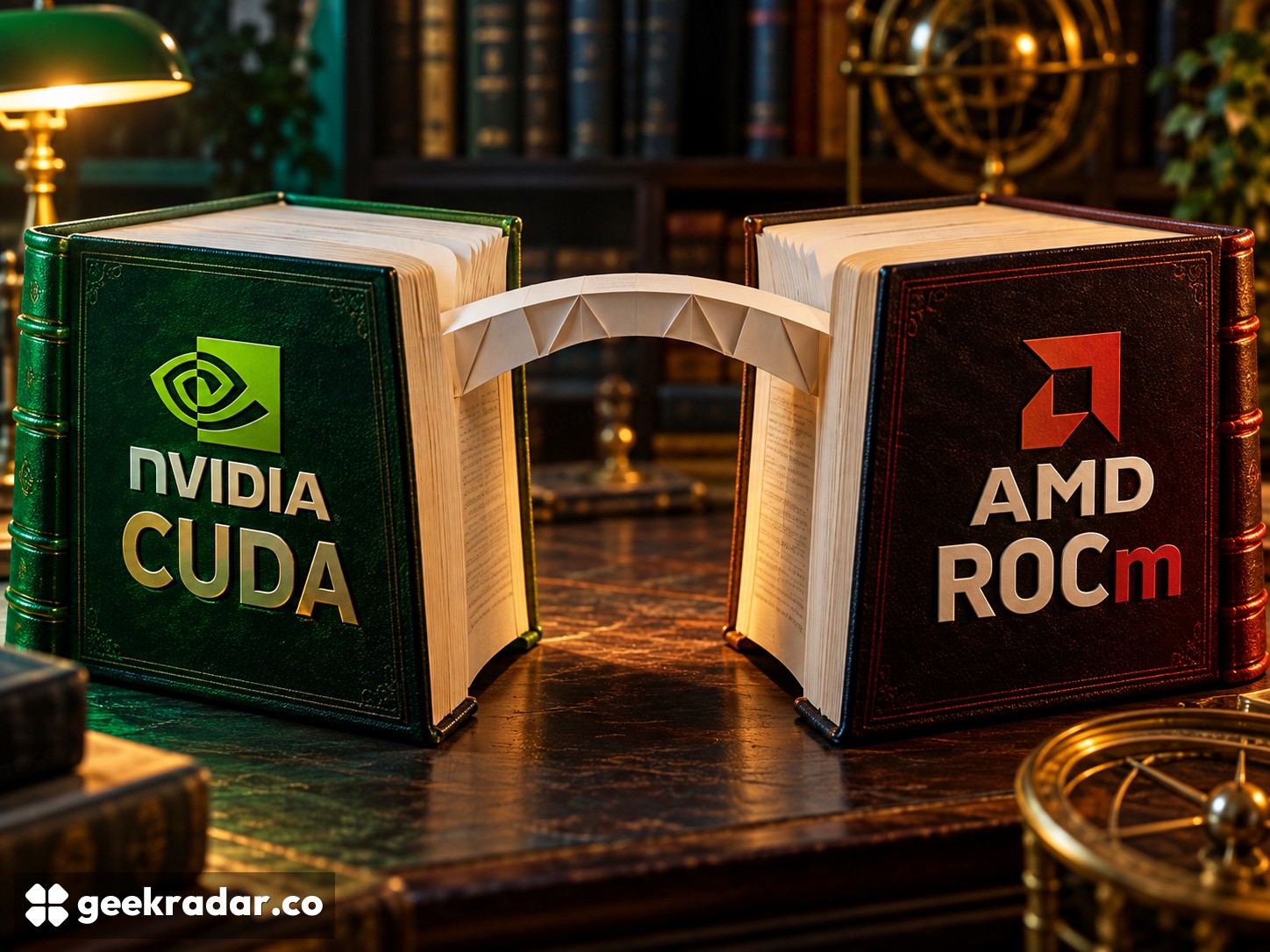
CUDA versus ROCm is a choice about the software that can use a GPU, and the effort required to keep that software working. NVIDIA's CUDA platform and AMD's ROCm ecosystem both support accelerated computing. Their practical value depends on libraries, frameworks, supported hardware and deployment requirements long before a theoretical compute figure becomes useful.
For somebody running an existing application, the first decision may already have been made by its developers. For somebody writing GPU software, the choice includes a longer commitment to tools and portability. Those two audiences should not receive the same buying advice.
CUDA's advantage begins with a concrete dependency
NVIDIA describes CUDA as an accelerated-computing platform that includes a toolkit, libraries and development tools, with access through programming languages and frameworks. That matters because many users never write a GPU kernel themselves. They depend on a framework package or an application that has already selected its acceleration path.
If your required application supports only CUDA acceleration, compatible NVIDIA hardware is the direct route. That is a software requirement, not proof that every NVIDIA GPU is faster than every AMD alternative. An application may also have a CPU mode, but buying a GPU that the application cannot use would defeat the reason for the purchase.
The trade-off is concentration. A project built around NVIDIA-specific libraries or kernel behavior may need meaningful work before another backend is viable. That cost can be justified by delivered functionality. It should still be recorded as an engineering dependency rather than hidden behind a generic promise of future portability.
ROCm is a supported configuration, not every AMD card
AMD's ROCm compatibility matrix identifies hardware and operating-system combinations and emphasizes alignment between firmware, drivers and userspace components. The relevant question is whether your exact GPU and software environment are supported. A Radeon product name, sufficient memory or a successful gaming driver installation does not answer it.
ROCm deserves consideration when the required framework and operations support its backend on hardware you can actually deploy. It gives teams an AMD route through accelerated software, which can be valuable for procurement flexibility or an existing machine fleet. The qualification is that a framework's general support claim may not cover every extension, custom operation or package version in your project.
For example, a model can load successfully while an optional attention implementation or third-party extension still assumes CUDA. The useful acceptance test is the complete workload: preprocessing, execution, output checks and any export or serving stage. A successful introductory notebook establishes much less.
HIP can reduce porting work without erasing it
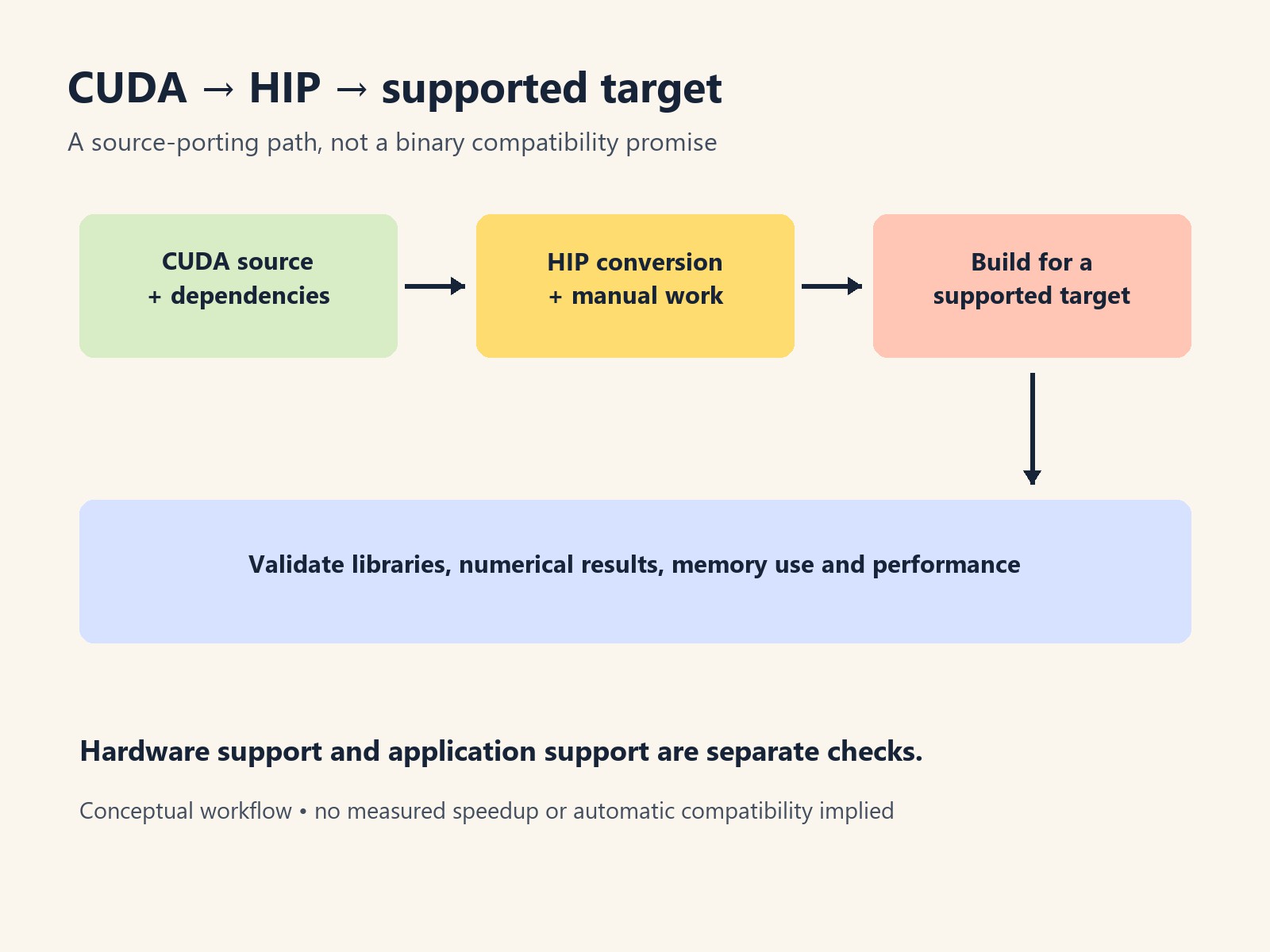
AMD's HIP FAQ explains that HIPIFY tools can convert substantial portions of CUDA runtime code, while unsupported capabilities and architecture-specific details can require further porting. This is source-level migration work. It does not mean an arbitrary compiled CUDA program can simply be launched on a Radeon card.
Porting also has two finish lines. Correct execution comes first; useful performance follows. Memory access patterns, library choices and kernel configuration may need different tuning. A team should budget for validation and maintenance after the first successful build, especially if both backends must remain supported as the application evolves.
| Starting situation | CUDA case | ROCm case |
|---|---|---|
| Existing CUDA-only application | Direct supported route on compatible NVIDIA hardware | Requires an actual alternative backend or port |
| Framework with both backends | Check the CUDA package and required extensions | Check the ROCm package, exact hardware and operations |
| Custom GPU development | Direct access to NVIDIA's tools and libraries | AMD deployment path, with HIP as a possible portability tool |
| Main long-term cost | NVIDIA-specific dependencies | Compatibility validation and any migration/tuning work |
Our earlier Hopper analysis approached performance as a system problem. The same discipline is useful here: the accelerator is only one component of a working compute environment.
Measure completed work, not theoretical capacity
A useful comparison holds the task, output quality, precision and memory requirements constant. For inference, report the conditions behind throughput and latency; for training, include numerical behavior and the time to the intended result. More memory can enable a workload that otherwise will not fit, but it does not establish faster execution for one that fits both cards.
Choose CUDA when its supported software path gets the required job into production with the least justified effort. Choose ROCm when the full workload works on a supported AMD configuration and the resulting cost, capacity or procurement flexibility outweighs maintenance. The decisive purchase is the one that completes the job reliably—not the GPU whose arithmetic you cannot reach from your software.