Smile starts science with an X-ray challenge still to solve
The mission combines images of Earth’s magnetic environment with local particle measurements. ESA’s latest verified update leaves its stray-light problem unresolved.
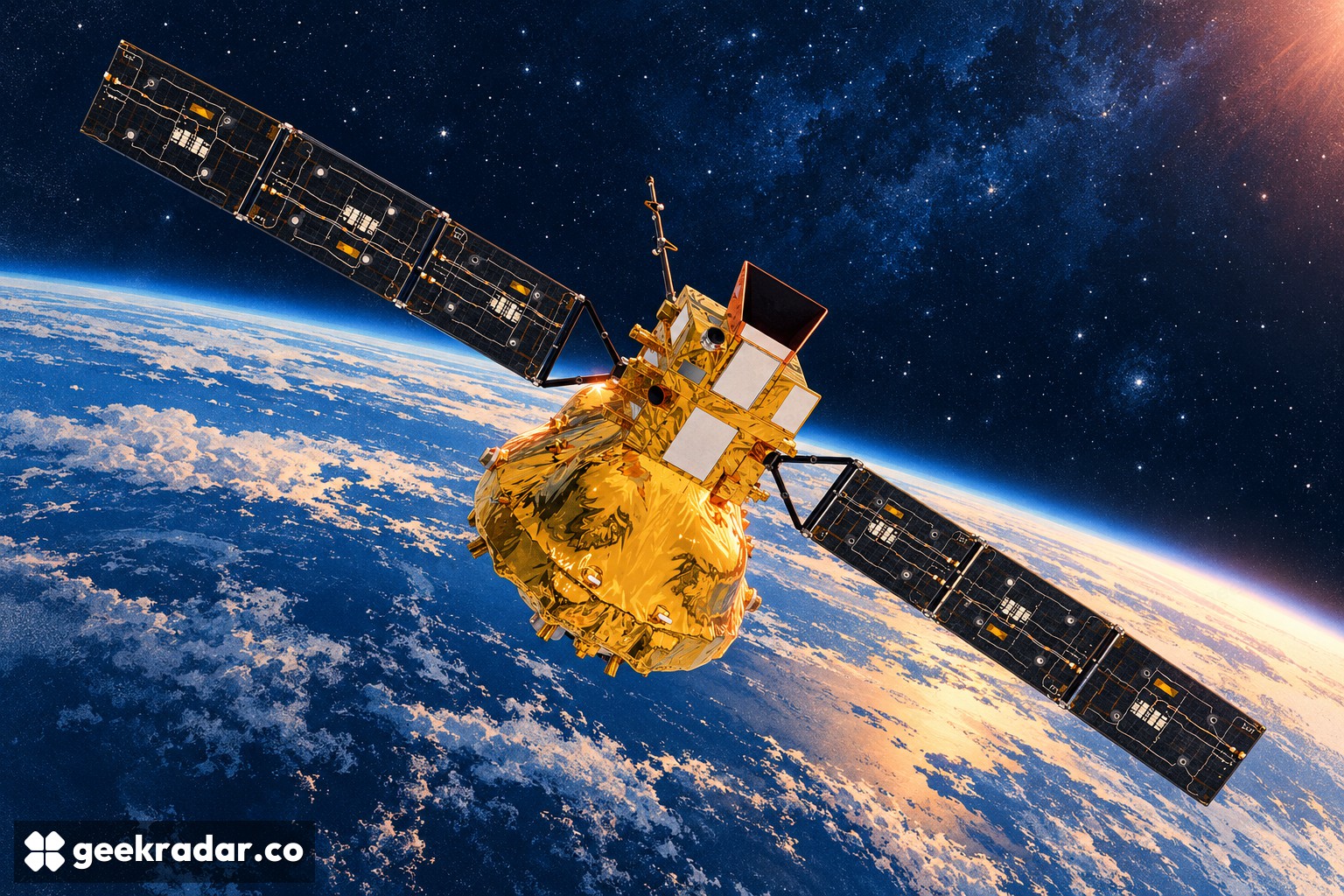
Smile has entered its science phase, but its most ambitious camera still has a problem to work around. ESA's September 30 status report says the European–Chinese mission was cleared for science on September 23 while engineers continued reducing stray light affecting its soft X-ray imager. The agency expected naturally darker observing conditions around mid-October—a useful window, not confirmation that the issue has been resolved.
That distinction matters now. The mission is intended to connect changes in the solar wind, Earth's magnetic environment and the aurora in one observing system. Calling it operational does not mean every instrument has already delivered its ultimate science result.
A camera for an enormous, invisible boundary
Earth's magnetosphere is the region shaped by its magnetic field. The solar wind presses against it, and the boundary facing the Sun changes with those conditions. Measuring that system from inside it is rather like trying to understand the shape of a moving crowd while standing among the people: local measurements are valuable, but they do not provide the whole outline.
ESA's explanation of Smile's X-ray technique describes how charged solar-wind particles interacting with neutral particles can produce soft X-rays. Smile aims to use that faint emission to follow the magnetosphere's sunward boundary, the magnetopause. It is observing a physical signal associated with the interaction, rather than photographing magnetic field lines as visible objects.
Its camera uses micro-pore optics: many small channels guide X-rays toward detectors. The broad view is important because the scientific question concerns how an extended boundary moves, not just what happens at the spacecraft's own location.
Four instruments supply different parts of the story
The mission's science toolbox combines two remote imagers with instruments measuring the local environment. The ultraviolet imager follows auroral activity. The magnetometer measures magnetic fields, while the light ion analyser samples charged particles encountered by the spacecraft.
These measurements answer different questions. An image can establish where an extended feature is changing. A local instrument can characterize the material and field passing the spacecraft. Combining them offers a way to relate the external conditions to the system's response without pretending that one measurement describes every location.
The interpretive work lies in aligning those observations. An auroral change and a change in the upstream environment become more informative when their timing and geometry can be compared. Simultaneous coverage can therefore add scientific value beyond simply collecting more pictures of the same event.
Stray light is a measurement problem
In ESA's September status update, the ultraviolet imager had already produced auroral footage and the X-ray camera had observed a distant stellar remnant for calibration. Pointing toward Earth brought more unwanted light than expected. The team was adjusting settings and software while anticipating improved seasonal conditions.
For a faint-signal instrument, unwanted light can obscure the distinction the measurement is meant to reveal. A successful observation of a calibration target is useful evidence that the instrument works, but it does not establish identical performance in another pointing geometry. The constraint is specific enough to explain why “first image” and “science readiness” should not be treated as interchangeable headlines.
Our earlier coverage of Roman's telescope focus work concerned a different observatory and a different optical task. The shared lesson is the importance of characterizing an instrument before interpreting its pictures as final science.
Smile's promise remains unusually concrete: relate the shape of Earth's magnetic boundary to local space conditions and the aurora. The latest verified status supports the start of that work. It does not yet support a claim that the stray-light problem is behind the mission or that its first complete X-ray view has arrived.