How to spot Jupiter’s ring in the photograph that revealed it
Voyager 1’s camera swayed through more than eight cycles during one exposure. Its wandering stars help explain why the planet’s thin ring looks so wide.
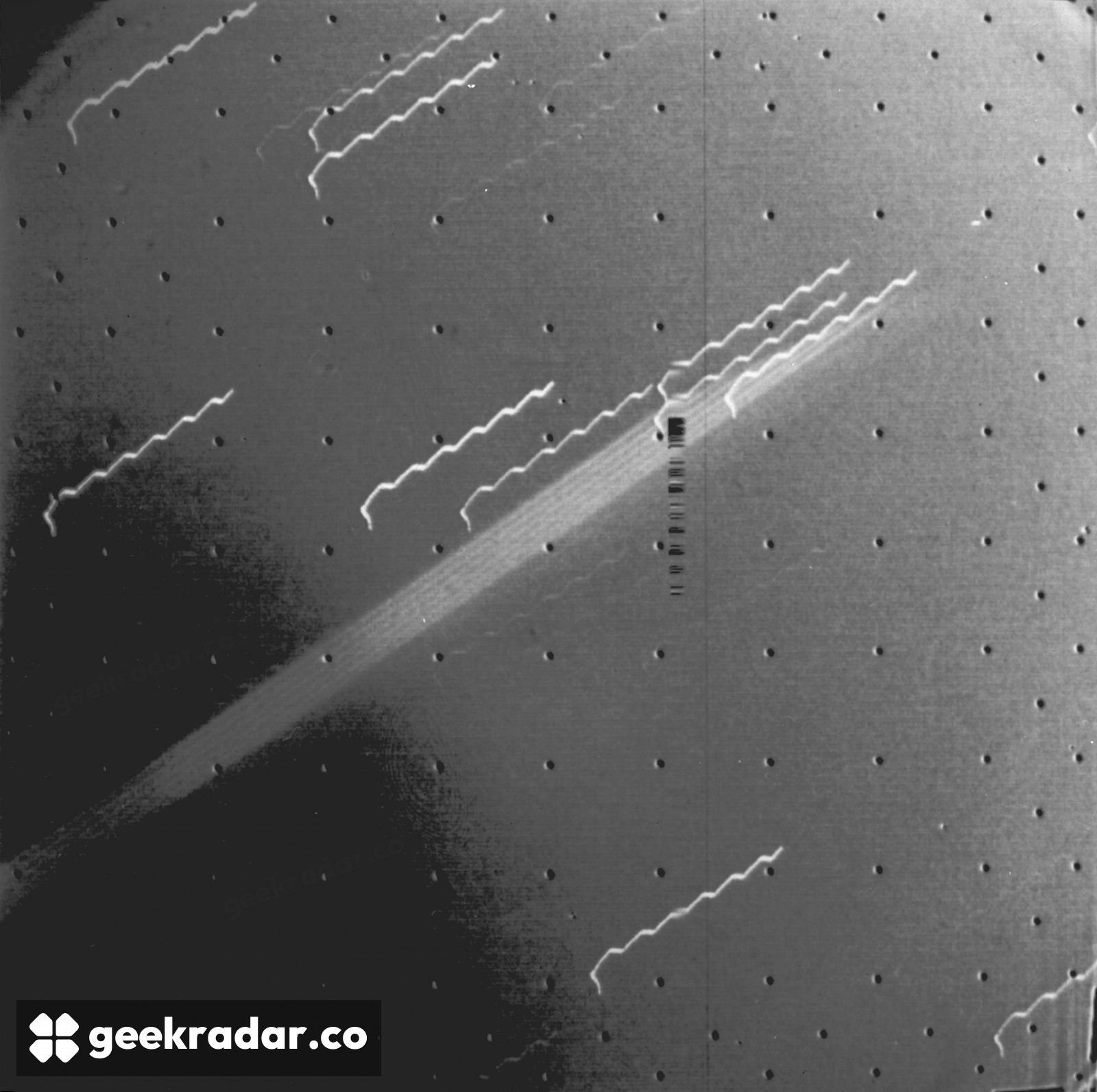
The first photograph to show a ring around Jupiter is full of things that look more convincing than the ring. Bright zigzags cross the frame. Black dots sit at regular intervals. The discovery is the pale, broad streak running diagonally through the middle. On March 4, 1979, Voyager 1 kept its camera looking near Jupiter’s equator for 11 minutes and 12 seconds to catch it.
Voyager 1 made news this week when its radio signal reached Madrid from one light-day away. As Live Science’s retrospective on the Jupiter encounter recalls, its close pass also gave astronomers pictures of a world they had observed for centuries. This particular exposure is worth opening at full size. To see what the camera discovered, it helps to know what the spacecraft itself contributed to the picture.
Why the stars look like bent wire
The camera team had planned a search along the planet’s equatorial plane. In NASA and JPL’s description of the discovery frame, the ring’s edge was about 57,000 kilometres above the visible cloud tops and more than 1.2 million kilometres from the spacecraft. A long exposure gave light from that faint material time to accumulate. It also recorded every small change in the camera’s pointing.
Voyager was slowly oscillating, completing one cycle in about 78 seconds. During the 672 seconds of the exposure it went through that motion more than eight times. A star that might have registered as a point in a short exposure traced a wavering line. Look at several of those lines together and the same wiggle repeats across the sky. The evenly spaced dark dots have a different origin again: they were geometric calibration marks in the camera.
The ring suffered from the motion too. Light from a thin feature spread across the picture, giving it the appearance of a wider band. Drawing a ruler across that band and converting pixels to kilometres would measure some of Voyager’s motion along with the ring. The frame gave astronomers a place to look again, from a different angle.
What sunlight from behind the ring revealed
In July 1979, Voyager 2 looked back from Jupiter’s shadow with the Sun behind the rings. NASA’s account of the second encounter describes an unexpectedly bright view. Tiny particles scatter a substantial amount of incoming light onward, close to its original direction. A camera on the far side of the dust can pick up that light. The change in viewing angle therefore offered a clue to what the ring was made of.
Later, Galileo’s mosaic of Jupiter’s rings separated a flat main ring, a halo inside it and a diffuse outer region. Small impacts on nearby moons supply dust to the system. That helps explain how a planet can have rings that escape notice beside its bright disk.
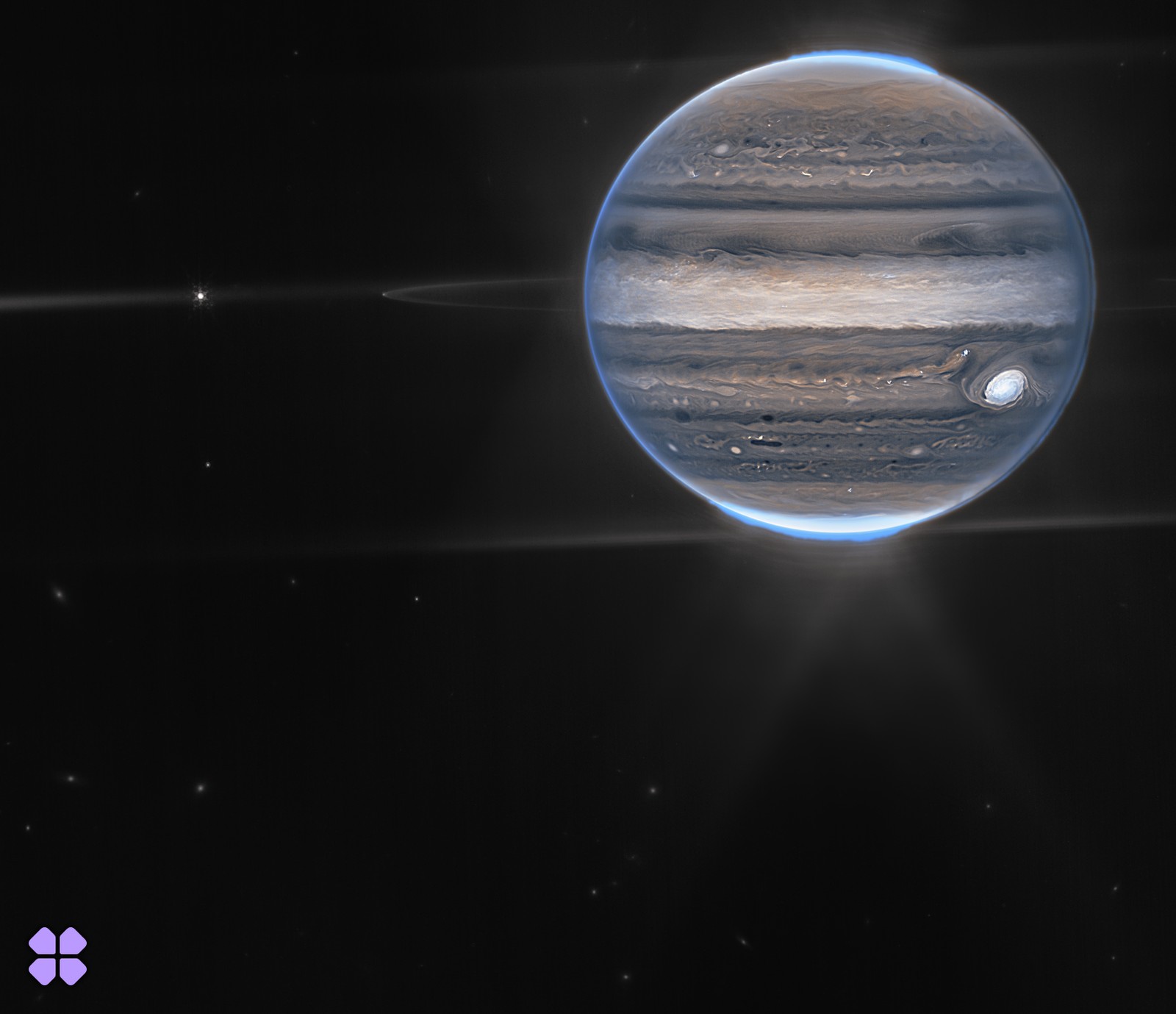
The colour image at the top comes from Webb’s two-filter infrared observation in July 2022. The team describes the rings as a million times fainter than Jupiter in this view. Follow the fine line out from the planet, then go back to Voyager’s grainy frame. The streak is much easier to pick out the second time. The camera team had to recognise it the first time, with the stars apparently wriggling around it.