
A proposed Riemann proof passed two independent checkers. What did they verify?
The checks on Levent Alpöge’s Claude-assisted submission go beyond compiling the files. One asks whether the argument proves the statement mathematicians meant.
Two independently written proof checkers have accepted the machine-readable argument that Levent Alpöge released on November 20 as a proposed proof of the Riemann hypothesis. There is also a check on a more basic question: did the files prove the statement mathematicians actually asked for? In a verification report updated at 10:05 UTC on November 21, MIT mathematician Andrew Sutherland reports that an independent comparison matched all five headline theorems to their targets. Some further checks were still running at that cutoff.
This is substantial evidence for a claim Alpöge made in a four-page note describing his work with Claude. The note itself is an account of a discovery. The argument that people can test is in the accompanying files, written in Lean, a language in which a mathematical statement and the reasoning behind it can both be expressed precisely. There are already two quite different ways to ask whether the work holds up. A computer can check each logical step. A number theorist wants to know which idea made the next step possible.
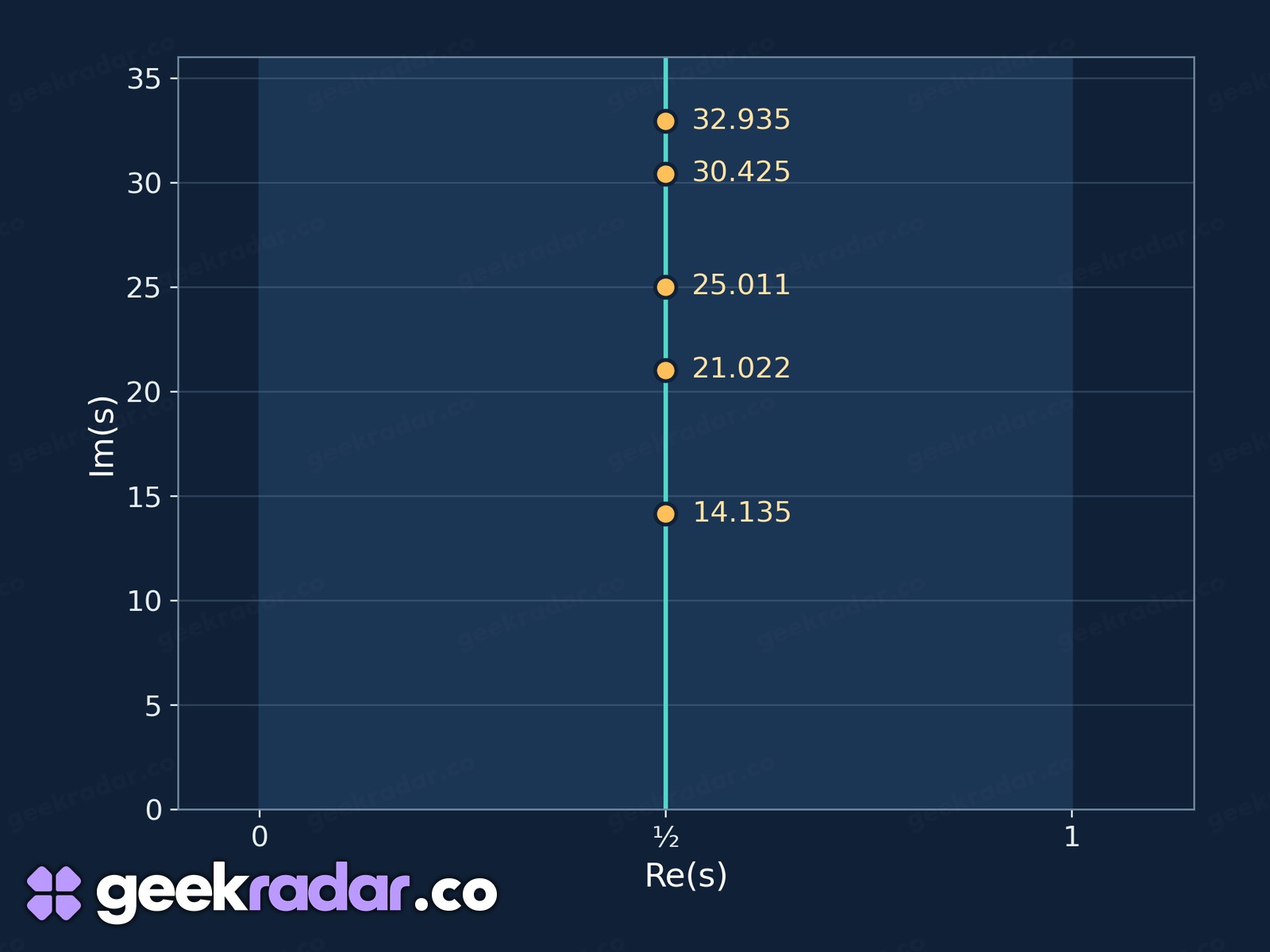
Why the line through one-half matters
The prime numbers thin out as the numbers get larger. Mathematicians have a good estimate for how many primes lie below a given number, but the actual count wanders around that estimate. The Riemann zeta function connects those departures to particular points in the complex plane. Each point has two coordinates, a real part and an imaginary part. The hypothesis says that every nontrivial zero of the function has the same real coordinate, exactly one-half. The Clay Mathematics Institute’s account of the problem
You can see what that means in the chart. The first five zeros above the real axis have markedly different heights, yet each sits on the same vertical line. A sixth dot, or a trillionth, would still leave infinitely many unexamined. The claim in the Lean files is a statement about every such zero. Alpöge also claims a result for a family of related functions called Dirichlet L-functions. That is the scope of “generalized” in this announcement. NIST’s guide to the zeros
What an independent checker adds
Imagine a proof that every zero in a list lies on the line. It might be impeccable, even if the intended theorem was about zeros absent from the list as well. A program could accept every inference and still answer the wrong question. That is why checking the target matters. The ordinary Riemann theorem in the submission uses the existing definition in Mathlib, Lean’s mathematics library. The auditor also checked which assumptions the five results depended on. Lean reported the three standard axioms, with no new assumption carrying the result in through a side door. Sutherland’s verification files and logs
A second check asks whether the software accepting the inferences might itself be mistaken. Sutherland reports that all 175,187 modules compiled. Beyond that, two separate implementations of the logical checker, nanoda and con-leche, accepted the exported proof. At the time of the report, Lean’s own checkers were still processing that export, although a separate replay of the individual modules had already finished. The distinction between the thing verified and the tools doing the verifying also mattered in GeekRadar’s coverage of formal checks on Signal’s code.
One particularly revealing test steps away from complex numbers. Sutherland connected the submission to independently formalized results about the sum of a number’s positive divisors. For 12, that sum is 28: add 1, 2, 3, 4, 6 and 12. Arithmetic of that kind appears in inequalities known to be equivalent to the Riemann hypothesis. Deriving those statements from the submission gives reviewers a way to inspect what the result means in the language of ordinary integers.
Alpöge says he intends to write up the argument in a form people can understand and simplify. A successful checker can tell a researcher that a long sequence of deductions reaches the stated destination. What a readable proof could give the next researcher is a much shorter answer to a different question: which turn in those deductions is worth trying on another problem?