FireCuda Forge pairs a huge hard drive with your SSD. The cache is the buying decision
Seagate's USB4 storage system manages one volume across two tiers, but its required SSD is sold separately and supports at most 1TB.
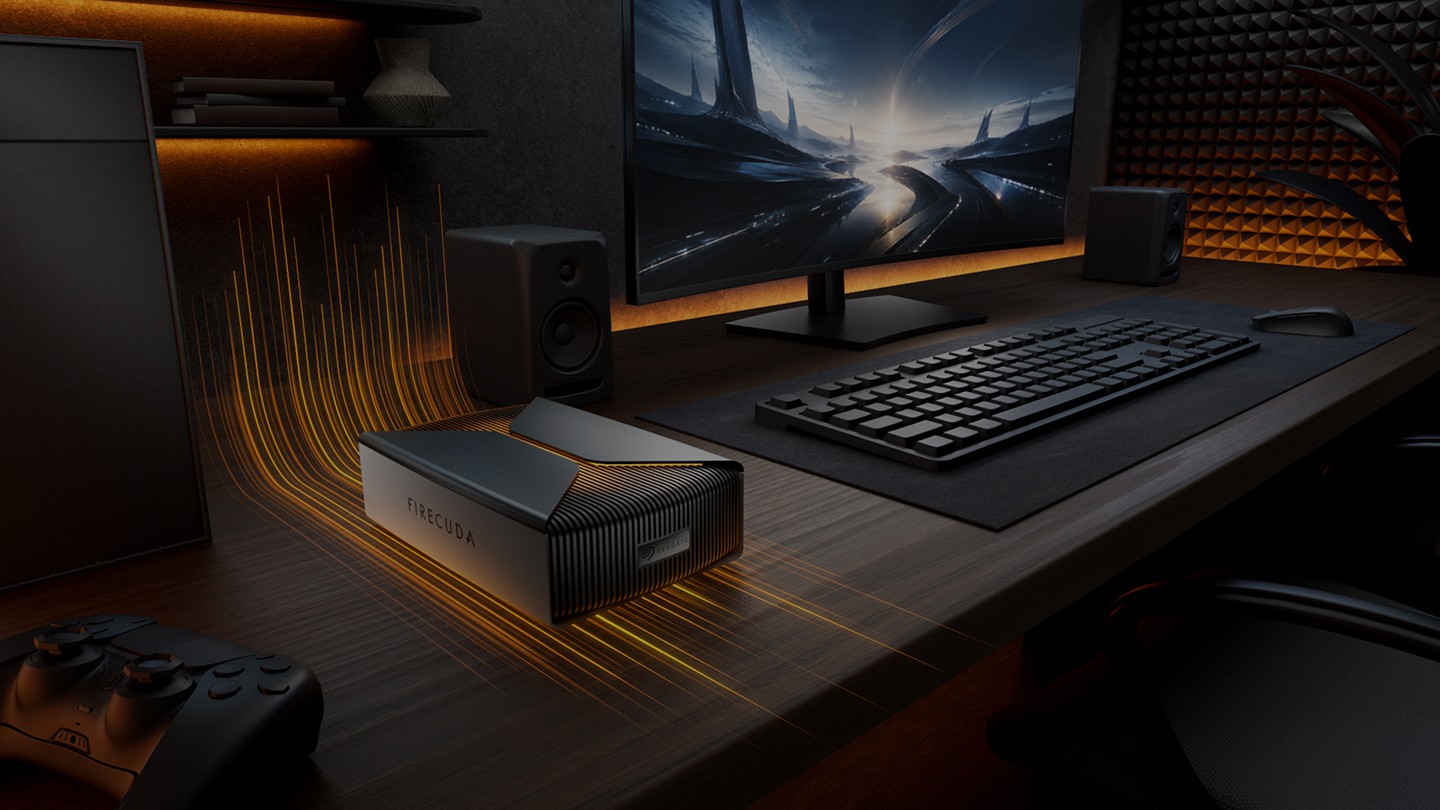
Seagate's FireCuda Forge combines a large hard drive with an SSD that the owner supplies, then presents them as one storage system. Its new Alkemi platform automatically prioritizes frequently accessed data on the SSD, leaving less-active material on the hard drive. The promise is a large library with faster access to the part currently in use, without manually moving files between two drives.
The November 10 announcement lists 8TB and 20TB configurations starting at US $699 and $899, with availability varying by market. The most important purchasing detail is separate from those capacities: a compatible NVMe SSD is required and is not included. This is not a self-contained external hard drive that happens to gain an optional speed boost later.
The fast part has a finite size
Alkemi's on-device caching explanation describes a system that adapts to access patterns. Files used repeatedly can benefit from the SSD, while colder data remains on the higher-capacity disk. Both sit behind one volume, reducing the need to decide manually which drive letter or location should hold a current project.
That architecture fits a library with a smaller active working set: one or two games played regularly, for example, alongside a much larger installed collection. It is a less straightforward match for a workload that continually reads new material across the entire disk. The cache can prioritize what it has learned is useful; it cannot turn every byte of a 20TB drive into solid-state storage at once.
Seagate itself notes that new data may not immediately benefit from an established access pattern. That makes first access and repeated access meaningfully different situations. A benchmark showing the fast path would not, by itself, establish what happens when a project suddenly needs a large collection of files that have been sitting idle.
These requirements come from the FireCuda Forge product page. A physically fitting drive should not be assumed compatible without checking the complete specification. The maximum supported SSD capacity also matters when comparing the system's fast tier with its much larger headline HDD capacity.
USB4 speed is a path, not a promise for every file
Seagate advertises up to 2,500MB/s reads and 2,000MB/s writes over USB4. Those are manufacturer figures, not GeekRadar measurements. The interface, host configuration, installed SSD and the data being accessed all matter to the experience.
The distinction is especially important for creators. Reopening a project whose active assets are already prioritized is a different task from ingesting a large new shoot or sweeping through an archive. A useful assessment would distinguish those workloads; a single headline transfer rate cannot describe them all. That follows directly from the separation between the SSD and HDD tiers.
Forge supports Windows 11 and macOS 26 or later, according to the announcement. It also has an upgradeable hard drive. These are practical boundaries to check before comparing it with a conventional external SSD or a storage server, rather than reasons to treat the categories as interchangeable.
Pay for the management you actually need
Our earlier Beelink ME Pro coverage examined modular network storage. FireCuda Forge addresses a different problem: a directly connected USB4 device managing fast and slower storage behind one volume. It does not become a NAS merely because it holds a large library.
Its strongest argument is convenience for a changing but limited set of active files. The purchase calculation should include the compatible SSD, the host connection and the capacity of that active set. If a buyer mostly needs predictable speed across everything, the cache is a qualification to investigate. If the daily irritation is moving the same projects back and forth, automatic placement is the part of Forge that could earn its cost.