Beelink ME Pro separates NAS storage from compute upgrades, if the modules keep coming
The Kickstarter launch proposes interchangeable computing modules across two- and four-bay enclosures. Software and future availability decide the lasting value.
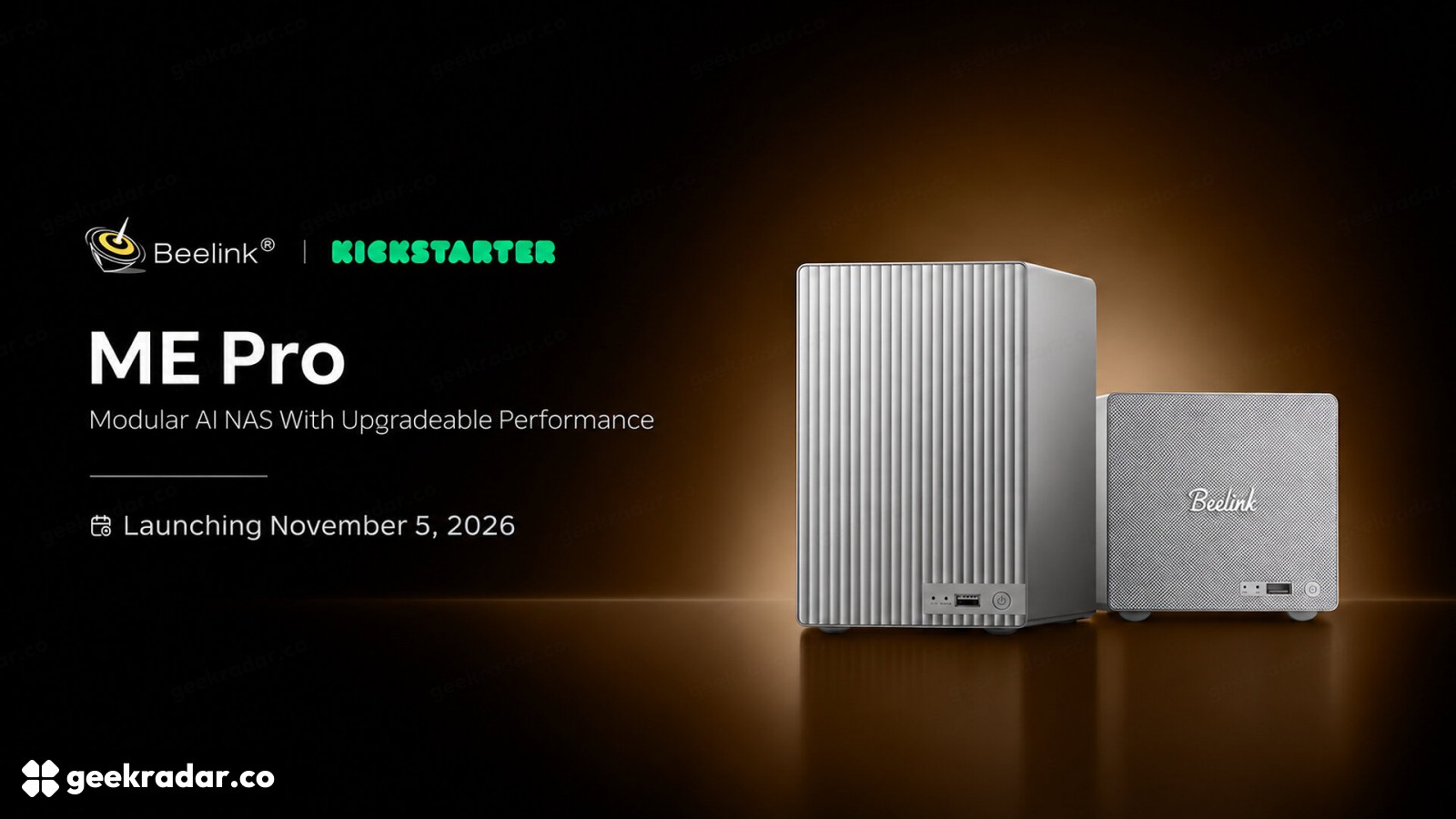
Beelink's new ME Pro crowdfunding launch proposes a different upgrade path for a network-attached storage device: remove the computing module without replacing the whole enclosure. The company says its two-bay and four-bay systems accept interchangeable compatible motherboard modules, including Intel and AMD options. The attraction is retaining useful hardware when computing needs change.
The November 5 company announcement presents a slide-out design and the ability to move a module between the two enclosure sizes. This is a claim about Beelink's modular system. It does not mean an arbitrary desktop motherboard will fit, or that every future processor will receive a compatible module.
Two upgrade problems are being separated
A NAS has at least two distinct capacity questions: how many drives it can accommodate and how much computing work it can perform. A household may need more storage without needing a faster processor, while media processing or additional services can create the opposite pressure.
ME Pro's proposed architecture attempts to separate those decisions. A compatible module could move into the larger enclosure as drive needs grow; a new module could change the processing capability while retaining other parts. That is more flexible in principle than replacing a sealed appliance as a single unit.
The long-term benefit still depends on modules being sold, supported and compatible when an owner actually wants an upgrade. A removable component is only a useful upgrade route if there is something appropriate to replace it with. The crowdfunding launch establishes the design intention, not a guaranteed catalogue several years into the future.
Local AI needs a workload, not only a TOPS figure
Beelink also promotes an AI 470 configuration and support for running several large language models locally. It lists models up to Qwen 3.5 35B, DeepSeek R1 32B and Gemma 4 26B. The claim is that these configurations can run supported models; it does not establish response speed, simultaneous users or the memory available to other NAS services.
The quoted AI throughput figure cannot settle those questions by itself. Model format, memory use and the actual software path affect the experience. A storage server that can load a model is not automatically a responsive shared assistant while it is also backing up devices or serving media.
The company's FygoOS description includes synchronisation, backup, snapshots, photo organisation and remote access. Those are useful categories, but they need to be evaluated as working features with clear recovery procedures, not simply counted as a longer list than another NAS provides.
An upgradeable box still needs dependable software
The launch is on Kickstarter, so configuration, delivery and support conditions should be checked in the actual campaign. Early-backer pricing is different from an established retail offer. The press release's size and noise claims also lack enough comparable test conditions to turn them into an independent buying verdict.
ME Pro's most useful idea is reducing the amount of hardware discarded when one requirement changes. For storage equipment, that promise has to coexist with something less eye-catching: years of predictable access to the files. A module that slides out easily is a good beginning; a supported replacement and a reliable path back to the data are what would make it an upgrade.