Eufy’s tracking light is clever. Continuous recording still needs a cable
The S1’s detailed specifications separate radar coverage, camera view, lighting limits and solar operation.
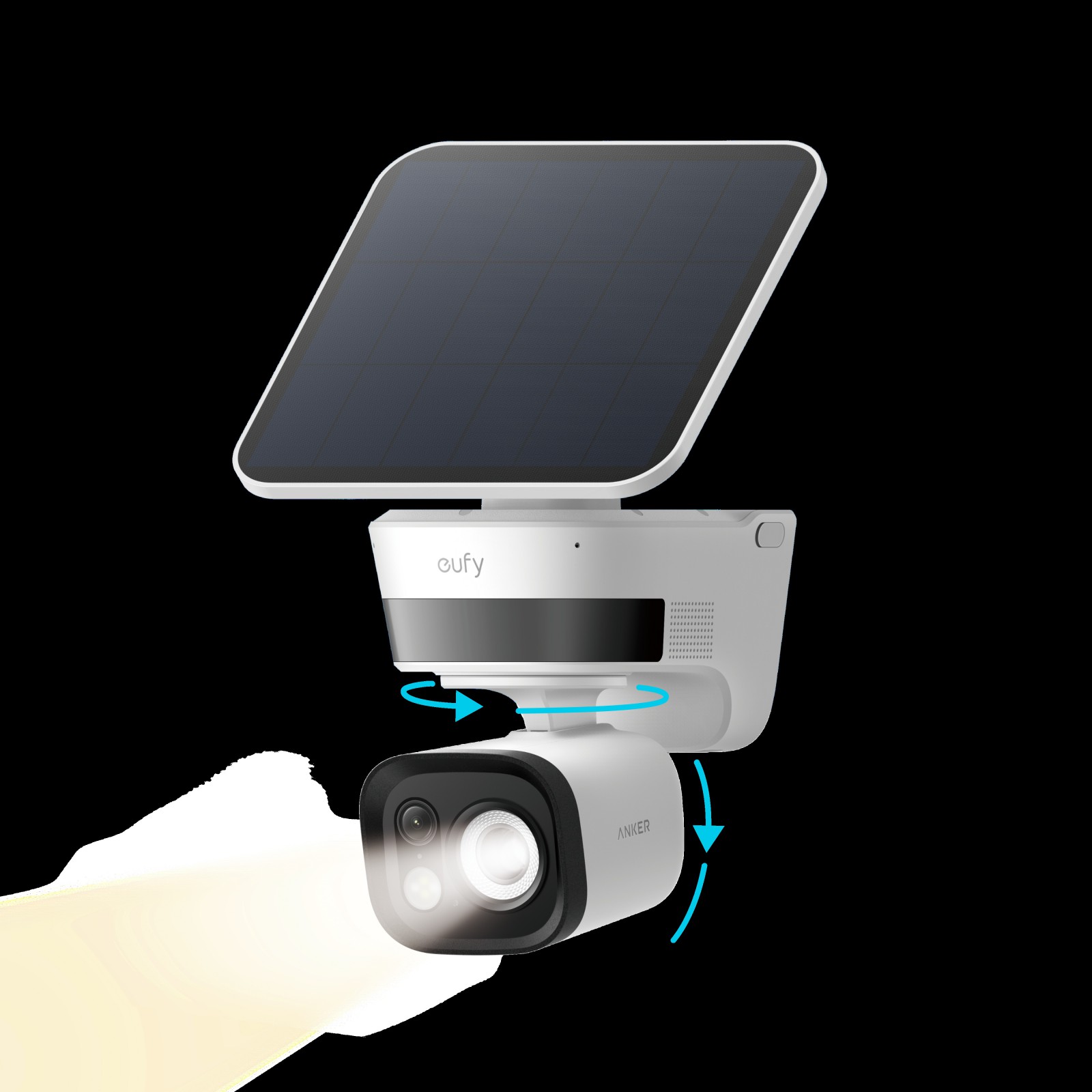
Eufy's TrackLight Cam S1 follows detected movement with an adjustable narrow beam, combining a pan-and-tilt camera with lighting that can point toward a subject. The US product page lists $299.99, 4K video and a solar panel, but its detailed specifications tell a more useful story than the broad promise of round-the-clock protection.
The important qualification is that continuous 24/7 recording requires direct power. The battery and solar panel support a different operating pattern. Buying a solar camera does not automatically provide continuous video without a cable.
The light and the lens cover different areas
TrackLight adjusts its focused beam between 10 and 30 degrees. The floodlight's beam is wider, at 120 degrees. Dual radar sensors detect across 180 degrees at up to twelve metres under the stated conditions, while the camera's lens covers approximately 85.8 degrees horizontally and 46.6 degrees vertically.
These figures describe different parts of the system. Detection can identify movement beyond the current camera view, after which the motor changes the viewing direction. Eufy specifies 355 degrees of pan and 75 degrees of tilt. That movement should not be presented as the lens recording a complete surrounding panorama at every instant.
The TrackLight Cam S1 profile also distinguishes the advertised 10x zoom as digital. Enlarging part of the image is not equivalent to an optical lens supplying ten times the captured detail. The video specification is up to 4K at 15fps, another relevant condition when judging motion rather than a still promotional image.
Solar power comes with an activity assumption
The camera combines a 15,000mAh battery and 5.5W solar panel. In its FAQ, Eufy describes an example workload of 36 daytime recordings of twenty seconds and one nighttime deterrence event lasting sixty seconds. Its estimates for daily solar collection assume suitable sunlight.
That example is not the same workload as a busy entrance recording continuously. Weather, shading and trigger frequency affect the balance between energy collected and used. A large battery can buffer that balance; it does not make it irrelevant.
The lighting has its own limits
Eufy says the light cannot remain on continuously. Its triggered duration is limited to 120 seconds, with at least five seconds between triggers, even when direct power and continuous recording are enabled. A customer seeking an always-on garden light should not assume the camera's floodlight replaces that function.
The siren is rated at 105dB at a distance of 0.1 metre. Keeping the measurement distance attached avoids turning a near-source reading into a claim about loudness across a garden or street.
Storage also needs planning. The camera has no built-in eMMC storage; local recording uses a microSD card up to 128GB, sold separately, or a supported Eufy storage device. Google Home works directly, while Apple Home requires HomeBase 3 according to the compatibility notes.
TrackLight's distinctive idea is a beam that follows the point of interest instead of lighting the whole scene equally. The purchase decision should start with the installation: where sunlight reaches, where a power cable could run and what must be recorded continuously. The camera's most important specification may be the one that decides which of those jobs it can actually do.