HyperOS 4’s global schedule separates models that sound almost identical
Xiaomi’s November and December groups are rollout starting windows. Model suffixes, regions and feature requirements still decide what reaches a phone.
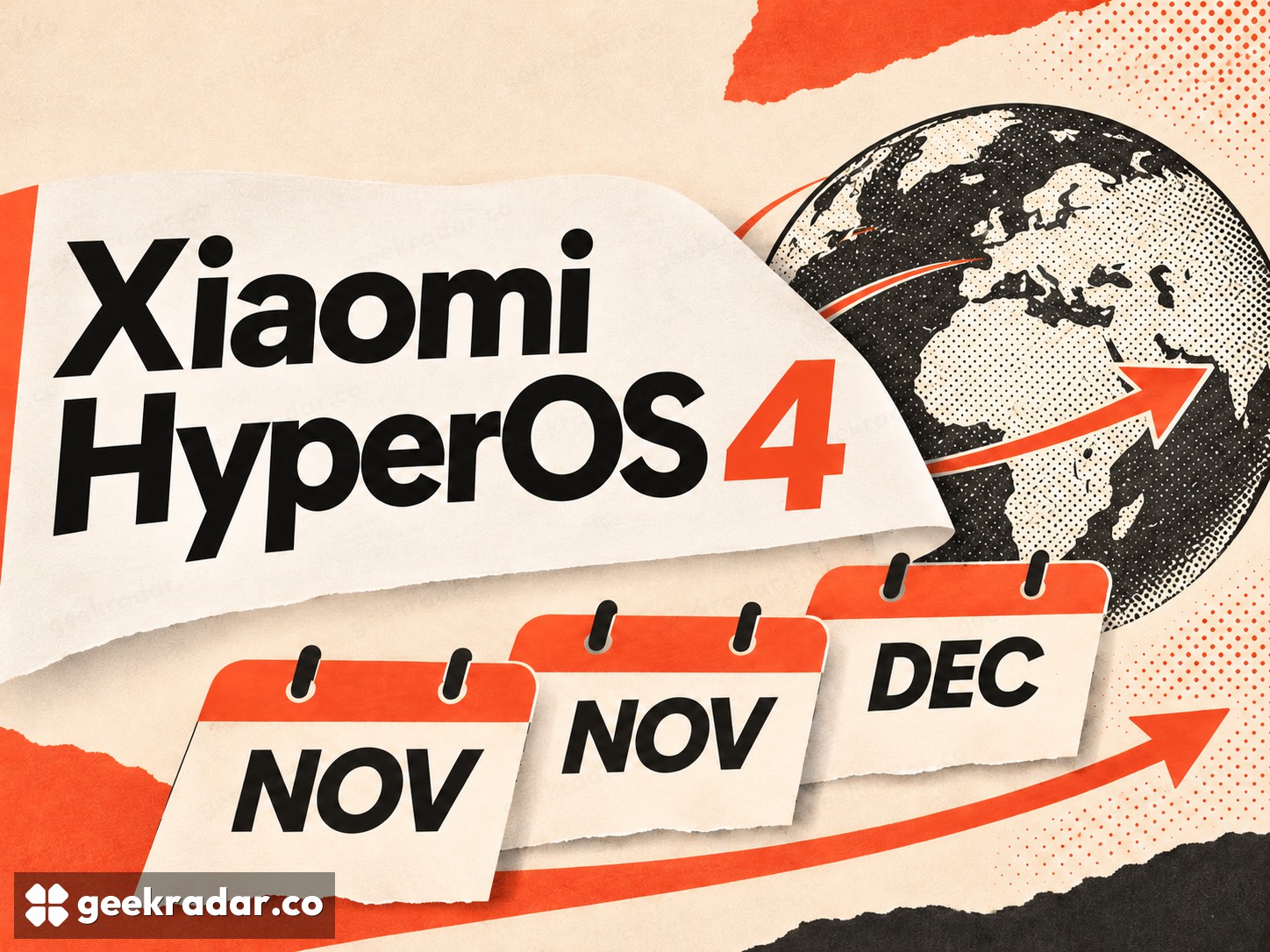
Xiaomi’s global HyperOS 4 page now gives owners a more useful answer than a general compatibility list: three estimated rollout windows, starting in early November, mid-November and December. The official schedule covers devices outside mainland China. It describes when distribution is expected to begin, rather than a date by which every eligible handset will have received the update.
That is a meaningful development after the separate Chinese and beta announcements discussed in our HyperOS 4 feature guide. It also makes exact model names unusually important. Xiaomi 17 and Xiaomi 15 are in different groups; POCO X8 Pro and POCO X8 are not interchangeable entries.
Read the group beside the complete model name
The early-November group includes Xiaomi 17 Ultra, Xiaomi 17, Xiaomi 17T Pro and 17T, plus the Leica Leitz phone powered by Xiaomi. Redmi Note 15 variants, POCO F8 Ultra and F8 Pro, and Xiaomi Pad 8 and Pad 8 Pro also appear in this first window. This is a cross-price-range rollout, not a simple procession from newest flagship to cheapest phone.
Mid-November includes Xiaomi 15 Ultra, Xiaomi 15, Xiaomi 15T Pro and 15T; Redmi Note 17 models; POCO F9 Ultra and F9 Pro, the F7 family, and the regular POCO X8. Several tablets are in that group too, including Xiaomi Pad 7, Pad 7 Pro and Pad Mini.
December brings Xiaomi MIX Flip, the Xiaomi 14 and 13 families listed on the page, 14T and 13T models, POCO F6 Pro and F6, and selected older Redmi and tablet lines. The official page contains the complete device list; the table below highlights distinctions that are easy to lose in a shortened summary.
A start window is not a delivery receipt
Xiaomi’s schedule footnote allows timing to vary with region, carrier, device model and development progress. It also says the order of names does not define the order of distribution. Finding your model near the top of a group therefore does not establish that it should update before a model printed below it.
This matters when comparing screenshots of update notifications. Two owners may have the same marketed phone name but different regional software or carrier conditions. An update appearing on one device is evidence for that installation, not proof of a universal release or a fault in another phone’s updater.
The feature page has another set of conditions
Receiving HyperOS 4 does not mean receiving every feature in its showcase. Xiaomi limits widget stacking to selected devices, distinguishes phone features from tablet support, and attaches regional, language, hardware and network conditions to AI functions. The major version number is a shared label over several configurations.
Likewise, performance comparisons made on a Xiaomi 17 Ultra cannot establish the same improvement on an older Redmi. The useful document when the update arrives is the changelog attached to the build offered to your device, read alongside the global feature conditions.
The new calendar gives owners something concrete to plan around. Its value survives only if the model suffixes and the word “start” survive with it: being in the November group is a reason to check the updater, not a reason to conclude that every missing notification is a broken promise.