Nintendo removed extra Ocarina of Time warp points to preserve discoveries
A new developer interview explains why shorter journeys and richer scenery can change what a remake communicates.
Nintendo tried adding extra warp points to its Ocarina of Time remake, then removed them because the shortcuts were cutting out discoveries along the way. Producer Eiji Aonuma describes that reversal in a new developer interview published on November 2. It is an unusually concrete example of a convenience feature being rejected because of what happened between the destinations.
The first chapter of Nintendo's interview concerns additional points tested during development. It does not say the team removed every original form of fast travel. The distinction matters: this is a design experiment that was undone, rather than a blanket claim that the remake prohibits shortcuts.
A shorter journey can remove the interesting part
Aonuma says he initially wanted to address the time spent crossing the original game's world. In testing, however, the extra warps caused the team to miss moments when a player stops and notices something on the route. He asked for the additions to be taken back out.
The useful lesson is specific to how this adventure is arranged. Travel can be empty repetition, but it can also be the space in which a player forms a question that the main objective has not supplied. A shortcut improves the first problem and can erase the second opportunity. The same feature can therefore feel like an improvement when measured in minutes and a loss when measured in discoveries.
That does not make inconvenience inherently valuable. Nintendo's account describes a particular tested change in a particular world. It supports a narrower conclusion: a remake cannot judge every modern convenience independently of the structure it is modifying.
New detail changes what a landscape seems to promise
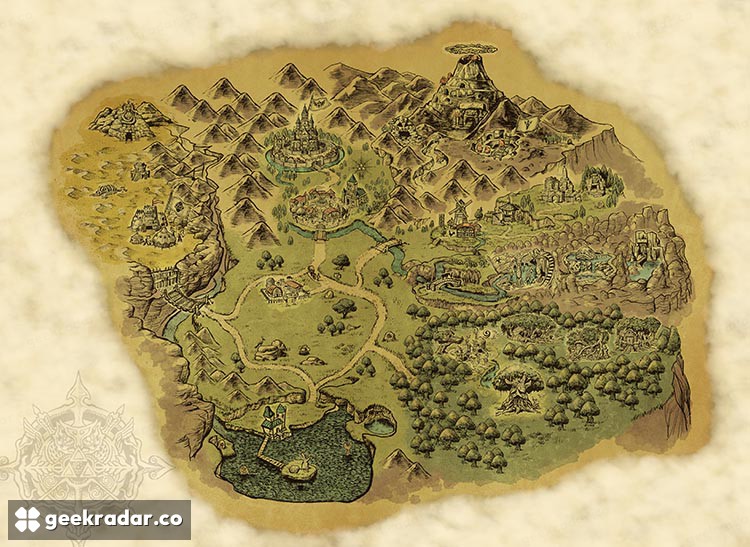
The second interview chapter examines another boundary: the remake retains separate areas rather than turning the entire adventure into a seamless open world. Director HokWai Ng and art director Aya Shida discuss how the visual treatment supports the intended experience.
More detail can make a landscape more appealing, but it can also suggest that everything visible is reachable. The team describes concentrating detail where players can go and managing distant scenery and landmarks to keep the world legible. In a game built around specific routes and spaces, visual richness has to communicate those limits as well as decorate them.
That is a different goal from making a screenshot as dense as possible. A richly rendered mountain can become a misleading invitation if the game offers no way to climb it. The issue is not whether detail is good; it is what the detail tells a player they can do.

A remake with its own visual materials
Shida's discussion of practical-effects and puppet-like qualities offers another route away from a generic push toward photorealism. Research into materials, including weaving tests for Link's clothing, treats texture as part of a deliberate visual language. It is an artistic direction, not an announcement that the game simulates every physical property of fabric.
Together, the travel experiment and art discussion suggest a remake organized around preserving the meaning of actions while changing how the world looks. That remains the developers' stated intention, not a verdict on the finished game's controls, pacing or performance.
Nintendo has announced November 5 for the Switch 2 release. The interview provides specific pre-launch context without revealing the story: a clear account of which changes were considered and why one was rejected. The most revealing upgrade may be the shortcut that did not survive testing, because the journey was already doing work the destination could not replace.