Lucy has reached the Trojan asteroid region. Its first close encounter is still ahead
The milestone puts a long trajectory into context, with Eurybates scheduled for August 2027 and a sequence of different worlds beyond it.
NASA’s Lucy spacecraft has reached the region occupied by Jupiter’s Trojan asteroids, but its first encounter with one is still ahead: Eurybates on August 11, 2027. The milestone is a change in where the mission is traveling, not the beginning of a close-up asteroid visit today.
In its October 28 mission update, NASA says Lucy has traveled about 2.2 billion miles since launching on October 16, 2021. A large distance traveled and a distant destination are different measurements: the number describes the spacecraft’s journey along its route, not a straight-line separation from Earth.
There is no wall at the edge of the Trojan region
The Trojans occupy broad populations associated with Jupiter’s orbit, ahead of and behind the planet near the L4 and L5 regions. Lucy has entered the leading population’s region. There is no sharply marked border that the spacecraft crosses like a national frontier.
Nor is this a dense obstacle course. NASA puts the average separation between Trojan asteroids at more than six million miles. The familiar cinematic image of a spacecraft weaving continuously between nearby rocks is a poor model for this environment.
That sparseness explains why reaching the region and reaching a particular asteroid are very different achievements. A flyby requires meeting one moving target at the right time and geometry. Entering a vast volume containing many targets does not remove the need to travel carefully toward the chosen one.
The first encounter begins a sequence
Eurybates is scheduled for August 2027, followed by Polymele in September. Lucy’s planned route then reaches Leucus in April 2028 and Orus in November 2028. These dates describe future encounters, not observations already completed by the mission.
The sequence matters because a mission to several objects can ask comparative questions that a single encounter cannot. Differences in shape and surface appearance become more informative when scientists can examine more than one member of a population. The journey is designed around that diversity rather than treating the first asteroid as the entire objective.
Lucy is then planned to return toward Earth for a gravity assist in 2030 before reaching the Patroclus–Menoetius binary in March 2033. Returning to Earth’s neighborhood is part of the route to the later target, not a retreat from the mission. Orbital travel can make a seemingly indirect path the useful one.
Farther sunlight, continuing power
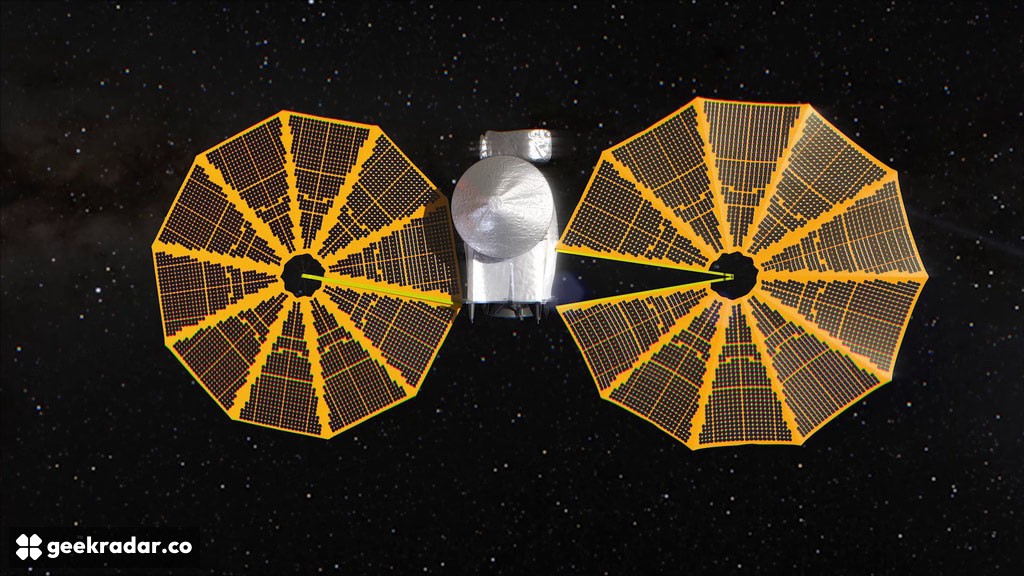
NASA’s mission overview explains the hardware behind that journey: two solar arrays, each about seven meters across, extend the spacecraft’s total span to roughly 16 meters.
At this stage of the journey, Lucy is more than five times farther from the Sun than Earth is. NASA says the spacecraft’s power systems are performing as expected in that environment. That is an operational report about the present mission, rather than a reason to assume every later encounter is guaranteed.
The contrast with Voyager 1’s recent power-saving decisions is instructive without making the missions equivalent. Distance, spacecraft design and the available power source shape what can be operated and when. “Far from Earth” is not one engineering condition shared identically by every probe.
Lucy’s latest milestone is consequently quieter than a first close-up image, but it gives the coming observations a firmer geographical context. The spacecraft is now traveling within the broad population it was sent to study. The next challenge is turning that enormous, mostly empty region into a precisely timed meeting with one small world.