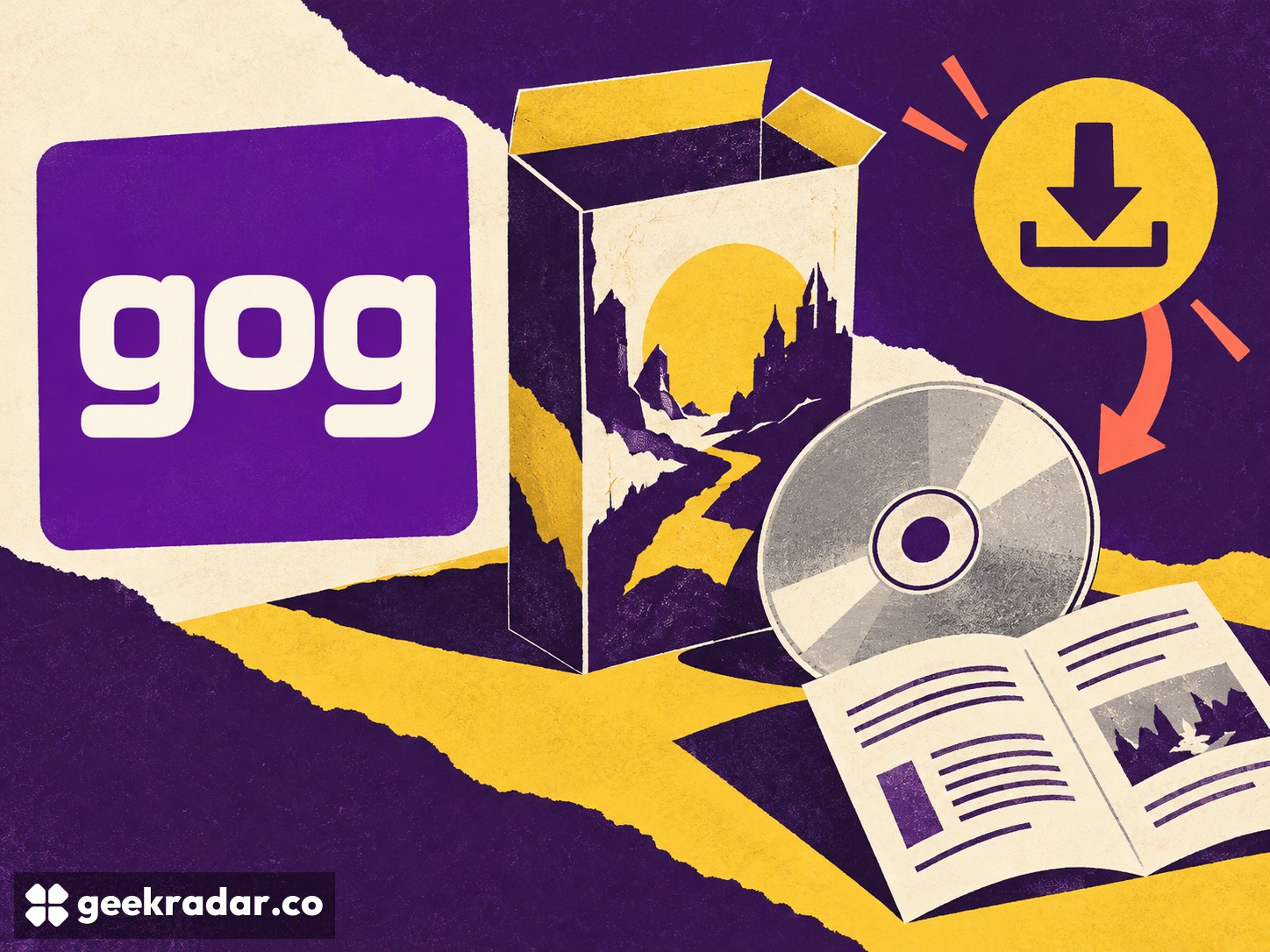
GOG’s physical-game ambition is separate from the boxes you can print today
An interview describes a future ambition. Offline installers, compatibility work and original packaging each preserve a different part of a game.
GOG’s leaders would like to make physical copies of games part of its future, but an October 31 interview does not amount to a launch announcement. There is no announced ordering service, price or delivery date. What players can already obtain is more concrete: offline installers and, for selected classics, downloadable scans and printable versions of their original boxes.
The distinction matters in GamesRadar’s interview with GOG’s Marcin Paczynski and Adam Ziółkowski. Physical distribution is discussed as an ambition that could take years, rather than a new product readers can buy today.
Three different things can be preserved
A game’s executable files, the ability to run them and the physical materials surrounding them are related but separate. Keeping a cardboard box does not keep an activation server online. Keeping an installer does not automatically make an old program compatible with every future operating system. A compatibility patch cannot reconstruct a manual that has been lost.
GOG’s Preservation Program concentrates resources on selected games, with a commitment to compatibility work, support and access to offline installers. The program label is therefore more specific than the general fact that a game is sold in the store.
An installer that can be retained locally changes the relationship between a purchase and continued access to the storefront. It gives the owner something they can back up. It does not transfer copyright ownership or preserve every server-dependent feature of a game. Those boundaries are important precisely because the useful part of the proposition is real.
The box project already exists
In September, GOG added original-box scans and printable artwork to five selected games: Star Trek: 25th Anniversary, Armikrog, Descent, Hitman: Codename 47 and Myst. The project was made with Big Box Collection, using scans of actual packaging.
The downloadable models allow the box to be examined from different sides. The printable versions let owners build a paper reproduction themselves. This preserves another layer of the experience: the artwork, layout and presentation through which games were encountered before installation.
A printable box and a commercially produced physical edition are not equivalent. Manufacturing, distribution and the contents of an edition introduce decisions beyond making a file available to download. The interview’s enthusiasm should not be used to fill in those missing commitments.
Running the game is an ongoing responsibility
The same discussion also shows why preservation is not simply a matter of changing everything to modern preferences. GOG’s team describes weighing control changes against the way a game was originally designed. A more familiar input method can help access, but a change that alters difficulty or the relationship between movement and danger can also change the work being preserved.
Our Ghostwire: Tokyo coverage examined a more specific obstacle: removing an external account requirement from a particular release. Such changes are easier to evaluate when their scope is explicit, rather than being folded into a promise that a game is now preserved forever.
The practical result is already useful without a speculative shipping date. Players can retain the available installer and its accompanying materials, while compatibility work continues around them. A future physical edition could make that collection more tangible. The part worth securing today is the ability to install what the box is supposed to contain.