Adafruit Hydra’s useful connections come with compatibility limits worth reading
The ESP32-P4 board combines camera, display and wireless interfaces. Uno-style headers do not make its 3.3 V GPIO tolerant of 5 V signals.
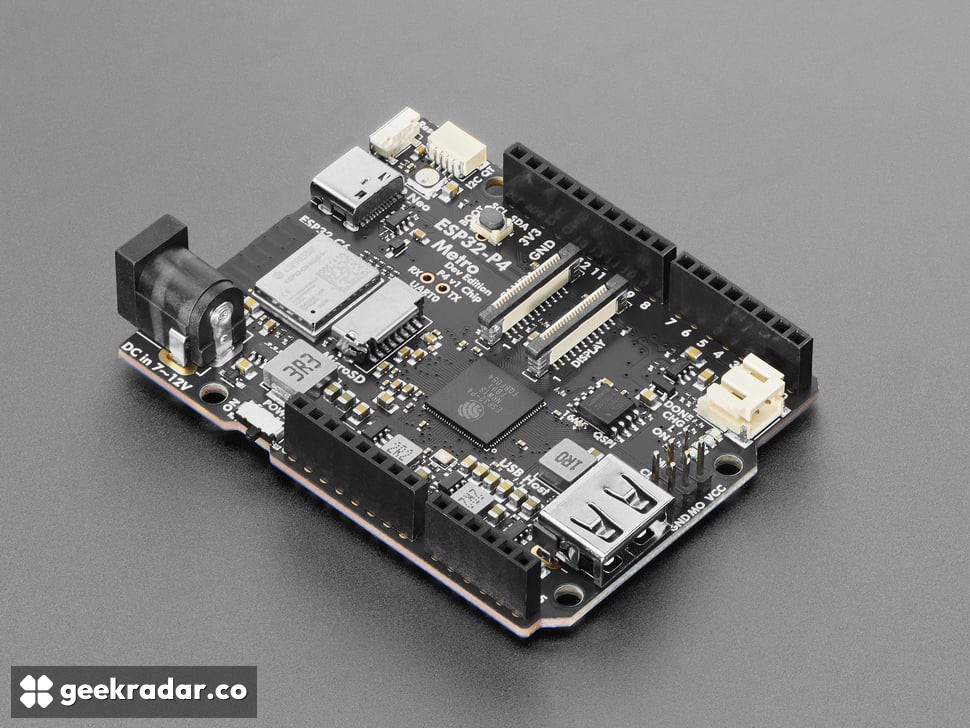
Adafruit’s Hydra is a $34.95 development board built around the ESP32-P4, but its most useful distinction is the combination of display, camera and wireless connections around that processor. It can be a foundation for an embedded interface or camera project. It should not be bought on the assumption that it is a small Linux desktop computer.
The official product listing identifies the chip as ESP32-P4 revision 1, not the newer P4X revision 3, and showed the board out of stock when checked. The price therefore describes the listed product, not a guarantee that it can ship immediately. Firmware support and the exact chip revision belong in the purchase decision alongside the connectors.
The connectors determine what you can actually build
The board combines a dual-core 360 MHz RISC-V processor with 16 MB flash and 16 MB PSRAM. PSRAM supplies additional working memory, but it does not turn the board into a general-purpose computer with the software environment of a Raspberry Pi. The application still has to be developed for this embedded platform.
A separate ESP32-C6 provides wireless capabilities. That division matters when selecting firmware: a radio chip being present is not the same thing as every Wi-Fi, Bluetooth or other supported protocol being ready in the particular software stack a project uses.
Hydra also exposes MIPI display and camera connections. Adafruit names the Raspberry Pi Touch Display 2 and OV5647 camera as supported targets. It specifically distinguishes the latter from the IMX708-based Camera Module 3. Similar-looking camera ribbons are not a sufficient compatibility test.
Familiar headers can hide unfamiliar electrical limits
The Uno-style layout is convenient because it gives developers a familiar physical arrangement. Electrical compatibility remains a separate question. A shield expecting 5 V signals can be unsuitable even if its pins line up. Checking supply voltage, logic levels and the firmware driver before connecting a peripheral is more useful than treating the header shape as a universal promise.
The integrated LiPo charging facility gives battery-powered designs another starting point. It does not establish the battery life of a finished device: screen brightness, wireless activity, processor workload and the chosen cell will determine that. Likewise, a 480 Mbps USB interface is a bus capability rather than a measured sustained transfer rate for an application.
For readers of the hardware section, Hydra’s appeal is the concentration of useful embedded interfaces on a low-cost board. Its limitations are specific enough to plan around. The best purchase is the one for a project whose display, camera and electrical requirements already match those interfaces, rather than a basket of accessories selected because the sockets look familiar.