Artemis III’s short stack is ready for the next kind of ground test
NASA’s assembly images lead toward a core-stage tanking exercise. The mission described by the agency tests docking before later lunar landings.
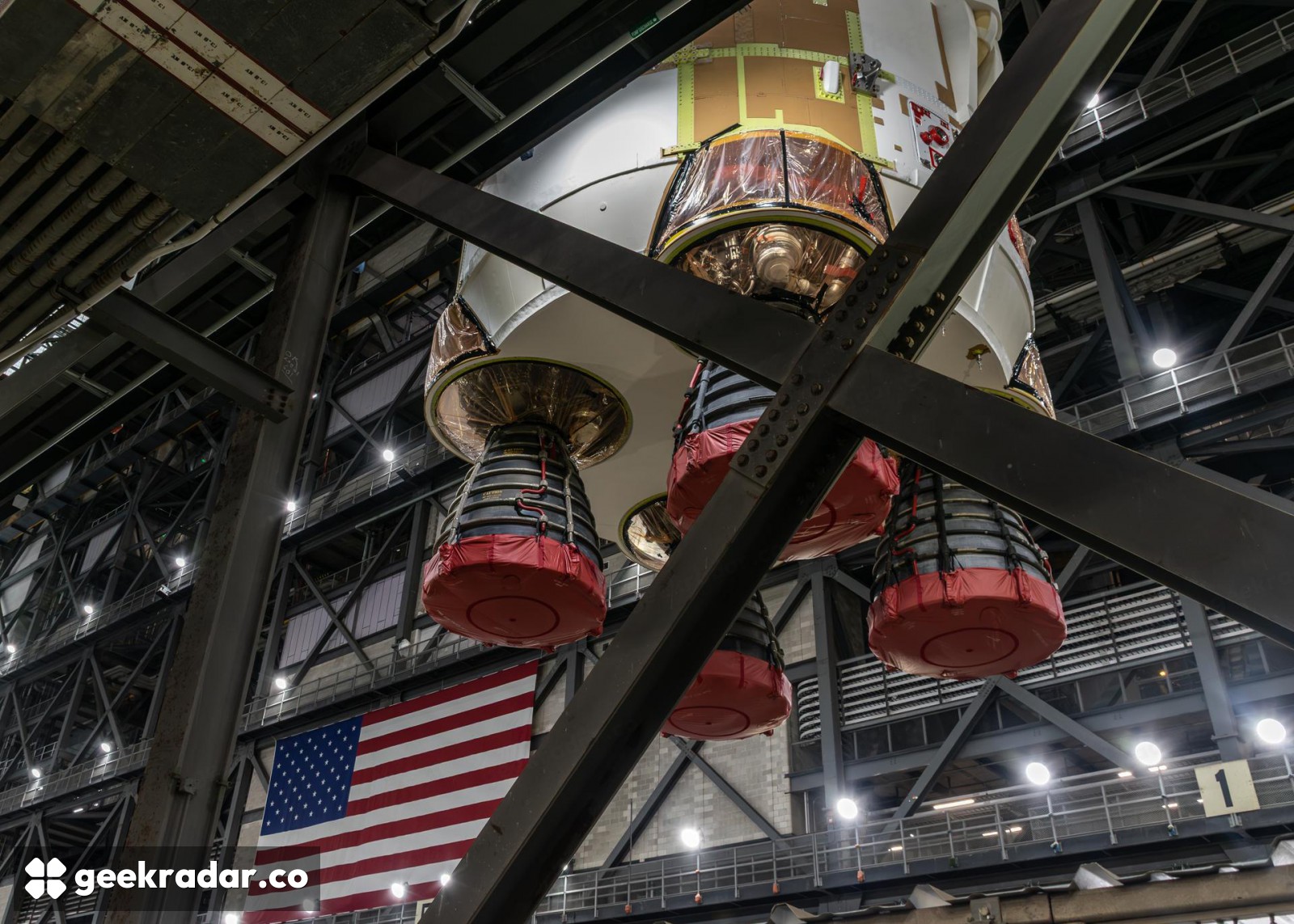
NASA has joined the Artemis III Space Launch System core stage with its solid rocket boosters at Kennedy Space Center. The next substantial test described by the agency is a tanking exercise at Launch Pad 39B, with liquid hydrogen and oxygen loaded into the core stage. This is an assembly and ground-operations milestone, not a launch or a lunar landing.
The photographs published on October 28 document the large stage being handled inside the Vehicle Assembly Building. At 212 feet, roughly 64.6 metres, the core is a major structure in its own right. A dedicated lifting beam allows technicians to move it into position on the mobile launcher beside the boosters.
Why NASA calls it a short stack
The current arrangement brings together the core and boosters before the complete launch vehicle and spacecraft are assembled. That limited configuration has a practical purpose: it lets teams test the core’s propellant-loading operations without treating the exercise as a complete launch rehearsal for every element of the mission.
NASA says the stack will move to the pad after checkouts. During the tanking test, propellants will be loaded only into the core stage, while launch personnel practise countdown procedures and timelines. The word “only” is useful. It defines what the announced test can demonstrate and prevents a partial ground exercise from being mistaken for a full mission demonstration.
Propellant loading is operationally significant even without a launch. Ground equipment, the rocket and the launch team have to follow the same sequence successfully. The test is valuable because it exercises that relationship on the assembled hardware, rather than relying only on component-level work.
Artemis III’s mission is a docking test
The same NASA update identifies the crew as Randy Bresnik, Frank Rubio, Andre Douglas and ESA astronaut Luca Parmitano. Their Orion mission is intended to test rendezvous and docking with commercial spacecraft from Blue Origin and SpaceX, ahead of later missions that will land astronauts on the Moon.
That distinction changes how the assembly photographs should be read. They show hardware preparing for an important part of the lunar programme, but the described Artemis III flight is not itself the landing mission. A headline that collapses those steps would give the reader the wrong expectation of what this rocket is being prepared to do.
The agency’s images also span several October handling operations; publication day is not the date of every photograph. For readers following the space programme, the useful progression is visible in the hardware: large components become an integrated stack, then a system that can be filled, checked and operated together. The next proof will come from that operation, not simply from the impressive height of the assembled vehicle.