The cosmic web is a map of a model. Dark matter is still a question about matter
An astronomy visualization makes structure visible without photographing the particles behind it. That distinction is the useful part of the image.
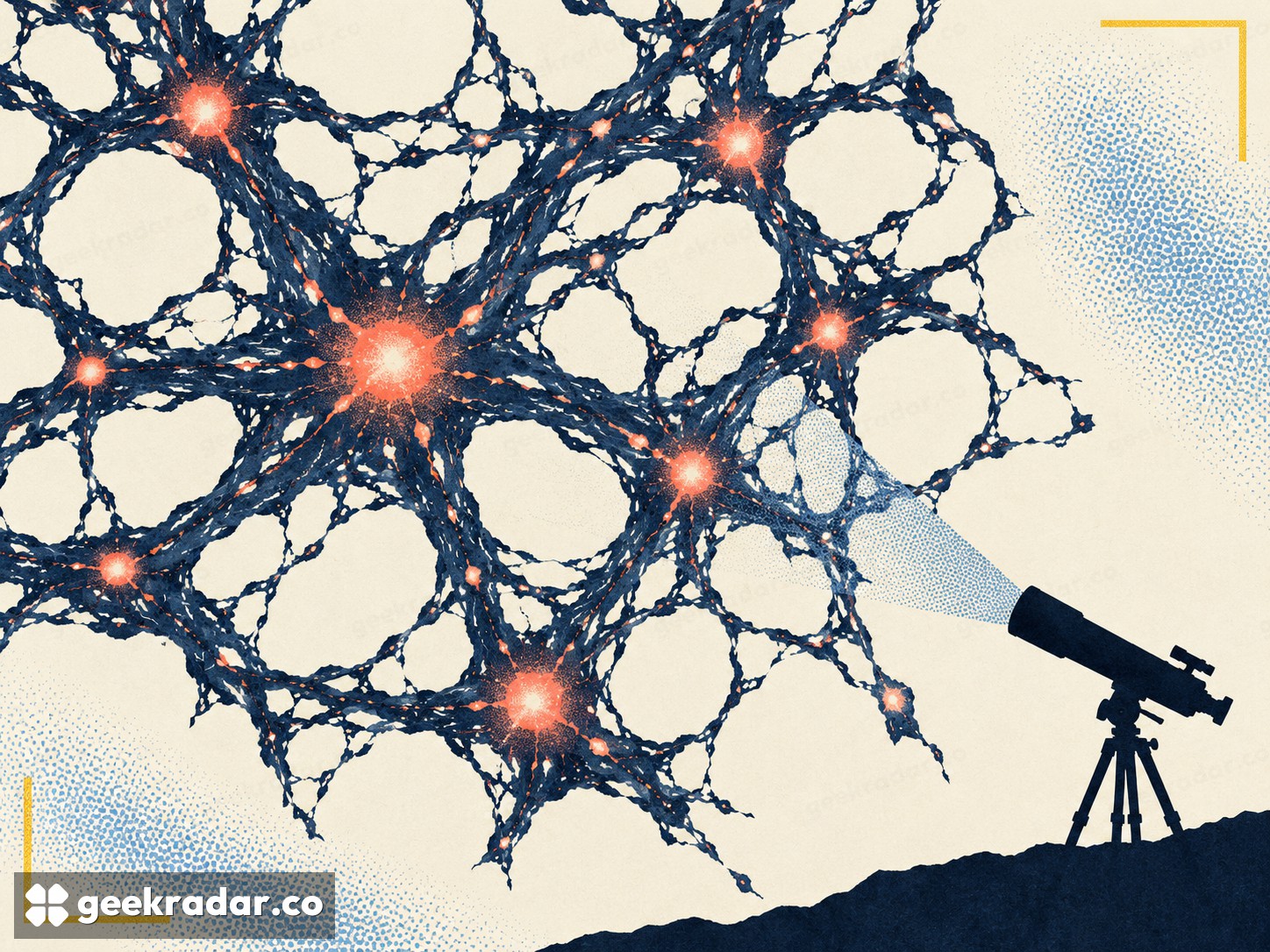
The dark web in NASA's October 25 Astronomy Picture of the Day is not a photograph of dark matter. It is a computer simulation, selected to illustrate how an invisible component can help explain the visible universe. That distinction is the most useful way into the image: a convincing scientific visualization is not the same kind of evidence as a telescope exposure.
The APOD explanation identifies the visualization with the American Museum of Natural History's Dark Universe presentation and work by Tom Abel and Ralf Kaehler. Its dark filaments and orange concentrations are assigned visual encodings. They do not represent colors that a sufficiently powerful camera could simply photograph.
Why infer something that does not shine?
The case for dark matter comes from its inferred gravitational effects. As CERN explains, motions within galaxies and galaxy clusters indicate more gravitating matter than the visible material alone accounts for. Gravitational lensing supplies another way to investigate mass through its effect on light travelling toward us.
These observations are not identical measurements repeated with different illustrations. They examine different systems and consequences of gravity. A useful explanation has to fit that broader set of evidence, rather than merely produce an attractive image of one galaxy.
Dark matter's particle identity remains unresolved. The phrase names a problem constrained by observations and a component of successful cosmological models; it does not mean a particular proposed particle has already been discovered.
The web is a prediction about structure
Large-scale structure offers a way to test how an initially uneven distribution develops. Gravity amplifies differences over time: denser regions attract more matter, while the resulting distribution can be compared statistically with the universe astronomers observe.
“Statistically” is important. A simulation need not place a particular familiar galaxy at the exact location seen in a photograph to be useful. Researchers can compare patterns such as clustering and the distribution of structures. Conversely, a visual resemblance alone does not establish that every assumption in the model is correct.
The image's colors and contrast make those relationships legible. Like a weather map, it requires a key and a description of what has been calculated. Removing that context turns an explanation into something that can easily be mistaken for a discovery image.
Dark matter and dark energy answer different questions
The similar names do not make dark energy another label for the same substance. Dark matter is invoked in explaining gravitational structure and mass; dark energy concerns the accelerated expansion of the universe. Combining them into one mysterious “dark stuff” obscures what the observations are actually asking.
The renewed appearance of this visualization is therefore an opportunity for context, not news that dark matter has finally been photographed. Its power lies in making a model inspectable. The next scientific step remains outside the picture: testing whether the model's consequences survive comparison with measurements that were not chosen merely because they look like the web.