Rosetta’s comet selfie still explains the distance between arriving and landing
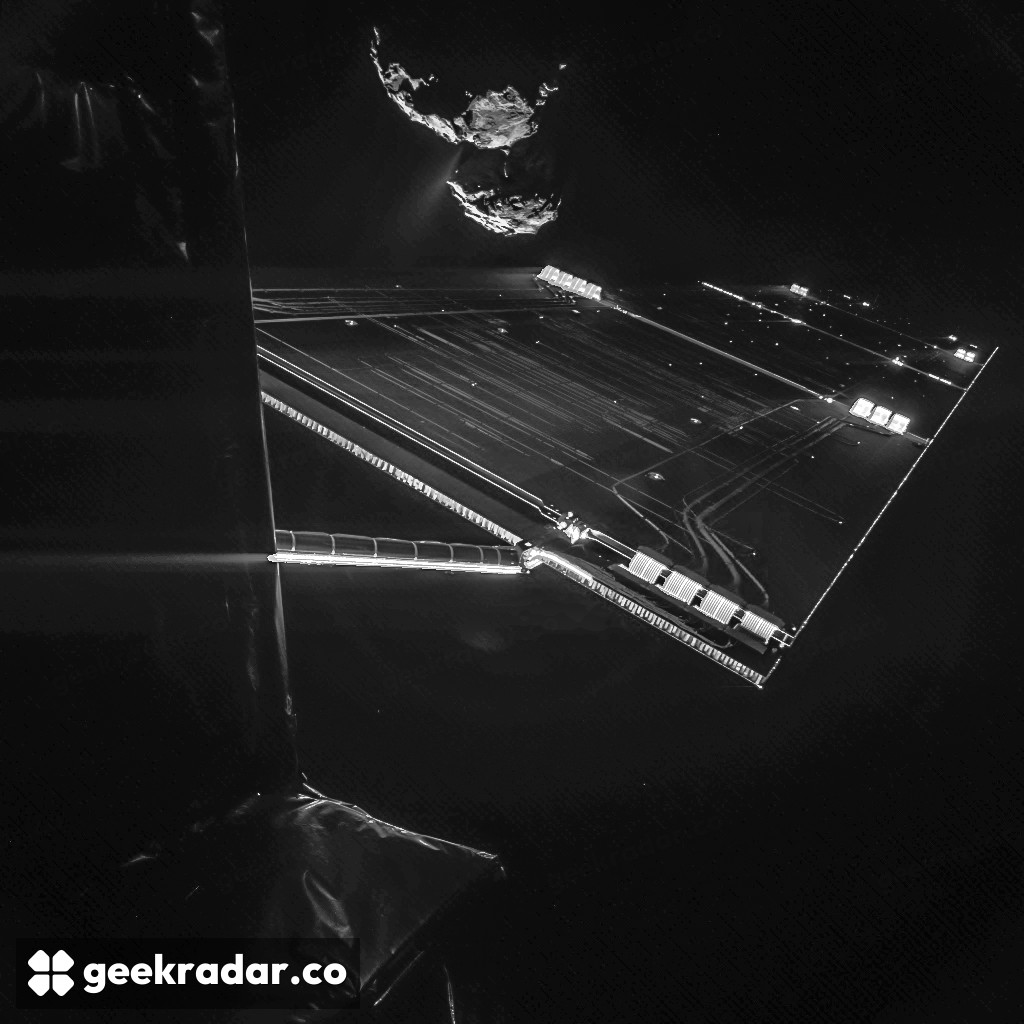
Philae took the 2014 image while still attached to the orbiter. Two exposures let a spacecraft and a dim comet share the frame.
A solar array crosses the foreground while comet 67P hangs beyond it. Rosetta's famous selfie, featured again by NASA's Astronomy Picture of the Day on October 24, remains a particularly effective way to understand the mission's physical proximity to its target. It is a historical image from October 7, 2014, not a new transmission from the spacecraft.
The camera belonged to Philae, the lander still attached to Rosetta when the image was taken. ESA's original account places the spacecraft about 16 kilometres from the comet's surface, or roughly 18 kilometres from its centre. Those are different reference points for the same encounter, not conflicting distance estimates.
The foreground makes the distance comprehensible
Many spacecraft pictures remove the vehicle from the frame and leave the target isolated against darkness. This one retains part of the spacecraft and a 14-metre solar array. The hardware supplies a human-engineered reference without making the comet's irregular shape any less strange.
It also changes the meaning of “near.” Sixteen kilometres is an ordinary terrestrial distance, but maintaining a useful position near a small, irregular, active body is not equivalent to parking beside a mountain. The image is valuable because it puts the observing instrument and the observed object into one composition.
The visible activity around the comet's neck belongs to the physical scene. ESA identifies streams of dust and gas extending away from that region. The picture does not, on its own, measure their speed or composition; those require the mission's instruments and analysis.
Two exposures preserve one difficult scene
ESA explains that the published image combines a short exposure with a longer one. The purpose was to accommodate a large brightness range, from illuminated hardware to the dark comet and spacecraft insulation. That is a documented imaging method, not a reason to treat the scene as imaginary.
This distinction is useful far beyond Rosetta. Scientific images often require processing to make recorded information visible. The relevant questions are what measurements went into the result and what transformations were applied. A composite of documented exposures can preserve information that a single exposure would lose.
Before the lander became a separate spacecraft
The selfie was taken before Philae separated for its November 2014 descent. At that moment, the lander's camera could still look back across the orbiter that had carried it. The composition records that relationship without requiring a reconstruction of events after separation.
Returning to the image today is worthwhile because it compresses the mission's scale into something readable: a machine built on Earth, its power-generating surface and a nearby comet in the same field of view. The familiar word “selfie” makes it approachable. The distance in ESA's caption makes it extraordinary.