A battery-free graphene sensor still needs an energy budget—and a first charge
Power-line harvesting can sustain a tiny sensing load. The startup limitation is essential to understanding the experiment.
A graphene-based temperature sensor has demonstrated a small but useful kind of independence: it can draw operating energy from the magnetic field around a nearby power cable and store that energy in capacitors. The result is not electricity from nowhere. It is an attempt to make an extremely low-power device consume less energy than its surroundings can supply.
Researchers at the University of Arkansas and the University of Michigan describe the work in Graphene powerline energy harvester powers a batteryless sensor. An October 23 university account explains the wider aim: sensors that can remain unattended without routine battery replacement.
The small energy budget is the point
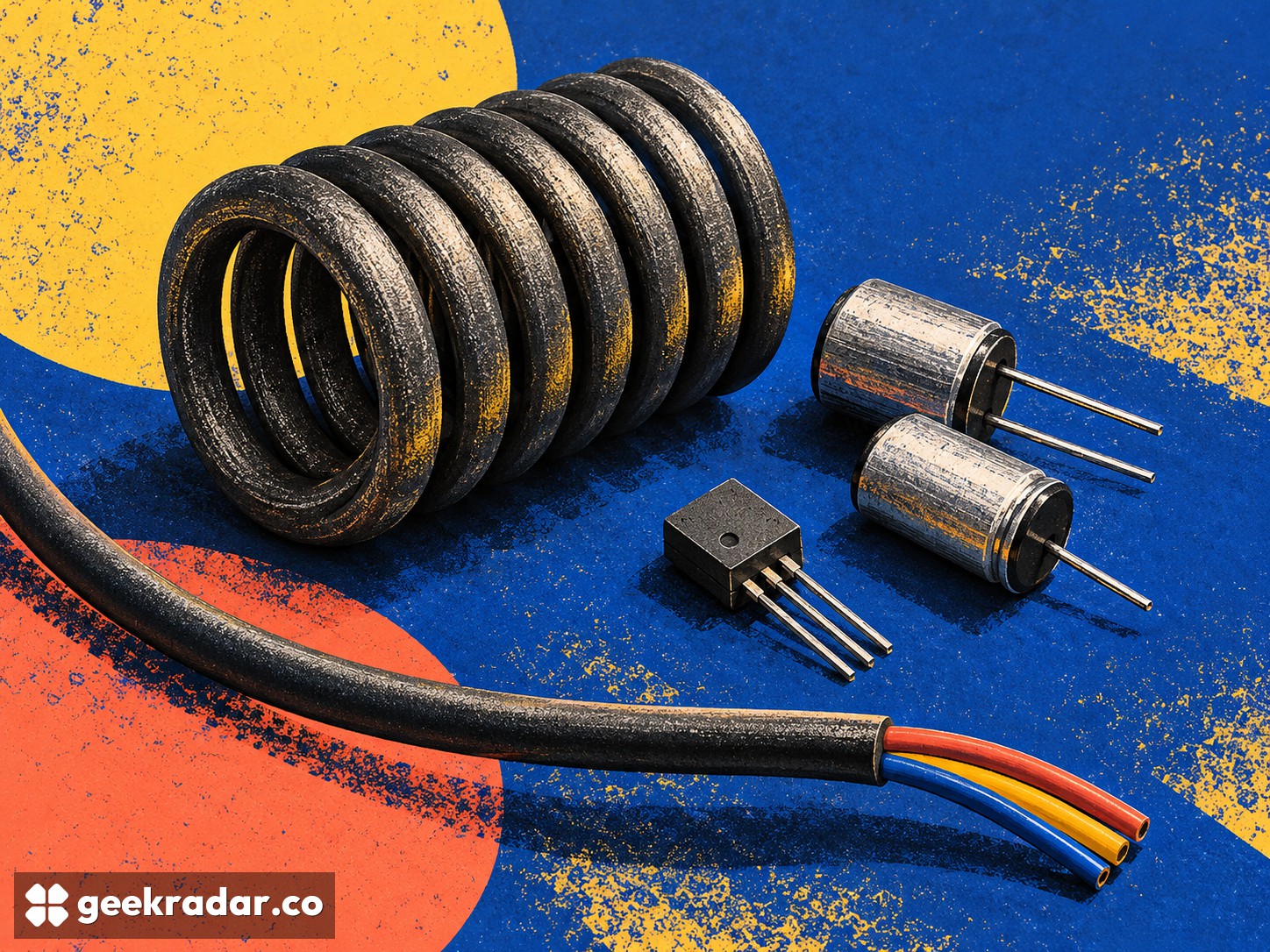
The system combines a graphene inductor, a circuit that converts and raises the induced voltage, and storage capacitors. The research abstract describes testing different inductor geometries and measuring the signal against current in a nearby cable. A steel core helps the inductor produce sufficient voltage for the circuit.
Each part has a role. Harvesting obtains a small flow of energy; conversion makes it usable; storage lets the sensor draw from a reserve rather than depend on every instant of the incoming signal. The application must then be frugal enough for that reserve to recover between demands.
This is why a temperature sensor is an appropriate demonstration. The claim is about a narrowly budgeted sensing system, not a substitute power supply for a phone or a household appliance. A successful low-power experiment becomes less informative, not more impressive, when described as though it could supply arbitrary loads.
The cable and the environment still matter
The university describes a setup focused on 60Hz electrical wiring, the frequency commonly used in the United States. That is a real experimental condition. A deployment elsewhere, around a different cable arrangement or with a different current, cannot inherit the result without checking the available field and the system's response.
Likewise, a claim about long unattended service is not proof that the prototype has already operated for decades. Removing a rechargeable battery can remove one maintenance burden, but it does not make the remaining electronics immune to aging, moisture or changes in their environment.
There is a useful distinction between this experiment and the much larger energy systems in our coverage of flexible electricity demand. Here the challenge is to match a tiny, local energy supply to a tiny load. No grid-scale capacity or battery replacement figure follows from the laboratory result.
Maintenance may be the more valuable saving
For a sensor installed in an awkward place, the cost of a battery is only part of the problem. Reaching the device, interrupting the equipment around it and checking that it still works can be the larger task. A reliable harvester could therefore be valuable even when the amount of electricity involved is negligible.
That benefit depends on placement, startup and interruptions being solved together. The most revealing question is not how much energy can be described as “ambient,” but whether the intended sensor can keep doing its job through the least favourable conditions it will actually encounter. A device that avoids one maintenance visit has achieved something more concrete than an unlimited-energy headline.