A thinner rotor profile could give future Mars helicopters more room to fly
Wind-tunnel tests and simulations favor a Mars-specific airfoil. The long-range figures describe future designs, not a flight already achieved.
The next major gain in a Mars helicopter’s capability may begin with something that looks almost too thin to be a rotor blade. NASA’s October 20 research report describes an experimental airfoil, roamx-0201, shaped specifically for Martian conditions rather than borrowed from the familiar rounded profiles associated with flight on Earth.
Computer simulations and wind-tunnel experiments favor the new design. They do not amount to a new helicopter flying on Mars, and the much longer ranges discussed in the report are projections for future aircraft. The distinction between a promising component and a complete mission is central to understanding the result.
Mars changes what an efficient blade looks like
Thin air makes generating lift difficult, while the speed of sound constrains how fast a rotor can move before compressibility effects become costly. Increasing rotational speed is therefore not an unlimited escape from the problem of low atmospheric density.
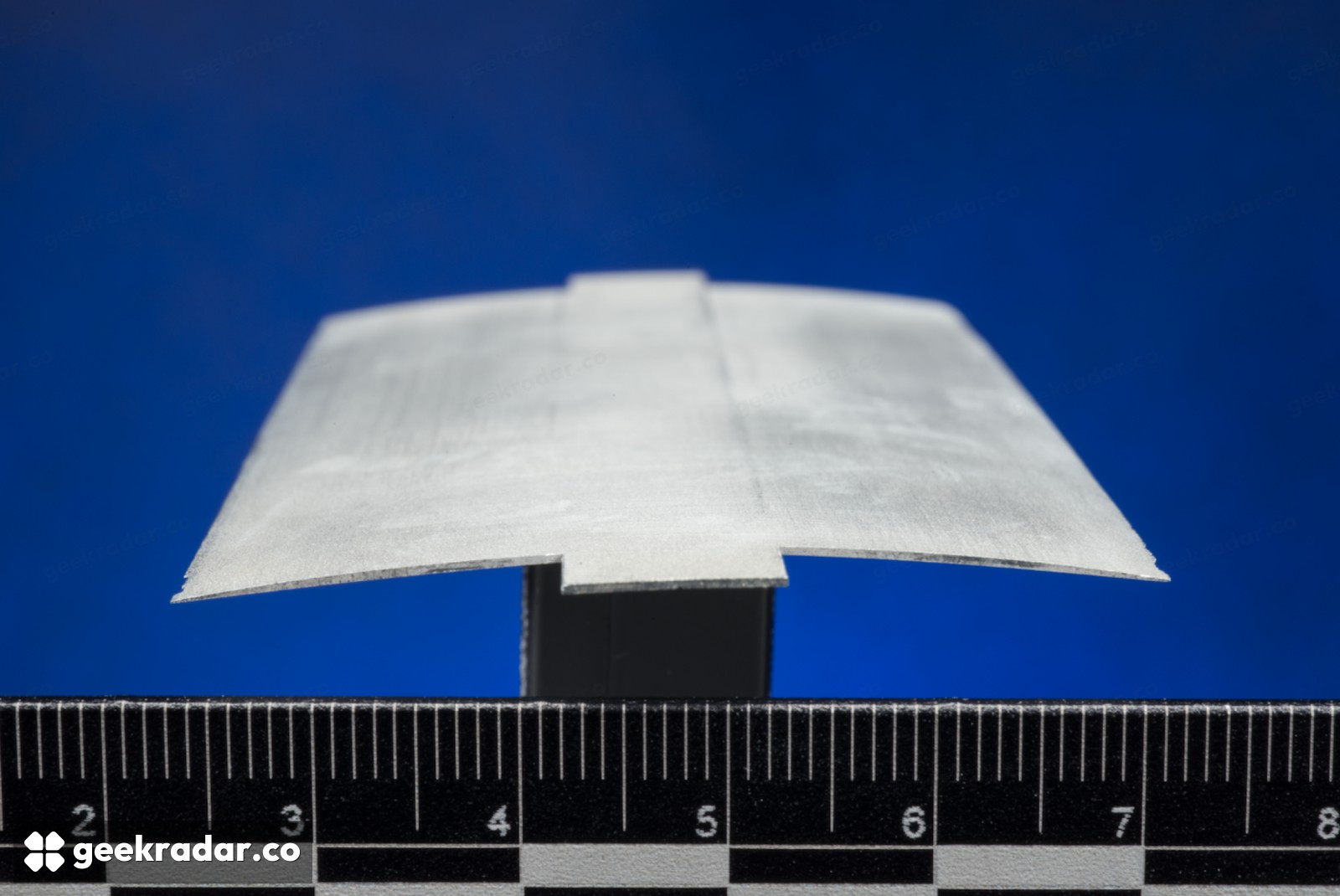
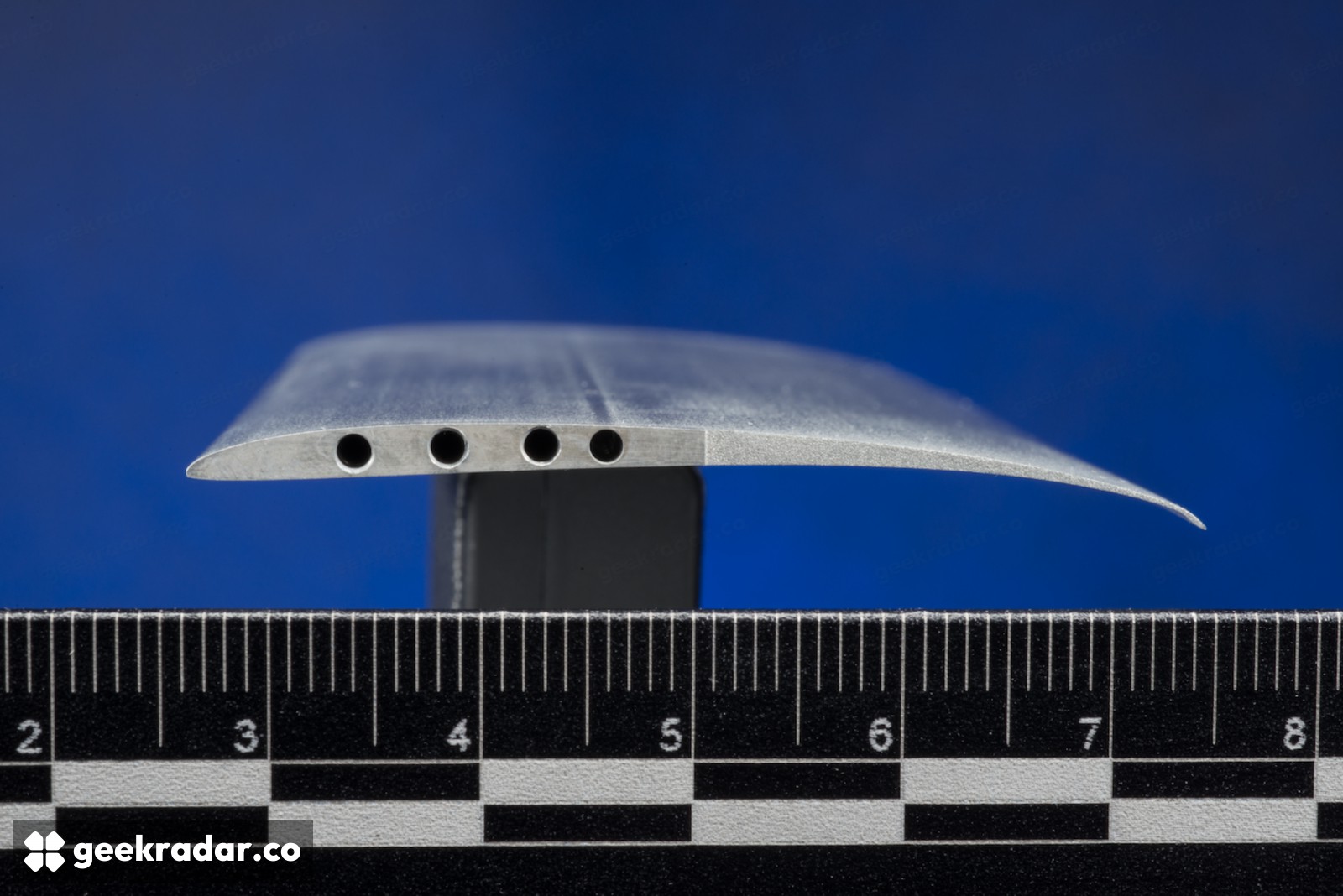
The new profile is thin and asymmetric. NASA’s researchers describe a design that deliberately changes the airflow near its leading edge and delays a sharp rise in drag at higher speeds. A shape that looks unconventional beside the Ingenuity baseline can be appropriate because it is solving a different combination of aerodynamic constraints.
The study’s primary abstract reports roughly 19–43 percent better lift-to-drag performance across the methods used. Those methods included two computational approaches and testing in Tohoku University’s Mars Wind Tunnel. The comparison was made at a Reynolds number of 20,000 and Mach 0.60 across several angles of attack.
Those conditions are not incidental fine print. Aerodynamic behavior depends on the flow regime and geometry. A result measured in a specified range should not become a claim that the blade is always 43 percent better under every possible operating condition.
Range belongs to the whole aircraft
NASA’s broader discussion contrasts Ingenuity’s 0.7-kilometer single-flight range with a projected capability reaching 18.7 kilometers for future instrument-carrying helicopters. That figure is not a distance this test article has flown, and it is not an upgrade being installed on Ingenuity.
An aircraft’s range combines aerodynamic efficiency with energy storage, mass, structural design, control and mission requirements. A better airfoil can improve the design space available to engineers without independently determining the finished vehicle’s performance.
The ROAMX program’s publication list reflects that broader work, spanning geometry, rotor testing and aircraft capability. A profile is a cross-section; a rotor must also work as a rotating structure. Turning the first into the second adds engineering questions that a photograph of the specimen cannot answer.
Disagreement is part of the useful result
NASA notes that differences between computational predictions and experiments still need investigation. That is a reason to refine the model, not to substitute a confident range headline for the research process. Agreement across methods strengthens a trend; discrepancies help reveal where the assumptions remain incomplete.
For a future science mission, the payoff would be concrete: useful instruments reaching more places per flight, rather than spending the entire improvement on carrying the aircraft itself. The thin blade matters because it could leave more of the vehicle’s limited resources available for the reason it was sent to Mars.
Research photographs: NASA.