Intel 270K Plus vs Ryzen 9850X3D: cores, cache and the whole platform
Twenty-four cores against eight is a misleading shortcut. Workload, cache behavior and the motherboard you already own give this CPU comparison its meaning.
Intel's Core Ultra 7 270K Plus has 24 cores. AMD's Ryzen 7 9850X3D has eight. That does not make the Intel three times as fast, or establish which is the better gaming purchase. These processors spend their silicon differently: Intel combines two kinds of CPU core, while AMD gives its eight-core design a large pool of additional cache.
The sensible comparison begins with the work the processor must finish and the computer it will join. A new build, an existing AM5 system and an existing LGA1851 system are three different shopping problems, even when the same two chips appear on the shortlist.
Twenty-four cores are not twenty-four identical workers
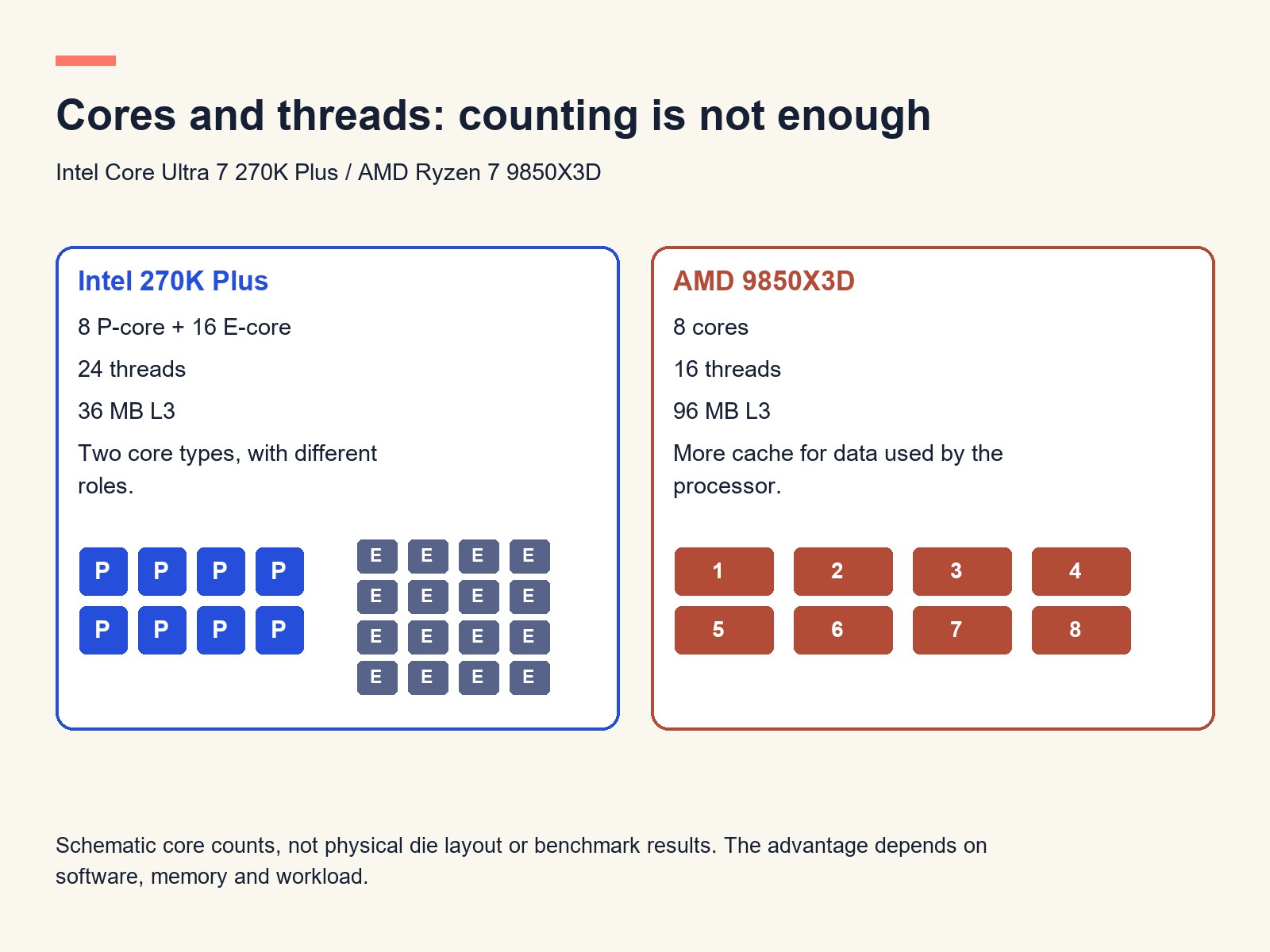
Intel's specification divides the 270K Plus into eight performance cores and sixteen efficient cores, with 24 threads in total. Those core types are not interchangeable units. Software that can distribute useful work across many threads has a different opportunity from a task dominated by a few dependent operations.
AMD lists eight cores, sixteen threads and 96MB of L3 cache for the 9850X3D. Cache holds data close to the processing cores. When the needed data is present there, the processor can avoid some slower trips to main memory. The benefit depends on the application's access patterns; more cache does not accelerate every operation equally.
That is why a game simulation, a video export and a software compilation can produce different rankings. They place different demands on memory access, parallel execution and specialized hardware. A single blended score erases the reason a result matters to one buyer and not another.
The gaming claim needs the right comparison
AMD's CES announcement includes gaming claims based on its own tests. The footnotes identify the comparison processor as Intel's Core Ultra 9 285K. Those figures cannot simply be reused as a result against the later 270K Plus. Different opponent, different conclusion.
Intel's software also makes configuration relevant. Its Application Optimization support list identifies supported games rather than promising a universal improvement. A benchmark using a particular optimization and firmware setup should say so. A reader cannot reproduce a feature by buying the CPU name alone.
At high resolutions with demanding graphics, the graphics card may determine the frame rate before either CPU reaches its limit. Spending more on a processor then produces less visible benefit than a test designed to expose CPU differences might suggest. Conversely, a high-refresh player running lighter graphics settings may care greatly about those CPU limits. The monitor and games belong in the decision.
Price the motherboard and cooling too
The Ryzen uses AM5; the Intel uses LGA1851. Neither is a drop-in replacement for the other. An existing owner needs the motherboard manufacturer's exact support list and required BIOS version, even when the socket name matches. A new builder must compare the total platform, including memory and cooling, rather than the processor's price alone.
AMD lists a 120W default TDP; Intel lists 125W base power and 250W maximum turbo power. These are different published definitions, not measured energy consumption during the same job. They are useful for understanding configuration requirements, but do not establish which machine finishes an export using less electricity.
Intel's current recommended customer-price range is $339–349. That is not an Italian retail quote. Compare local VAT-inclusive prices for the chip, a suitable board and the cooler you will actually use. Keeping compatible parts can outweigh a modest processor discount.
For an AM5 owner with a supported board, the Ryzen may present the simpler upgrade path. For a new system that spends hours in parallel workloads, the Intel deserves application-specific evidence rather than dismissal over gaming reputation. The best purchase is the platform that removes the bottleneck you have—not the core count that wins an argument on a box.