Why Japan’s MMX mission wants to bring a piece of Phobos home
Returned grains could distinguish competing origins for Mars’s moons. The spacecraft, Idefix rover and laboratories each supply a different part of the evidence.
Japan's Martian Moons eXploration mission is built around a deceptively small prize: material from Phobos that scientists can examine on Earth. Bringing those grains home could help distinguish between two very different histories for Mars's moons, while also testing the machinery needed for a round trip to the Martian system.
ESA's 13 October mission briefing accompanied launch preparations. The scientific case for MMX extends well beyond departure: it connects remote observations, surface exploration and laboratory analysis. This is an explanation of that scientific programme, rather than a report of a completed flight.
Two histories can leave different material behind
Phobos and Deimos might be captured asteroids, or they might have formed from debris produced by a major impact involving Mars. JAXA's science overview describes the observations and samples intended to investigate their origin. A moon's appearance alone cannot settle which account is correct.
The important idea is to compare several kinds of evidence. Composition can constrain which materials were present. Physical structure and surface observations provide context. Laboratory work can examine individual grains in ways that a distant camera cannot. No single attractive photograph is likely to carry the entire explanation.
This also makes sampling location consequential. A tiny collection is not automatically representative of a whole moon. Remote observations help researchers understand the setting from which the material came and interpret what it can, and cannot, say about Phobos more broadly. A sample without geological context would answer fewer questions.
The spacecraft and rover have different jobs
The mission combines observations from the main spacecraft with work on the surface. The German-French Idefix rover will examine local conditions before the larger spacecraft's sampling operations. DLR's project description explains the engineering challenge of moving in extremely weak gravity, where a rover cannot behave as if it were driving across a terrestrial test track.
Low weight does not make the vehicle's mass disappear. A movement can still impart momentum, while the weak pull toward the surface changes traction and settling. That is why a familiar-looking wheeled robot requires unfamiliar operating assumptions on Phobos. The rover's task includes learning about the surface as well as crossing it.
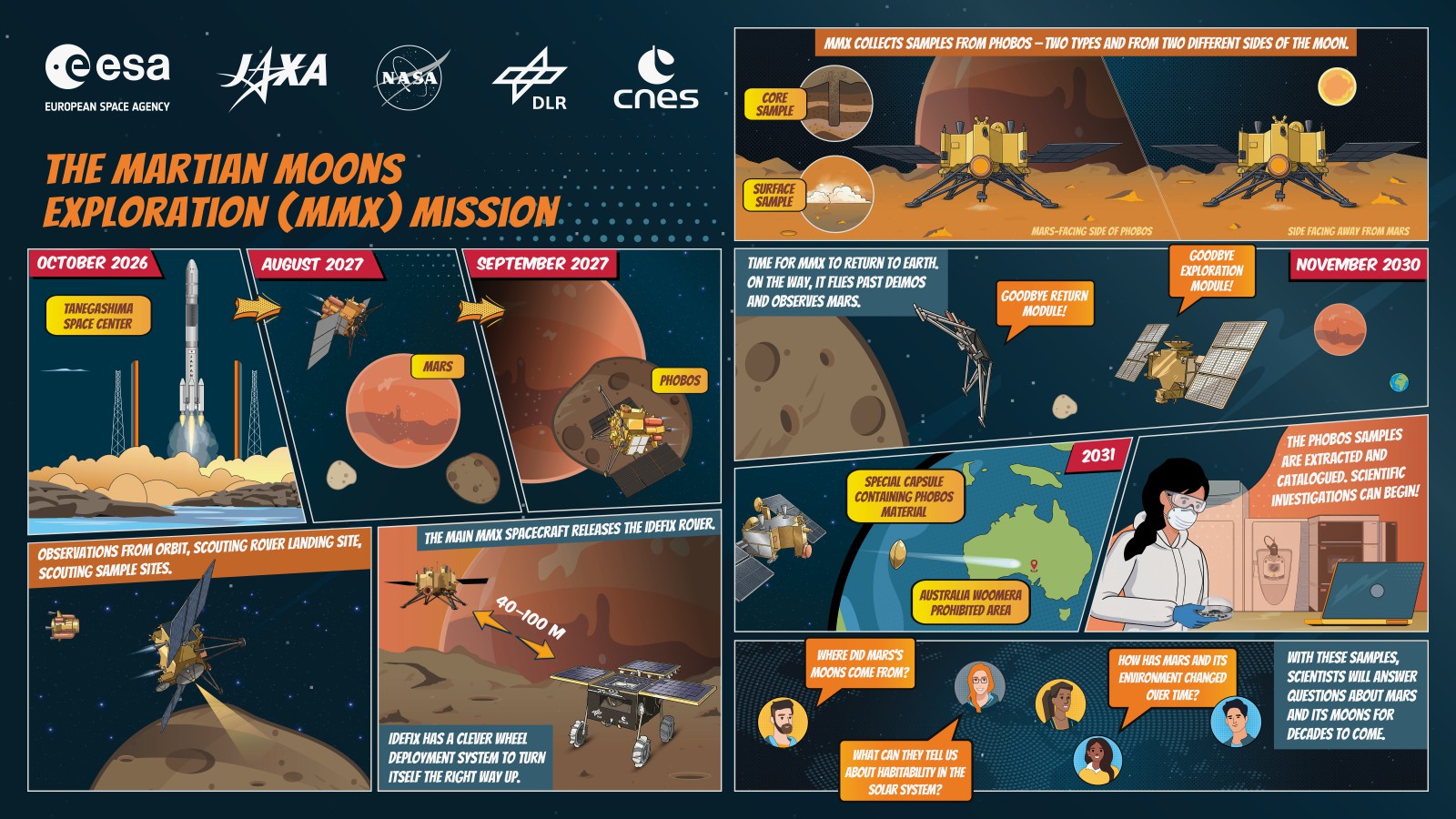
These are mission targets, not completed milestones. ESA's illustrated plan, reproduced under CC BY-SA 3.0 IGO, places the sampling and return operations within that longer sequence.
Measurements begin before the sample comes home
NASA's October mission briefing describes MEGANE, which measures gamma rays and neutrons, alongside a pneumatic sampling demonstration and communications support. The instrument helps investigate elemental composition; its role is complementary to imaging and laboratory analysis.
The difference is one of scale and access. Orbital measurements can relate locations across a broader area. A returned grain can be studied with instruments that would be impractical to carry on the spacecraft. Researchers can also preserve material for methods that do not yet exist when the mission flies.
That is the enduring value of sample return. It sends a physical piece of the question to a much larger scientific infrastructure, rather than limiting every later investigation to the spacecraft's original instruments. Our Space topic follows both observation missions and exploration hardware. MMX joins those approaches: first understand where to look, then bring home material that can be questioned again.